
Staring at a massive, heavy mirror and dreading the installation process is a common anxiety. The fear of watching a prized possession crash to the floor-and tear out a massive chunk of drywall in the process-is entirely valid. Before picking up a drill, it is crucial to recognize that secure wall-mounting is not just about aesthetics; it is an engineering challenge governed by your home's structural framing.
Selecting the correct hardware grants you absolute peace of mind, ensuring your statement piece remains securely anchored. However, proper installation requires a clear understanding of your specific wall type and weight limits. For instance, mounting a seventy-five-pound antique gilded mirror demands a completely different approach than securing a lightweight frame.
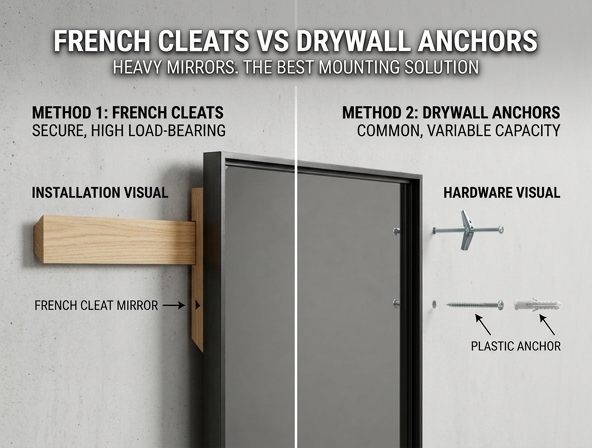
To help you make the safest choice, this guide compares French cleats against heavy-duty drywall anchors, evaluating their weight capacities, installation complexity, and long-term wall impact to find your perfect mounting solution.
Introduction: The Heavy Mirror Dilemma
Large, floor-to-ceiling or oversized statement mirrors are a staple of modern interior design. They instantly elevate the aesthetic appeal of any room, reflecting natural light and creating an illusion of expansive, open space. Whether it is a rustic wood-framed piece in the entryway or a sleek metal-framed mirror in the dining room, these design elements serve as striking focal points that tie a home's decor together.
However, hanging these beautiful but heavy objects comes with significant safety risks. If a heavy mirror is mounted incorrectly, the consequences can be catastrophic. A falling mirror can cause severe structural damage to your walls, shatter into dangerous shards, and pose a life-threatening hazard to children and pets. To prevent these disasters, DIYers must understand the science of secure mounting. Two primary hanging methods dominate the industry: drywall anchors and French cleats. Each system offers unique advantages depending on your wall type, mirror weight, and personal installation experience.
Understanding Drywall Anchors: Types and Weight Limits
Drywall anchors are specially designed inserts that allow you to hang objects on walls where no wooden wall stud is available. Because drywall itself is made of compressed gypsum plaster and is highly crumbly, a standard screw inserted directly into it will quickly pull out under tension. Drywall anchors solve this problem by expanding, clamping, or gripping the backside of the drywall sheet, distributing the weight over a wider surface area.
Plastic Sleeve Anchors
These are the most common and basic anchors, typically shaped like a small tube. When you drive a screw into the sleeve, the plastic expands inside the pre-drilled hole, pressing tightly against the surrounding drywall. They are best suited for lightweight mirrors, generally supporting up to 10 to 15 pounds.
Self-Drilling (Threaded) Anchors
Often made of zinc or hard plastic, these anchors feature deep, sharp threads that cut directly into the drywall without requiring a pre-drilled pilot hole. They provide a much stronger grip than simple plastic sleeves, with some heavy-duty varieties rated to hold up to 50 pounds in 1/2-inch drywall.
Toggle Bolts
For maximum strength in hollow walls, toggle bolts are the gold standard. They consist of a bolt and a spring-loaded wing assembly. Once pushed through a pre-drilled hole, the wings spring open behind the drywall. When the bolt is tightened, the wings are pulled flush against the backside of the wall, providing exceptional pull-out resistance that can safely support weights up to 100 pounds or more.
Understanding French Cleats: The Interlocking Wedge System
A French cleat is an elegant, highly stable mounting system that relies on mechanical interlocking rather than tension or friction. The system consists of two matching, extruded metal or wood brackets cut at a matching 45-degree angle. One bracket is mounted horizontally to the wall with the angled wedge pointing upward and outward, while the second bracket is secured to the back of the mirror with its wedge pointing downward and inward.
When you lift the mirror and lower it onto the wall bracket, the two 45-degree angles nest tightly together. The downward force of the mirror's weight pulls the brackets closer together, creating a secure connection with high gravity-locked shear strength. Because this mechanism distributes weight evenly across the entire length of the cleat, it minimizes localized stress on both the mirror frame and the wall structure, making it the preferred choice for heavy glass installations.
Weight Capacity and Load Distribution: Which is Stronger?
When comparing weight capacity, French cleats are vastly superior to drywall anchors. The key difference lies in how these two methods distribute the load. Drywall anchors concentrate the entire weight of the mirror onto small, localized points within the drywall sheet itself. Because drywall has low shear strength, relying solely on anchors for exceptionally heavy items introduces a continuous risk of structural fatigue over time.
In contrast, French cleats are designed to span a wide horizontal distance, allowing you to secure the wall-side bracket into multiple wooden wall studs. Instead of putting stress on the fragile gypsum board, the weight of the mirror is transferred directly to the home's structural framing.
"Never rely on drywall anchors alone for mirrors weighing more than 50 pounds. For heavy, oversized, or antique mirrors, mounting hanging hardware directly into at least two wall studs is an absolute safety requirement."
Step-by-Step Guide: Mounting a Mirror with Drywall Anchors
- Weigh your mirror using a scale to ensure you select anchors rated for at least double the actual weight of the mirror for safety.
- Hold the mirror up to the wall at your desired height, and use a pencil to mark the exact locations of the mirror's hanging D-rings or wire.
- Choose a drill bit that matches the diameter specified on your anchor packaging. For standard toggle bolts, a
1/2-inchspade bit is often required; for self-drilling anchors, no pilot hole is needed. - Drill the holes cleanly at your pencil marks, holding the drill perfectly perpendicular to the wall.
- Insert the drywall anchors into the holes. Push plastic sleeves in until flush, screw in self-drilling anchors with a manual screwdriver, or fold and insert toggle bolt wings through the wall.
- Drive the metal screws into the anchors, leaving approximately
1/8-inchof the screw head protruding so the mirror's hanging hardware can easily hook onto it. - Carefully mount the mirror onto the screws and gently pull down to verify that the brackets have caught securely.
Step-by-Step Guide: Installing a French Cleat System
- Determine the desired hanging position of the mirror and mark the top edge of the frame on the wall.
- Use a high-quality stud finder to locate the wall studs behind the installation area, marking their centers clearly with a pencil.
- Measure the distance from the top of the mirror to the mounting point of the cleat on the back of the mirror, and transfer this measurement to the wall to establish your level mounting line.
- Place the wall-side cleat bracket against the wall, align it with your mark, and use a bubble level to ensure it is perfectly horizontal.
- Drive heavy-duty wood screws through the pre-drilled holes of the cleat directly into the center of the located wall studs.
- Secure the corresponding cleat bracket to the upper backside of the mirror frame using the provided wood screws, ensuring it is level and centered.
- With the help of an assistant, lift the mirror slightly above the wall bracket and lower it slowly until the two 45-degree wedges slide together, interlocking the system.
Precision and Leveling: The Room for Error
Achieving a perfectly level mirror is critical for visual harmony in a room, but the two mounting methods offer very different margins of error. When using drywall anchors, you must achieve fixed placement precision from the very beginning. Because the anchors are driven into specific, permanent holes in the drywall, a placement error of even a fraction of an inch will result in a permanently crooked mirror. Fixing this mistake requires drilling entirely new holes and patching the old ones, which can compromise the integrity of the surrounding drywall.
French cleats, on the other hand, offer highly forgiving sliding adjustability. While the wall bracket must be installed perfectly level, the physical placement of the mirror can be adjusted laterally after it is hung. Because the interlocking channel runs the entire width of the cleat, you can slide the mirror left or right by several inches to center it perfectly on your wall without having to reinstall any hardware or drill new holes.
Wall Damage and Removal: Repairing the Aftermath
Before choosing a mounting system, consider the long-term impact on your walls. Drywall anchors leave behind localized, easily patchable damage. Traditional plastic sleeves or self-drilling anchors leave holes ranging from 1/4 to 1/2 inch in diameter. Removing them is simple: you can tap them slightly into the wall or pull them out with pliers, then apply a small dab of spackling compound, sand it flush, and apply touch-up paint to fully restore the surface.
French cleats require a different trade-off. Because they must be secured to the studs to function properly, they leave behind deeper screw holes directly in your wooden wall framing. However, the holes left in the drywall itself are usually smaller in diameter than those left by heavy-duty toggle bolts. If you remove a French cleat, you will need to patch several small screw holes along a horizontal line. While this process is straightforward, maintaining the structural integrity of your studs requires using proper wood filler if you plan to drill in those exact spots again in the future.
Side-by-Side Comparison: Anchors vs. Cleats at a Glance
| Feature | Drywall Anchors | French Cleats |
|---|---|---|
| Weight Limit | Low to Moderate (Up to 50–100 lbs max with toggle bolts) | Extremely High (Up to 200–300 lbs when secured to studs) |
| Ease of Installation | Quick and simple; basic tools required | Requires stud finder, precision leveling, and dual-piece mounting |
| Adjustability | None (Fixed placement once drilled) | High lateral adjustability (Sliding left or right) |
| Wall Damage | Medium holes in drywall; easily patched with spackle | Deep, small holes in studs and drywall across a horizontal line |
| Cost | Very inexpensive ($2 - $10) | Moderate ($15 - $40 depending on length and material) |
The Final Verdict: When to Use Which Hanging Method
Selecting the ideal hanging method depends on your mirror's physical characteristics, your wall construction, and how comfortable you are with home improvement projects. Matching the correct hardware to your specific project guarantees both visual perfection and long-term peace of mind.
- Choose Drywall Anchors if:
- Your mirror is relatively lightweight (under 30 pounds).
- You are renting and need to minimize wall damage for easy repair later.
- There are no wall studs located where you want to center your mirror.
- You want a quick, budget-friendly installation using basic household tools.
- Choose French Cleats if:
- Your mirror is heavy, oversized, or has an antique wooden or metal frame (over 50 pounds).
- You want the peace of mind that comes with securing your mirror directly into structural wooden studs.
- You need the flexibility to slide the mirror left or right to center it perfectly on the wall.
- You want a completely flush mount with no visible tilt or gap between the mirror and the wall.

Leave a comment