
Cleaning a crystal chandelier is a notoriously nerve-wracking task. The fear of scratching delicate prisms, tangling fragile wire connectors, or leaving behind unsightly lint prevents many homeowners from tackling the inevitable buildup of dulling dust.
As the crowning centerpiece of a grand foyer or dining room, these intricate fixtures require highly specialized care. Understanding the physics of dust removal is the necessary first step before touching your fixture. Choosing the correct tool guarantees you restore the brilliant, rainbow-like light refraction of your crystal, though we must stipulate that dry dusting is strictly a preventative maintenance step and cannot substitute for a wet, deep-cleaning solution when dealing with baked-on kitchen grease.
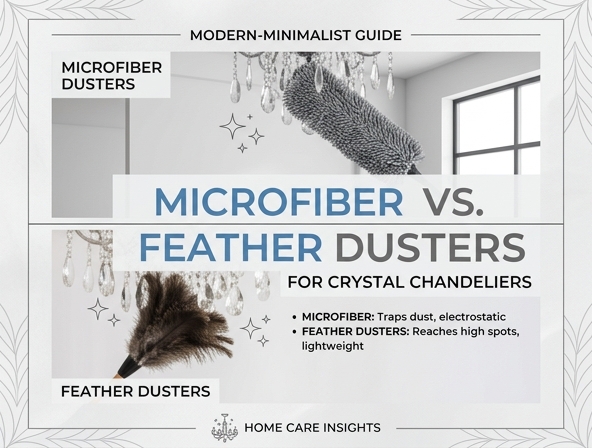
Whether you are maintaining precision-cut Swarovski crystal strands or delicate hand-blown Murano glass, the tool you select makes all the difference. Below, we compare microfiber and feather dusters across key metrics-including static attraction, snag risk, and debris retention-to help you decide which tool best preserves your lighting investment.
The Delicate Brilliance of Crystal Chandeliers
Crystal chandeliers serve as the breathtaking centerpiece of any grand room, casting a warm, fractured light that dances across the walls. However, preserving this majestic glow requires regular maintenance, which presents a significant challenge. The intricate arrangement of prisms, pendeloques, and chains easily collects airborne debris. Cleaning these fixtures is a high-stakes task because delicate lead glass and fragile crystal facets can easily scratch, chip, or detach under heavy-handed pressure.
Meet the Contenders: Microfiber vs. Feather
To maintain that pristine sparkle without risking damage, homeowners and professional cleaners rely on two primary tools. On one hand, we have the traditional ostrich feather duster, a classic instrument celebrated for its whisper-light touch and natural elegance. On the other hand stands the modern synthetic microfiber duster, engineered specifically to grip microscopic debris through advanced polymer science. Both promise a dust-free shine, but they achieve this through vastly different physical properties.
Feather Dusters: Traditional Charm and Gentle Touch
For centuries, genuine ostrich feathers have been the gold standard for dusting delicate ornaments. Their unique structures allow them to glide effortlessly across uneven surfaces without pulling at fine parts.
Natural Static Attraction
The individual barbules of ostrich feathers possess a natural static charge when gently rubbed, which helps pull dust off the glass surface. Because they are exceptionally lightweight, they apply virtually zero physical pressure to the fixture.
- Ultra-lightweight profile: Minimizes the risk of swinging or shaking delicate hanging crystals during cleaning.
- Zero abrasive edges: The soft, natural keratin fibers cannot scratch even the most sensitive glass coatings.
- Exceptional flexibility: Feathers contour effortlessly around complex arms and chains.
Microfiber Dusters: Modern Science of Dust Trapping
Microfiber represents a massive technological leap forward in cleaning science. Composed of a polyester and nylon blend, these synthetic fibers are split to create microscopic hooks that physically grab debris.
Split-Fiber Technology
Unlike round natural fibers, split microfiber features a star-shaped cross-section. This shape creates microscopic channels that lift and lock dust particles deep within the fabric rather than pushing them around.
- High density: Millions of micro-hooks per square inch maximize surface contact.
- Positively charged: Naturally attracts negatively charged dust particles like a magnet.
- Absorbent structure: Capable of holding up to eight times its weight in liquid, making it perfect for dry or damp cleaning.
Dust Retention: Trapping vs. Spreading
When it comes to maintaining a crystal chandelier, simply disturbing the dust is not enough. If dust particles are dislodged and allowed to float through the air, they will quickly resettle on the glass facets or find their way onto the furniture below. Even worse, loose dust dragged across the surface of soft lead crystal can act as an abrasive, leaving micro-scratches that permanently dull the glass over time. Microfiber traps the dust securely within its weave, whereas feathers can sometimes shake particles loose if saturated.
"Always prioritize dust containment over dust displacement. Trapping the abrasive particles immediately is the only way to safeguard highly polished crystal coatings from microscopic scratching."
Safety First: Preventing Scratches and Snags
Safeguarding your heirloom lighting requires a clear understanding of the mechanical risks associated with each cleaning tool.
Feather Duster Risk Assessment
Feather dusters are incredibly gentle on glass, but the central wooden or plastic dowel holding the feathers together poses a hazard. If you accidentally bump the hard core of the duster against a crystal prism, it can chip. Additionally, the quill tips can occasionally snag on the delicate brass pins connecting the crystals.
Microfiber Duster Risk Assessment
Microfiber cloths and wand sleeves are completely soft, eliminating the risk of hard-impact damage. However, the tiny synthetic hooks that make microfiber so effective at trapping dust can also catch on sharp metal connectors, wire pins, or rough crystal edges. A firm tug on a snagged fiber could bend a pin or pull a crystal ornament clean off its hook.
Reach and Maneuverability in Complex Designs
Chandeliers are often suspended in high-ceiling entryways or dining rooms, making reach a critical factor. Feather dusters excel at sweeping over broad, hard-to-reach areas with minimal effort, but they lack the precision needed to clean the inner columns. Microfiber dusters often come on moldable, bendable wands, allowing you to shape the tool to match the curve of the chandelier arms, thereby ensuring maximum contact with hard-to-reach crevices and secure cleaning of elevated fixtures without risking a fall.
Durability, Washability, and Lifetime Value
Investing in high-quality cleaning tools pays off over time, especially when considering how often a prominent light fixture needs to be dusted to maintain its refraction properties.
Feather dusters require delicate hand-washing and air-drying to keep the feathers from becoming brittle or losing their natural shape. Microfiber, conversely, is highly durable and can survive hundreds of machine wash cycles without losing its electrostatic properties.
- Microfiber Dusters: Unmatched durability, machine washable, and retains dust-trapping properties for years.
- Ostrich Feather Dusters: Long-lasting if hand-washed carefully, but prone to shedding fibers and wearing down over time.
Best Practices: How to Safely Dust Your Chandelier
Regardless of the tool you choose, cleaning a delicate hanging light fixture requires a methodical approach to prevent swaying, which can lead to glass-on-glass impacts and breakage.
- Turn off the power to the fixture and let the light bulbs cool completely to avoid thermal shock or burns.
- Place a thick, soft blanket on the floor directly beneath the chandelier to cushion any accidentally dropped crystals.
- Work systematically from top to bottom, cleaning one section at a time to avoid spinning the fixture.
- Support each crystal strand gently with your free hand while applying light pressure with your dusting tool.
The Verdict: Which Duster Reigns Supreme?
Choosing between traditional elegance and modern engineering depends on the complexity of your light fixture. While feather dusters offer unmatched gentleness and are perfect for a quick, surface-level sweep, they fall short in long-term dust containment and durability. Microfiber dusters provide the superior scientific advantage by trapping abrasive dust particles completely, preventing scratches, and offering bendable shapes for deep cleaning. For a flawless, scratch-free shine that preserves your heirloom investment, the synthetic microfiber duster is the superior choice.
Leave a comment