
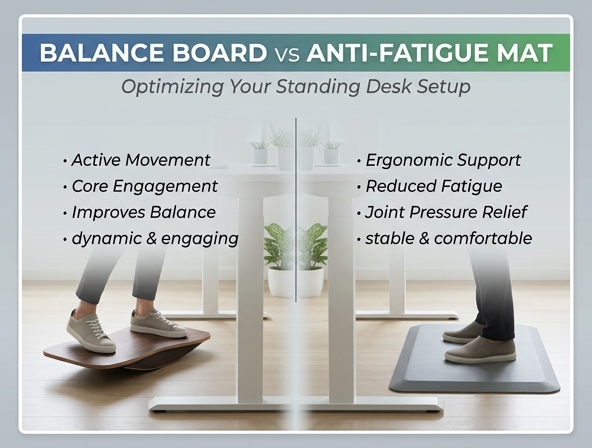
You upgraded to a standing desk to escape the health hazards of a sedentary lifestyle, only to find yourself facing a new struggle: aching heels, lower back stiffness, and daily fatigue. Transitioning to a standing posture is a vital first step, but standing static on hard, unyielding floors can actually worsen joint strain over time. To unlock the true cardiovascular and posture-boosting benefits of your workstation, you need the right ergonomic foundation.
Importantly, these tools are not one-size-fits-all solutions; their effectiveness depends on your physical stamina and daily workflow. For instance, while high-density foam anti-fatigue mats provide passive cushioning, dynamic rocker balance boards actively engage your core and leg muscles. In this article, we will compare the pros, cons, and ideal use cases of balance boards versus anti-fatigue mats to help you make the best investment for your home office health.
Introduction: The Standing Desk Dilemma
The remote work revolution has made standing desks a staple of the modern home office, promised to rescue us from the health hazards of prolonged sitting. However, many remote workers quickly discover a painful truth: trading a chair for hours of standing on flat, hard floors brings its own set of physical challenges, including sore feet, aching calves, and lower back tension. To combat this unexpected standing fatigue, two primary ergonomic solutions have emerged to transform the standing desk experience: the cushioned anti-fatigue mat and the dynamic balance board.
Why Standing Still Isn't Enough
While standing burns slightly more calories than sitting, remaining completely motionless at a desk creates a different set of ergonomic issues. Stationary standing causes gravity to pool blood in the lower limbs, which can lead to swelling and cardiovascular strain over time. Without movement, your muscles remain locked, placing the entirety of your body weight directly onto your joints, spinal discs, and plantar fascia. To prevent stiffness and fatigue, standing must be dynamic, requiring either cushioned relief to reduce impact or subtle movement to keep the body's natural muscle pump active and blood circulating freely.
What is an Anti-Fatigue Mat?
An anti-fatigue mat is an ergonomically designed, cushioned pad placed on the floor to reduce the physical strain of standing on hard surfaces. The science behind these mats lies in their micro-instability; the supportive, energy-returning material yields slightly under your weight, which forces your calves and feet to make subtle, involuntary micro-movements. These gentle contractions act as a continuous pump for your vascular system, significantly improving blood flow, distributing body weight more evenly across the feet, and absorbing the harsh impact of concrete or hardwood flooring.
The Pros and Cons of Anti-Fatigue Mats
Before investing in floor support, it is helpful to weigh the immediate physical benefits against the potential limitations of static cushioning.
Advantages of Anti-Fatigue Mats
- Immediate, pillow-like comfort that significantly reduces foot soreness right out of the box.
- Extremely budget-friendly and accessible for remote workers trying to optimize their setup.
- Requires zero learning curve or physical coordination to use safely.
Disadvantages of Anti-Fatigue Mats
- Does not actively challenge your core or stabilizer muscles.
- Still keeps the body in a relatively static posture, which can lead to hip flexor tightness over time.
- Can be bulky to store or slide out of the way when transitioning back to an office chair.
What is a Standing Desk Balance Board?
A standing desk balance board is an active ergonomic accessory designed to introduce controlled instability to your workspace. Unlike traditional athletic wobble boards, these office-friendly versions feature a subtle curvature or a rocker base that requires constant, low-level engagement of your core, ankle stabilizers, and glutes to stay upright. By keeping your body in motion, a balance board encourages natural pelvic tilt corrections, prevents slouching, and ensures that your weight is constantly shifting from side to side.
The Pros and Cons of Balance Boards
Integrating dynamic movement into your workday offers unique physical benefits, but it also demands more energy and attention.
Advantages of Balance Boards
- Increases daily caloric burn and metabolic rate compared to static standing.
- Strengthens the core, improves overall balance, and stabilizes ankle joints.
- Enhances cognitive focus and alertness by keeping the nervous system mildly stimulated during monotonous tasks.
Disadvantages of Balance Boards
- Requires a distinct learning curve and minor physical coordination to master while typing.
- Can cause premature muscular fatigue, making it difficult to use for long, continuous stretches.
- The constant movement might prove distracting during high-focus, precision mouse tasks.
Direct Comparison: Comfort and Joint Relief
When comparing these two tools strictly through the lens of pain mitigation, they target different issues. An anti-fatigue mat acts as a protective shield for your lower body, absorbing impact force and providing immediate relief to aching heels and arches. In contrast, a balance board targets joint stiffness by promoting dynamic fluid movement in the hips and lower back, preventing the spinal compression that occurs when you sink into a static standing posture.
"For those suffering from severe plantar fasciitis or heel spurs, the soft, forgiving surface of a high-quality mat is often superior to the rigid, active surface of a balance board."
Direct Comparison: Energy Expenditure and Focus
The balance board is the clear winner for physical engagement, as it forces the body to burn more calories by engaging muscle groups that would otherwise remain dormant. However, this increased energy expenditure is a double-edged sword; while it wards off afternoon drowsiness, it can sometimes pull focus during tasks requiring intense, microscopic hand-eye coordination. The anti-fatigue mat offers a more passive experience, keeping your body subtly active without demanding conscious physical management, making it highly compatible with deep, uninterrupted cognitive work.
Choosing the Right Accessory for Your Work Style
To determine which accessory will best complement your daily routine, consider how your physical needs and work tasks align with these user profiles:
- The Chronic Pain Sufferer: If you struggle with lower back pain, knee arthritis, or plantar fasciitis, choose the anti-fatigue mat for its impact-absorbing properties.
- The Fitness Enthusiast: If you want to squeeze active recovery, core engagement, and calorie burning into your 9-to-5, opt for the balance board.
- The Budget-Conscious Worker: If you want reliable, durable comfort without spending a fortune, start with a highly rated, simple ergonomic mat.
Conclusion: Elevating Your Home Office Setup
Choosing between an anti-fatigue mat and a balance board comes down to whether your body craves cushioned comfort or active movement. Mats provide the necessary shock absorption to protect your joints from hard surfaces, while balance boards inject vitality and strength into your daily routine. By understanding your physical limits and alternating between these tools, you can craft a dynamic, pain-free standing desk experience that keeps you healthy and productive all day long.
Leave a comment