
Staring at a cherished family heirloom or a promising thrift-store find, wanting to revitalize it but fearing you will ruin the wood with the wrong finish, is a frustratingly common struggle. Before picking up a brush, however, it is essential to understand how different paint formulations bond with existing wood grain and aged topcoats.
Selecting the correct medium grants you a flawless, durable finish that elevates your furniture from a simple DIY project to an artisanal masterpiece. It is important to stipulate, however, that neither coating is a universal cure-all; success depends entirely on your specific substrate. For instance, a high-use oak dining table requires a vastly different bonding capability than a decorative, heavily distressed pine sideboard.
To ensure your next project's success, this guide will analyze the unique chemical compositions, application workflows, and long-term durability of both chalk paint and milk paint, helping you select the perfect finish for your furniture.
Introduction to the Ultimate Paint Showdown
Staring at a tired, worn-out dresser can spark a wave of creative energy. You know it has potential, but the path to breathing new life into it depends heavily on your choice of medium. Enter the two giants of the furniture refinishing world: Chalk Paint and Milk Paint. Both have captured the hearts of DIY enthusiasts globally, yet they offer vastly different pathways to transforming your home decor. Whether you are aiming for a sleek, contemporary look or a timeworn heirloom vibe, picking the right option is crucial. Which paint type is best for your specific DIY furniture project? Let us dive deep into the unique characteristics of each to find out.
Understanding Chalk Paint: Modern, Matte, and Easy
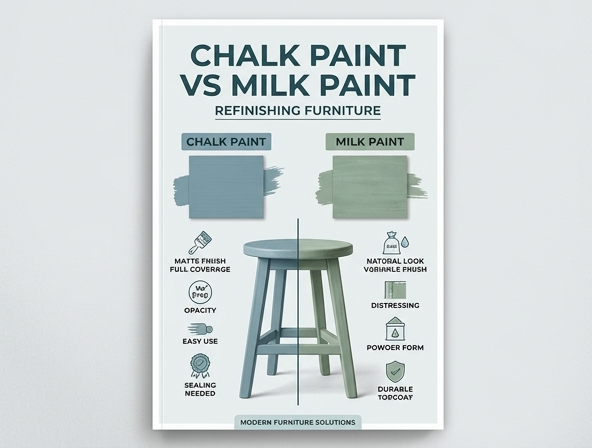
Chalk Paint is a modern, water-based decorative paint that has revolutionized the refinishing industry. Formulated with a synthetic mineral base, it is celebrated for its incredible ease of use and ability to cling to almost any surface without extensive preparation. Its signature characteristic is a velvety matte, ultra-flat finish that instantly softens the lines of any piece of furniture. Because of its forgiving nature and simple distressing capabilities, it quickly became the foundational staple of the modern DIY explosion and the beloved shabby-chic aesthetic, allowing painters to achieve a beautifully aged look with minimal effort.
Demystifying Milk Paint: Historic, Organic, and Textural
In contrast to modern synthetic options, Milk Paint boasts an ancient lineage dating back thousands of years to cave paintings and Egyptian tombs. This paint is made from completely natural, organic ingredients: casein (milk protein), lime, and natural earth pigments. Sold in a dry powder form to preserve its ingredients without chemical preservatives, it must be mixed with water before application. Its hallmark trait is its beautiful unpredictability on pre-finished surfaces, where it flakes off in some areas while adhering perfectly to others. This creates an authentic, "chippy" antique look that cannot be replicated by any modern formula, making it the premier choice for historic restorations and rustic farmhouses.
Prep Work and Application: Which is Easier?
The No-Prep Convenience of Chalk Paint
For DIYers eager to skip the tedious labor of preparation, Chalk Paint is often the default choice. It is famously marketed as requiring virtually no sanding or priming on most wooden, metal, or glass surfaces. You simply open the can, stir, and start painting.
The Chemistry and Mixing of Milk Paint
Milk Paint requires a more hands-on, deliberate approach to prep work and application. Because it comes in powder form, you must mix it yourself, ensuring a smooth, lump-free consistency before you begin.
- Chalk Paint Prep: Clean the surface to remove grease, and you are ready to apply. Sanding is rarely necessary unless the original finish is peeling.
- Milk Paint Prep: Mix powder with warm water in a 1:1 ratio. If applying to non-porous surfaces like laminate or previously varnished wood, you must mix in a liquid bonding agent to ensure the paint adheres instead of flaking off completely.
Aesthetics and Texture: Velvet Smooth vs. Chippy Charm
Chalk Paint's Reliable Elegance
Chalk Paint delivers a highly predictable, solid, and consistent color layout. If you want a smooth, clean, contemporary look or a controlled, artificially distressed finish, this paint makes it easy to control exactly where and how much of the paint is rubbed away to reveal the wood underneath. The final appearance is always smooth, uniform, and velvety.
Milk Paint's Wild, Rustic Soul
Milk Paint behaves with a mind of its own, especially over old finishes. It penetrates deeply into raw wood to act like a stain, highlighting the grain with rich, multi-toned depth. On finished surfaces, it resists adhesion in random spots, resulting in a truly authentic, weathered, and textured patina that looks like it took a century of natural wear to develop.
Durability, Sealing, and Topcoats
Neither paint is fully protected without a final seal, but their relationship with topcoats differs dramatically. Chalk Paint remains incredibly porous and soft after drying; without a topcoat, it will absorb oils and dirt, leading to unsightly stains. Milk Paint, on the other hand, dries to a hard, durable finish, particularly when applied directly to raw wood where it chemically binds with the fibers.
- Sealing Chalk Paint: You must apply a clear wax, tinted wax, or a water-based polyacrylic. Waxing provides a traditional, buttery feel but requires periodic reapplication, whereas polyacrylic offers robust, long-term protection.
- Sealing Milk Paint: While it can be left raw for an ultra-matte look, sealing it with hemp oil, tung oil, or wax enhances the depth of the color. Once sealed, milk paint is exceptionally durable and will not peel or chip further over time.
Eco-Friendliness and Ingredient Safety
For indoor projects, the safety and environmental impact of your materials are vital considerations. Milk Paint represents the pinnacle of green crafting. It is completely non-toxic, biodegradable, food-safe, and possesses zero volatile organic compounds (VOCs). It smells faintly of fresh milk during application and poses no risk to children, pets, or the planet.
While Chalk Paint is a water-based formula that is significantly safer and lower in VOCs than traditional oil-based paints, it is still a chemically-formulated synthetic product containing binders and preservatives to keep it liquid in the can.
Budget and Shelf Life: Cost vs. Convenience
When planning your budget, look beyond the upfront price tag of a single container. Chalk Paint is sold fully mixed and ready to spray or brush, which offers ultimate convenience. However, this convenience comes with a premium price per quart, and once a can is opened, its shelf life is limited as air exposure causes it to dry out and thicken over several months. Milk Paint is highly cost-effective because you only mix what you need. The dry powder has an indefinite shelf life when stored in an airtight container, ensuring zero waste. However, once mixed with water, Milk Paint must be used within a few days, or it will spoil due to the natural proteins.
Chalk Paint vs. Milk Paint: Side-by-Side Comparison
| Feature | Chalk Paint | Milk Paint |
|---|---|---|
| Prep Required | Minimal (cleaning only) | Moderate (mixing, bonding agent needed for shiny surfaces) |
| Final Finish | Solid, velvety matte, consistent | Chippy, textured, multi-toned, rustic |
| Ingredients | Synthetic mineral-based water formula | Organic casein, lime, earth pigments |
| Skill Level | Beginner-friendly | Intermediate (requires managing mixing and chipping) |
| Best Use Case | Modern styles, clean mid-century, or uniform distressing | Primitive, weathered farmhouse, raw wood staining |
The Verdict: Choosing the Best Paint for Your Piece
Your choice between these two exceptional mediums comes down to the structural nature of your furniture and your desired aesthetic. If you want a straightforward, predictable, and stress-free painting process with a beautifully clean or elegantly distressed outcome, grab a can of Chalk Paint. If you want an artistic adventure, love historical authenticity, or want to highlight the natural grain of raw wood with a rustic, chippy finish, Milk Paint is your perfect partner.
Leave a comment