
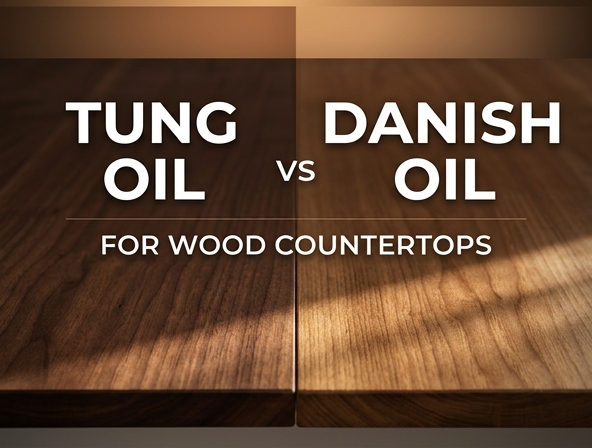
Selecting the wrong finish for custom wood countertops can quickly turn a stunning kitchen investment into a warped, water-stained headache. As solid wood surfaces continue to dominate modern interior design, understanding the inherent vulnerability of natural timber is the critical first step before applying any protective coat. Fortunately, choosing the correct finish grants your wood countertops a food-safe barrier, enhanced water resistance, and a rich, deep luster that highlights the wood's natural grain. However, it is vital to establish that no oil finish is completely "set-and-forget"; periodic maintenance is always required to preserve the seal. For instance, a hard maple prep station situated near a farmhouse sink demands a vastly different protection level than a decorative walnut island. To help you navigate this choice, we will compare pure tung oil and Danish oil across application, durability, and long-term upkeep, outlining which option best suits your kitchen's needs.
Introduction: The Battle for the Perfect Wood Countertop Finish
Wood countertops bring an organic warmth and incomparable character to a kitchen, serving as both a functional workspace and a striking design centerpiece. However, because the kitchen is a high-moisture, high-wear environment, bare wood cannot survive long without a high-quality protective barrier. Selecting the wrong finish can lead to water rings, food stains, warping, or even wood rot, turning an expensive investment into a maintenance nightmare.
Among the array of finishes available to homeowners and woodworkers, two popular contenders stand out: Pure Tung Oil and Danish Oil. While both options promise to enhance the natural beauty of wood grain, they operate on completely different chemical levels, offering vastly different timelines for application and cure. The key dilemma lies in choosing between the slow-curing, completely natural resilience of pure plant oil and the rapid, hard-drying convenience of a synthetic resin blend.
Understanding Pure Tung Oil: Nature's Resilient Shield
Pure Tung Oil is an organic finish derived from the pressed seeds of the nut of the tung tree, native to ancient China. For centuries, artisans have relied on this oil to protect marine vessels and fine woodwork, appreciating its unique ability to penetrate deep into wood fibers before curing. Unlike mineral oils that remain wet and easily wash away, Tung Oil is a drying oil that hardens through a natural process of oxidation and polymerization rather than solvent evaporation.
When exposed to oxygen, the molecules in Tung Oil link together into a highly elastic, plastic-like matrix. This bond becomes part of the wood itself, allowing the countertop to expand and contract naturally with seasonal humidity changes without cracking or peeling. The resulting finish is incredibly water-resistant, matte in appearance, and completely free of artificial chemical driers.
- 100% Organic and Non-Toxic: Free of VOCs, chemical solvents, and synthetic additives, making it ideal for food-contact surfaces.
- Elasticity: Flexible cured state prevents the finish from cracking under thermal expansion or physical impact.
- Deep Penetration: Bonds within the cellular structure of the wood rather than forming a brittle surface shell.
- Mildew and Acid Resistance: Naturally repels common kitchen liquids, including vinegar, citrus juices, and standing water.
Deciphering Danish Oil: The Fast-Drying Blend
Unlike Pure Tung Oil, Danish Oil is not a single, standardized ingredient. It is a generic term for a proprietary, varnish-oil hybrid finish manufactured by various wood-care brands. This formulation bridges the gap between the penetrating depth of natural oil and the surface-hardening speed of modern polyurethane. By blending a drying oil (usually linseed or thinned tung oil) with synthetic resins and chemical driers, manufacturers create an easy-to-use product that protects the wood from both the inside and the outside.
The chemical driers speed up the oxidation process dramatically, allowing the product to dry to the touch in a fraction of the time required by pure oils. The added resins sink into the top wood fibers, forming a hard, protective micro-film that seals out moisture while leaving a subtle satin sheen. While it lacks the pure organic simplicity of raw oils, its chemical structure is engineered for modern efficiency.
Food Safety and Water Resistance in the Kitchen
When protecting a kitchen countertop, particularly one housing a sink or used for meal prep, water resistance and food safety are paramount considerations.
Pure Tung Oil: The Gold Standard for Food Safety
Pure Tung Oil is one of the few natural finishes that is fully FDA-approved for direct food contact in its cured state. Because it contains no added volatile organic compounds (VOCs) or metallic driers, you can safely chop vegetables and roll out pastry dough directly on a tung-oil-finished surface. Near sinks, its natural water-shedding properties are superb. Water beads up on a properly built-up tung oil finish, refusing to penetrate the wood cells below, provided the finish is maintained regularly.
Danish Oil: Safe Once Cured, but Guarded Around Water
Danish Oil contains chemical solvents and metallic driers that emit strong odors and VOCs during the application and drying phases. However, once the curing process is 100% complete and all solvents have evaporated, the cured resin-oil matrix is generally considered inert and safe for indirect food contact. Near sinks, the synthetic resins in Danish Oil provide a highly effective immediate barrier against standing water. However, if water gets beneath the thin resin layer through a deep scratch, it can trap moisture and cause localized wood discoloration.
Durability, Wear, and Long-Term Maintenance
A kitchen countertop is a workhorse, subjected to sliding pots, dropped utensils, and hot coffee mugs. How each finish reacts to this daily wear determines its long-term viability in your home.
Pure Tung Oil offers exceptional resistance to scratching because it does not form a hard, glassy film on top of the wood; instead, the wood itself remains the wear surface. If a scratch occurs, it is barely visible because there is no synthetic surface layer to fracture or turn white. However, Tung Oil is vulnerable to harsh alkaline cleaners and requires gentle soap and water for cleanup. When it comes to upkeep, refreshing a tung-oil-finished surface is incredibly simple. It requires no sanding-you simply clean the surface and rub on a fresh, thin coat of oil to restore its protective qualities through re-polymerization.
Danish Oil relies on its resin content to create a harder, more scratch-resistant surface barrier. However, because it creates a microscopic film, deep scratches can occasionally break this barrier, leaving the raw wood underneath vulnerable to moisture. Over time, high-traffic areas near stoves or sinks may experience a worn-through appearance. Repairing Danish Oil is still relatively simple compared to full polyurethane, but it often requires a light scuff-sanding with fine steel wool or abrasive pads before applying a maintenance coat to ensure proper adhesion of the new resin blend.
The Application Process: Which Is Easier to Apply?
The experience of applying these finishes differs greatly, particularly regarding the time investment and the number of coats required to achieve maximum protection.
While applying both finishes relies on a wipe-on, wipe-off philosophy, the preparation, dilution, and patience required for each project set them worlds apart.
- Preparation: Sand the wood countertop up to 180 or 220 grit. Ensure the surface is free of dust and completely dry before beginning either application.
- Applying Pure Tung Oil:
- For the first 2-3 coats, dilute the pure oil 1:1 with a natural solvent like citrus solvent or mineral spirits to assist deep penetration.
- Apply a generous wet layer of the mixture with a lint-free cloth or brush, allowing the wood to absorb it for 40 minutes.
- Wipe away all excess oil completely to prevent tacky spots.
- Wait 24 hours between coats, light sanding with 0000 steel wool, then repeat for a total of 5 to 6 coats. The final 2 coats should be applied undiluted.
- Applying Danish Oil:
- Apply the Danish Oil straight from the can using a brush or rag, flooding the wood surface.
- Allow the wood to absorb the mixture for 15 to 20 minutes, reapplying to any dry spots that appear.
- Thoroughly wipe off all excess oil from the surface with clean rags.
- Wait 6 to 8 hours, then apply a second coat. A third coat can be applied the next day for enhanced durability. No dilution is ever required.
Aesthetics: How They Alter the Wood's Appearance
Both finishes excel at highlighting the innate beauty of wood grain, but they yield different visual and tactile results upon curing.
Pure Tung Oil yields a soft, flat matte finish that preserves the natural feel of the wood texture under your fingertips. It enriches the wood's natural color, giving it a warm, amber-toned depth that deepens gracefully with age. Because it does not build up a glossy plastic layer on the surface, the wood retains its organic, raw character while gaining a subtle, velvety sheen under direct light.
"A pure oil finish respects the tactile truth of the wood. It allows you to feel the grain, the growth rings, and the organic soul of the tree, rather than a cold barrier of synthetic plastic." - Master Furniture Maker & Woodwright
Danish Oil, due to its varnish component, darkens the wood more rapidly and creates a richer, more dramatic ambering effect upon the first application. As multiple coats are applied, the resins build up slightly to produce a satin or semi-gloss sheen that reflects more light than pure oil. This sheen can make intricate wood grains, such as curly maple or walnut crotch, pop with impressive three-dimensional depth, though it sacrifices some of the raw, tactile wood feel in favor of a smoother, sealed surface texture.
Cure Time vs. Drying Time: Patience vs. Speed
A major point of divergence between these two finishes is the timeline required before you can safely use your new wood countertop. Understanding the difference between "dry-to-touch" and "fully cured" is vital to avoiding ruined finishes.
Danish Oil is formulated specifically for speed. Because of its volatile solvents and metallic driers, it dries to the touch in just . This rapid evaporation allows homeowners to complete a multi-coat application process in a single weekend. The chemical resins reach a fully cured, hardened state in approximately , meaning your kitchen can return to full service quickly.
Pure Tung Oil demands far more patience. It dries to the touch in , but because it relies entirely on natural oxidation without chemical accelerators, it requires to fully cure. During this curing window, the countertop must be kept dry, and heavy objects should not be left resting on the surface. For households with active kitchens, this month-long curing period can represent a significant logistical challenge.
Direct Comparison: Tung Oil vs. Danish Oil at a Glance
To help you weigh your options, this table summarizes the key metrics of both finishes side-by-side.
| Feature / Metric | Pure Tung Oil | Danish Oil |
|---|---|---|
| Composition | 100% natural tung tree nut oil | Blend of oil, synthetic varnish, and solvents |
| Eco-Friendliness | Excellent (Zero VOCs, biodegradable) | Moderate to Low (Contains VOCs and solvents) |
| Drying Time (Between Coats) | 24 hours | 6 to 8 hours |
| Full Cure Time | 15 to 30 days | 3 to 7 days |
| Food Safety | 100% FDA-approved; food-safe naturally | Safe for indirect food contact once fully cured |
| Required Coats | 5 to 6 coats | 2 to 3 coats |
| Visual Sheen | Soft, natural matte finish | Satin to semi-gloss sheen |
| Long-term Maintenance | Easy wipe-on replenishment; no sanding | Moderate; may require light sanding over time |
The Verdict: Which Finish Wins for Your Wood Countertop?
Choosing the right finish for your kitchen wood countertop comes down to balancing your aesthetic preferences against your tolerance for downtime and maintenance. Each finish shines under different circumstances, and identifying your household's daily habits will lead you to the ideal selection.
Select Pure Tung Oil if you prioritize a completely natural, non-toxic kitchen environment, appreciate a soft matte aesthetic, and have the patience to allow for a month-long curing process. It is the superior choice for dedicated prep islands, butcher blocks where food will directly contact the wood, and historic home restorations where authentic, organic aging is highly valued.
Opt for Danish Oil if you are working on a tight timeline, want a faster turnaround, and desire a satin sheen with added surface hardness. This finish is perfect for busy households that cannot afford to keep their kitchen out of commission for weeks, as well as for countertops featuring complex grain patterns that benefit from the visual enhancement of synthetic resins.
Leave a comment