
Waking up with a stuffy nose, itchy eyes, and a scratchy throat is an exhausting way to start the day, especially when your bedroom is supposed to be a sanctuary. For chronic allergy sufferers, this persistent nighttime congestion directly compromises restorative sleep and daytime productivity.
Before investing in any device, it is important to understand that indoor bedrooms naturally accumulate dense concentrations of airborne particles. Optimizing this specific microenvironment grants you the symptom-free, uninterrupted sleep your body needs by systematically capturing microscopic pollen, pet dander, and resilient mold spores.
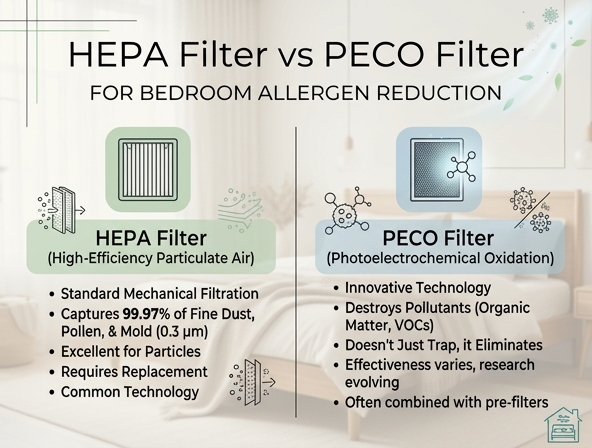
While an air purifier is not a medical cure-all for respiratory conditions, selecting the right filtration technology is a proven cornerstone of environmental control. In this guide, we will compare traditional True HEPA filtration against proprietary PECO (Photoelectrochemical Oxidation) technology, analyzing their mechanics, maintenance, and efficacy to help you secure the ideal bedroom defense.
The Battle for Clean Bedroom Air: HEPA vs. PECO
We spend roughly a third of our lives in the bedroom, making the quality of the air we breathe during sleep vital to our long-term health. For millions of people, night-time brings a frustrating cycle of congestion, sneezing, and disrupted sleep. Achieving true allergy relief depends heavily on selecting the right air purification technology. In this guide, we will break down the differences between two prominent filtration methods: the traditional, time-tested HEPA filter and the modern, innovative PECO technology.
Both systems promise to clear the air, but they operate on completely different scientific principles. This article compares their purification mechanisms, allergen capture efficiency, volatile organic compound (VOC) removal, noise generation, and long-term operating costs to help you choose the ideal system for your bedroom.
What is HEPA and How Does It Work?
HEPA, which stands for High-Efficiency Particulate Air, is a mechanical air filtration standard developed during the mid-20th century. Rather than relying on chemical reactions, a HEPA filter utilizes a dense, randomized web of fine fiberglass fibers to physically trap airborne particles as air is forced through the media by a fan.
The Three Mechanisms of Mechanical Filtration
HEPA filters do not act like simple sieves; they capture particles using three distinct physical processes: interception, where particles follow the airflow and collide with a fiber; impaction, where larger particles slam directly into the fibers due to inertia; and diffusion, where the smallest particles move erratically in Brownian motion, eventually hitting and sticking to a fiber.
Industry Standard Particle Capture
To qualify as a true HEPA filter under standard rating systems, the media must achieve a specific efficiency threshold. It is designed to capture a wide array of particulate matter, including:
- Large allergens like pollen and mold spores (10 microns and larger)
- Medium particulate matter like dust, pet dander, and dust mite debris (2.5 to 10 microns)
- Fine combustion particles, bacteria, and virus-carrying droplets (down to 0.3 microns at a 99.97% efficiency rate)
- Ultrafine particles and smoke (below 0.1 microns, captured with varying high efficiencies via diffusion)
What is PECO and How Does It Differ?
PECO, or Photoelectrochemical Oxidation, is a relatively new proprietary technology designed to address the limitations of mechanical filters. Developed by researchers and popularized by air purification companies like Molekule, PECO does not rely on a dense physical barrier to collect debris. Instead, it utilizes a chemical process to neutralize indoor air pollution.
The core of PECO technology involves a catalytic filter coated with a specialized semiconductor material. When this catalyst is excited by a specific wavelength of ultraviolet (UV) light inside the purifier, it initiates a chemical reaction on the surface. This reaction generates free radicals that interact with organic substances passing through the device. Rather than holding onto pollutants, the process of oxidation breaks down these complex compounds, leading to the complete molecular destruction of organic matter, converting viruses, bacteria, mold, and gaseous pollutants into harmless trace elements like carbon dioxide and water vapor.
Trapping vs. Destroying: The Core Technology Showdown
The primary philosophical and scientific difference between these two systems lies in what happens to the pollutants once they are pulled inside the machine. A HEPA filter acts as a holding cell, while a PECO system acts as an incinerator for organic material.
Over months of continuous use, HEPA filters accumulate a thick layer of dust, skin cells, pet hair, and active mold spores. Under humid bedroom conditions, this trapped organic matter can potentially become a breeding ground for bacteria or mold, which may release odors or biological byproducts back into your room if the filter is not replaced regularly. PECO prevents this accumulation of live pathogens by disintegrating the cellular walls of organic material, though it is less efficient at quickly collecting massive volumes of inorganic dust.
| Feature | HEPA Filtration | PECO Technology |
|---|---|---|
| Primary Action | Physical trapping of particles | Chemical destruction of organic compounds | Target Pollutants | Particulate matter (dust, dander, pollen) | Organic molecules (VOCs, mold, viruses, bacteria) | Filter Accumulation | Pollutants remain on the filter surface | Organic pollutants are destroyed and converted | Airflow Resistance | High resistance; requires powerful fan | Low resistance; allows open airflow design |
Allergy Relief: Dust Mites, Pollen, and Pet Dander
When it comes to relieving immediate bedroom allergy symptoms, the speed of particle clearance is paramount. Allergy sufferers react strongly to heavy, airborne particulates that settle on bedding, carpets, and nightstands.
Dust Mites and Pollen
Dust mite allergens and pollen grains are relatively large physical particles. HEPA filters excel at capturing these quickly. Because of their highly dense fiber matrices, a HEPA purifier can scrub these allergens out of a bedroom's air volume in just a few air exchanges, providing rapid relief from nighttime sneezing and morning congestion.
Pet Dander and Mold Spores
Pet dander and mold spores are highly buoyant and can linger in the air for hours. While HEPA filters capture nearly 100% of these particles upon contact, PECO takes a slower, multi-pass approach. PECO will destroy the mold spores and neutralize the proteins on pet dander that cause allergic reactions, but because it relies on chemical contact with the catalyst, it takes longer to lower the overall particle count in the room compared to a high-CADR (Clean Air Delivery Rate) HEPA unit.
Combating Bedroom VOCs, Odors, and Gases
Bedrooms often harbor a cocktail of invisible gaseous pollutants. Volatile Organic Compounds (VOCs) off-gas from mattress foam, treated furniture wood, fresh paint, carpets, and household perfumes. Traditional HEPA filters have a major vulnerability: because they are physical meshes, gaseous molecules pass straight through them without restriction.
Crucial Bedroom Tip: If you buy a HEPA purifier to combat bedroom odors or chemical fumes, make sure the unit includes a substantial activated carbon pre-filter. A standard HEPA filter alone cannot trap gas molecules or eliminate odors.
This is where PECO technology holds a distinct advantage. Because VOCs, cooking smells, and chemical fumes are carbon-based organic molecules, the photoelectrochemical oxidation process is highly effective at breaking their chemical bonds. PECO permanently destroys hazardous gases like formaldehyde, benzene, and household odors, converting them into harmless substances without relying on a carbon filter that can eventually saturate and release those gases back into your bedroom.
Noise Levels and Sleep Quality
No matter how clean the air is, an air purifier is not suitable for a bedroom if it keeps you awake at night. Sleep quality relies heavily on low decibel outputs and a consistent sound profile that does not disrupt your REM cycles.
Because HEPA filters are thick and dense, the purifier's fan must work hard to pull air through the tight weave of fibers. At higher speeds, this resistance can create a noticeable hum or high-pitched rushing sound. To maintain a quiet sleeping environment, many users run their HEPA units on low or sleep mode, which operates around 30 dB or less, but this significantly reduces the clean air delivery rate. PECO filters have a much more open structure, allowing air to flow freely without high resistance. However, some PECO devices require high-intensity UV lights and internal fan configurations that can still produce noise levels around 40 to 50 dB on medium settings, which might disturb light sleepers who require a whisper-quiet environment.
Filter Lifespan, Replacement Costs, and Maintenance
Maintaining an air purifier is an ongoing commitment. To evaluate the long-term investment of both technologies, let's look at what is required to keep them operating at peak performance over time.
HEPA filters typically need to be replaced once every 6 to 12 months, depending on use and room dust levels. PECO systems usually require two types of filter replacements: a pre-filter to catch large dust particles (replaced every 3 months) and the primary PECO catalytic filter (replaced every 6 months).
To understand the true cost of ownership, consider this step-by-step cost evaluation over a three-year period:
- Calculate the initial purchase price of the machine, noting that PECO-enabled devices often carry a higher upfront premium than standard HEPA units.
- Estimate the annual filter replacement cost, which ranges from $40 to $80 per year for standard HEPA filters, compared to $100 to $150 per year for proprietary PECO filter bundles.
- Factor in the energy consumption, checking if the HEPA unit requires a higher wattage fan to pull air through clogged filters over time compared to the low-resistance PECO system.
Pros and Cons: A Quick Bedroom Comparison
Choosing between these two technologies requires weighing their practical benefits against their drawbacks in a sleeping space.
HEPA Filters
- Pro: Exceptionally fast particulate clearance, making it highly effective for immediate relief from dust, pollen, and pet dander.
- Pro: Widely available, budget-friendly options with predictable, low-cost replacement filters.
- Con: Does not destroy captured pathogens; mold, bacteria, and viruses remain alive on the filter surface.
- Con: Incapable of capturing VOCs, gases, or odors unless paired with a separate activated carbon filter.
PECO Filters
- Pro: Destroys organic pollutants, including viruses, mold spores, and bacteria, at the molecular level.
- Pro: Highly effective at breaking down chemical VOCs, formaldehyde, and stubborn bedroom odors.
- Con: Slower physical particle clearance rate compared to high-performance HEPA units.
- Con: Higher upfront cost for the device and more expensive annual filter replacement cycles.
The Verdict: Which Filter Should You Choose for Your Bedroom?
The ideal selection depends on your specific health concerns, budget, and environmental needs. Neither technology is a one-size-fits-all solution, but matching their strengths to your lifestyle ensures you get the most restful night of sleep possible.
If your primary struggles are airborne allergens, seasonal pollen, dust mites, or pet dander, a True HEPA purifier is the most effective and economical choice. It will rapidly lower the particle count in your bedroom, helping you wake up without congestion. For those who want the best of both worlds, look for a sealed HEPA system paired with an activated carbon filter, which balances heavy particle capture with reliable odor and gas control.
Conversely, if you suffer from severe chemical sensitivities, live in a home with persistent VOCs, off-gassing furniture, or damp conditions prone to mold growth, a PECO purifier offers unique advantages. By destroying gaseous compounds and neutralizing live biological pathogens rather than just trapping them, PECO provides peace of mind for those sensitive to molecular-level indoor air pollutants.
Leave a comment