
Finding an entryway rug that survives the daily onslaught of muddy boots, pet claws, and heavy foot traffic without looking shredded within months is a notorious design challenge. To bridge the gap between utility and style, homeowners increasingly turn to organic textures to establish a warm, welcoming first impression.
Selecting the ideal weave grants your home both high-end aesthetic appeal and long-lasting floor protection. However, we must establish a crucial stipulation: natural fibers are not universally interchangeable, and their performance varies wildly under stress. For example, while plush jute offers barefoot comfort, it behaves very differently than ultra-dense sisal when subjected to wet shoes or abrasive dirt.
In this head-to-head comparison, we will analyze the distinct physical properties, maintenance needs, and lifespans of jute and sisal to determine the ultimate champion for your high-traffic entryway.
Introduction: The Rug Dilemma for Busy Entryways
The entryway is the gateway to your home, bearing the brunt of muddy boots, wet umbrellas, and heavy daily foot traffic. Finding a rug that balances style, functionality, and endurance is a notorious design challenge. Natural fiber rugs offer an organic, elegant solution, with Jute and Sisal standing out as the top two contenders. While both fibers bring warmth and texture to a foyer, they possess vastly different physical properties that affect how they perform over time. Understanding these differences is crucial to choosing a rug that survives the daily hustle of a busy home.
Understanding Jute: Softness and Warmth
Jute is a natural fiber harvested from the stalk of the Corchorus plant, primarily grown in the humid climates of India and Bangladesh. Often referred to as the "golden fiber" due to its natural shimmering hue, jute is celebrated for its remarkable softness. Unlike other coarse natural materials, jute fibers are relatively fine and flexible. This creates a rug with a chunky, woven texture that feels gentle and inviting. For homeowners aiming to establish a cozy, relaxed, or rustic aesthetic right at the front door, jute provides an immediate sense of warmth and comfort.
Understanding Sisal: Powerhouse of Durability
Sisal is harvested from the Agave sisalana plant, a hardy succulent that thrives in arid environments. This plant produces incredibly tough, fibrous leaves that are spun into a rope-like yarn. Known as the powerhouse of the natural fiber world, sisal is celebrated for its extreme resilience and robust structure. Unlike softer plant fibers, sisal is stiff, coarse, and highly resistant to stretching or breaking. This immense strength makes it an incredibly popular choice for high-utility spaces that require a rug capable of withstanding heavy friction and continuous abuse.
Durability Showdown: Which Survives High Foot Traffic?
When it comes to surviving the relentless flow of daily life, the structural differences between these two fibers become highly apparent. The foyer is a battleground of heavy shoes, active pets, and constant movement, requiring a material that does not easily degrade.
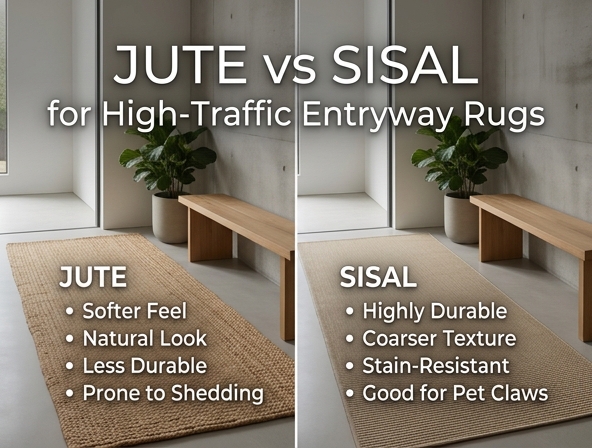
- Sisal Rugs: These rugs easily withstand the friction of hard-soled shoes, high heels, and sharp pet claws without fraying or shedding excessively.
- Jute Rugs: Because jute fibers are softer and more delicate, they are prone to shedding and breaking under intense pressure, making them less resilient against pet claws and heavy wear.
- Longevity: Sisal maintains its tight weave and structural integrity for years, whereas jute may show signs of thinning, fiber breakdown, and fraying in high-traffic zones much sooner.
Texture and Comfort Underfoot
The tactile experience of stepping onto a rug is a major consideration for many households. Jute offers a soft, chunky feel that is incredibly comfortable, even for those walking barefoot. It behaves more like a traditional textile, making it a pleasant surface to step on when entering a home. In contrast, sisal is significantly coarser and has a rough, rope-like texture. While highly durable, sisal can feel prickly or scratchy underfoot, which might not be ideal for families who prefer a softer landing. Choosing between the two requires balancing physical comfort with long-term wear resistance.
Spills, Mud, and Moisture: Maintenance Comparison
Entryways are highly susceptible to outdoor elements like rain, mud, and snow. Natural fibers generally have a complex relationship with moisture, but they handle liquid spills and dirt in distinct ways.
- Moisture Absorption: Both fibers are highly absorbent, but sisal is particularly prone to water staining, which can leave unsightly dark spots if not treated immediately.
- Dirt and Mud Management: Jute hides dry dirt well within its thick weave, while sisal's tight, flat weave allows dirt to sit on the surface, making it easier to vacuum up before it embeds.
- Cleaning Protocols: Clean both fibers by shaking out loose dirt, vacuuming regularly without a beater bar, and blotting spills immediately with a dry cloth rather than using wet shampooing methods.
When comparing the two, sisal is easier to sweep and vacuum, but both require careful protection from heavy rain and wet boots to prevent mold and fiber degradation.
Aesthetic Appeal and Design Versatility
Visually, both rugs bring a distinct organic charm to an entryway, but their color palettes and weave structures cater to different design styles. Jute rugs typically showcase a golden-brown tone with a thick, hand-woven look that pairs beautifully with bohemian, coastal, or farmhouse decors. Sisal rugs, on the other hand, offer a more refined, creamy-tan or neutral palette with precise, geometric weave patterns like boucle or herringbone. This clean, uniform appearance allows sisal to blend seamlessly into modern, minimalist, or traditional entryway spaces, providing a sophisticated and polished foundation.
Slip Resistance and Safety in the Foyer
A rug that slides across a polished hardwood or slick tile floor is a major safety hazard in a busy foyer. Because natural fiber rugs are lightweight and have a relatively smooth underside, they require proper stabilization. Many high-quality sisal rugs come with a built-in latex backing that provides natural grip, while jute rugs are usually reversible and lack any integrated backing. To ensure safety and prevent slipping, it is essential to use a high-quality, non-slip rug pad underneath both types of rugs. This not only keeps the rug securely in place but also protects your underlying floors from scratches caused by coarse fibers.
Sustainability and Eco-Friendly Benefits
For environmentally conscious homeowners, both jute and sisal present outstanding green credentials. Because they are derived entirely from fast-growing, renewable plant sources, these fibers require minimal chemical processing and pesticides to cultivate. Furthermore, unlike synthetic polyester or nylon rugs, both jute and sisal are completely biodegradable, ensuring they will not sit in a landfill for centuries once their lifespan ends. Selecting either of these natural materials reduces your household's carbon footprint while bringing renewable, Earth-friendly design directly into your home's entryway.
The Final Verdict: Jute or Sisal for Your Entryway?
To decide which natural fiber reigns supreme for your foyer, you must evaluate how you utilize the space and what demands will be placed on the rug.
- Choose Jute if your priority is a cozy, soft texture, a relaxed aesthetic, and comfort under barefoot traffic, provided the entryway is semi-protected from heavy mud and rain.
- Choose Sisal if you require maximum durability, exceptional wear resistance against heavy shoes and pet claws, and a clean, sophisticated look for a high-traffic foyer.
For a truly high-traffic entryway where boots, paws, and heels are a daily reality, sisal reigns supreme due to its unmatched structural resilience. While jute wins on comfort, sisal's ability to withstand the harshest entry conditions makes it the superior investment for busy households.
Leave a comment