
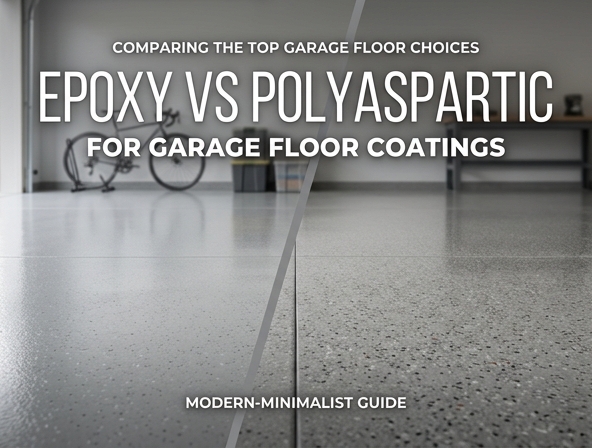
For many homeowners, the garage floor is a constant source of frustration-marked by stubborn oil stains, unsightly cracks, and concrete dust that traces into the living space. Before rushing to apply a temporary cosmetic fix, it is crucial to recognize that concrete preservation is a foundational home investment. Securing the right high-performance floor coating guarantees decades of chemical-resistant durability while instantly elevating your property's overall value.
However, an effective installation requires the stipulation that environmental factors, such as concrete moisture levels and UV exposure, must dictate your material choice. For instance, while standard DIY epoxy often succumbs to hot-tire pickup and yellowing, professional polyaspartic formulas maintain their integrity under extreme thermal stress.
To help you navigate these options, this article will compare epoxy and polyaspartic coatings across key benchmarks, including durability, cure times, installation costs, and long-term performance, ensuring you select the optimal system for your home.
Introduction: Upgrade Your Garage Floor
For decades, the garage was treated as an afterthought-a cold, dusty concrete bay reserved solely for parking vehicles, storing lawnmowers, and piling up cardboard boxes. Today, homeowners are viewing this square footage through a different lens. The modern garage has evolved into an extension of the home, serving as a high-tech workshop, a home gym, a man cave, or a clean entryway. To match this functional upgrade, upgrading the floor has become a primary home improvement priority.
When it comes to upgrading concrete surfaces, two dominant players rule the market: epoxy floor coatings and polyaspartic floor coatings. While both promise to transform a stained, cracked concrete slab into a sleek, professional showroom, they rely on vastly different chemical designs and offer distinct performance characteristics. Choosing the right one determines how well your garage floor resists heavy traffic, chemical spills, and the test of time.
What is Epoxy Floor Coating?
Epoxy floor coating is a traditional, widely recognized surface treatment composed of a thermosetting resin and a polyamine hardener. When these two components are mixed, they undergo a chemical reaction that bonds them to one another and to the prepared concrete substrate. This curing process forms a hard, thick plastic barrier that fills in minor cracks and imperfections, leaving a smooth, high-gloss finish.
Because of its reliable performance and straightforward application, epoxy has remained the industry benchmark for garage transformations for several decades. Homeowners frequently choose classic epoxy systems due to several distinct advantages:
- Excellent Self-Leveling Properties: Epoxy naturally flows into small divots and hairline cracks, creating an exceptionally flat surface.
- High Build Thickness: A standard high-solids epoxy coat provides a thick protective barrier that easily hides imperfections in older concrete.
- Affordability: It remains one of the most budget-friendly ways to achieve a clean, professional-looking floor.
- Wide DIY Availability: Countless user-friendly epoxy kits are readily available at local home improvement centers.
What is Polyaspartic Floor Coating?
Polyaspartic floor coating represents a major leap forward in polymer science. Technically a hybrid aliphatic polyurea material, polyaspartic was originally developed in the 1990s to protect steel bridges and heavy industrial equipment from harsh environmental exposure. Recognizing its incredible durability and rapid cure rate, the residential home improvement industry adapted this advanced technology for garage floors.
Unlike epoxy, which cures slowly through an exothermic reaction, polyaspartic cures through a reaction triggered by ambient moisture. This unique chemistry allows the material to wet out the concrete deeply, establishing an incredibly strong, flexible bond. As a result, the coating does not merely sit on top of the concrete; it integrates into the pores of the slab, providing unmatched resistance to peeling, cracking, and delamination.
Durability and Strength: Which Outlasts the Other?
Epoxy Durability
Epoxy coatings are remarkably rigid and highly resistant to impact from dropped tools, heavy equipment, and vehicular traffic. However, because epoxy is a rigid plastic, it lacks flexibility. Over time, as a concrete slab expands, contracts, or settles with seasonal temperature shifts, a brittle epoxy coating can develop micro-cracks or begin to peel away from the concrete substrate.
Polyaspartic Durability
Polyaspartic coatings offer up to four times the tensile strength of epoxy while remaining highly flexible. This elasticity allows the coating to move naturally with the concrete slab without cracking. Additionally, polyaspartic boasts superior scratch and abrasion resistance, making it much more resilient against dragged floor jacks, spiked shoes, and heavy impact.
The Threat of Hot Tire Pickup
Hot tire pickup occurs when a vehicle is driven on hot summer asphalt and then parked on a garage floor. As the tires cool, they contract, grabbing onto the floor coating. Because epoxy softens under heat, the cooling tires can easily pull the cured epoxy off the concrete surface. Polyaspartic coatings are thermally stable and completely immune to hot tire pickup, ensuring your floor remains intact even under hot performance tires.
Installation and Cure Time: Speed vs. Patience
The installation timeline is one of the most significant practical differences between these two systems. A classic epoxy installation requires patience. The concrete must be thoroughly prepped, followed by the application of a primer, a base coat, color flakes, and a clear topcoat. Because epoxy requires 12 to 24 hours of dry time between layers, and up to 72 hours of total curing time before you can park a vehicle on it, your garage may be out of commission for up to a full week.
In contrast, polyaspartic coatings are celebrated for their rapid-cure capabilities. Professional crews can often complete a multi-coat polyaspartic installation in a single day. The fast curing rate means you can walk on the surface in as little as 4 to 6 hours and park your car back in the garage within 24 hours of the final coat.
Pro-Tip: The rapid cure time of polyaspartic makes it challenging for DIY applications. Because the pot life (working time) of mixed polyaspartic is often less than 20 minutes, it requires a highly skilled, fast-moving installation crew to apply it evenly before it hardens.
UV Resistance: Battling the Yellowing Effect
Sunlight is one of the greatest threats to a beautiful garage floor. Standard epoxy coatings are highly susceptible to UV degradation. When exposed to natural light pouring through open garage doors or windows, the chemical bonds in epoxy break down. This results in ambering or yellowing of the clear topcoat, chalking of the surface, and a gradual loss of gloss, which can ruin the appearance of a custom color flake design.
Polyaspartic coatings are inherently aliphatic, meaning they possess a chemical structure that is completely stable under ultraviolet light. Even when subjected to direct, harsh sunlight for years, a polyaspartic clear coat will not yellow, fade, or lose its crystal-clear clarity. This makes it the superior choice for garages with windows, open carports, and outdoor patios.
Temperature Sensitivity and Application Climate
Weather conditions during the installation process can make or break a floor coating project. Epoxy is highly sensitive to ambient temperatures and moisture levels during application. If the temperature is too low or too high, epoxy will fail to cure properly, leading to a sticky surface, air bubbles, or poor adhesion to the concrete slab.
Polyaspartic coatings are engineered to be applied in nearly any climate, offering a massive operational window for year-round installation. Its curing mechanism relies on moisture rather than heat, allowing installers to coat your floor in extreme weather conditions.
- Epoxy Application Window: Typically requires a narrow temperature range between 50°F and 90°F (10°C to 32°C) with low humidity.
- Polyaspartic Application Window: Can be successfully applied in extreme temperatures ranging from -30°F to 140°F (-34°C to 60°C).
Upfront Cost vs. Long-Term Value
Budget is a major deciding factor for most homeowners. Epoxy is significantly cheaper to purchase and install upfront. If you are on a tight budget or plan to tackle the project yourself, epoxy offers a highly attractive price point. Polyaspartic represents a premium upgrade with a higher initial cost, but its longevity often makes it the more economical choice over the lifespan of your home.
| Feature / Metric | Epoxy Floor Coating | Polyaspartic Floor Coating |
|---|---|---|
| Average Cost (Installed) | $3 to $7 per square foot | $6 to $12 per square foot |
| DIY Friendliness | High (Long pot life, slow drying) | Low (Very fast cure, professional recommended) |
| Expected Lifespan | 5 to 10 years (subject to peeling) | 15 to 20+ years (highly durable) |
| Value Over Time | Moderate (May require recoating) | Excellent (One-and-done solution) |
Maintenance, Cleaning, and Lifespan
Routine Dusting and Mopping
Both epoxy and polyaspartic surfaces are incredibly easy to clean compared to bare, porous concrete. Regular maintenance involves sweeping or dust-mopping loose dirt, sand, and debris that can act as an abrasive. For a deeper clean, both floors can be mopped using warm water and a mild, non-abrasive soap.
Avoiding Harsh Chemicals
To preserve the integrity of your floor's protective seal, avoid using cleaners containing acids, vinegar, ammonia, or citrus additives, as these can dull the finish of both epoxy and polyaspartic. If motor oil, brake fluid, or gasoline spills on the floor, wipe it up promptly. While polyaspartic has a much higher chemical resistance and will not stain easily, leaving harsh automotive chemicals on any surface for extended periods is not recommended.
Expected Lifespan Comparison
A professionally installed epoxy floor in a residential setting typically lasts between 5 to 10 years before showing signs of wear, yellowing, or localized peeling. A high-quality polyaspartic system, installed by certified professionals over a properly prepared concrete substrate, frequently lasts 15 to 20 years or more without losing its gloss, yellowing, or delaminating from the concrete.
The Final Verdict: Choosing the Right Coating for Your Home
Both epoxy and polyaspartic coatings offer dramatic cosmetic and functional improvements over raw concrete. The ideal choice rests on a balance of your budget, your timeline, your regional climate, and how you intend to use your garage space.
Decision Checklist
Choose Epoxy if:
- You are working with a strict budget and want a cost-effective transformation.
- You plan to tackle the project yourself as a weekend DIY warrior.
- Your garage does not receive direct sunlight or experience extreme temperature swings.
- You can easily vacate your garage and leave your vehicles parked elsewhere for up to a week.
Choose Polyaspartic if:
- You want a premium, long-term solution that will last for decades.
- You want the installation completed in a single day with minimal disruption to your routine.
- Your garage floor is exposed to intense sunlight, extreme winter cold, or summer heat.
- You want maximum protection against heavy impacts, scratches, and hot tire pickup.
Leave a comment