
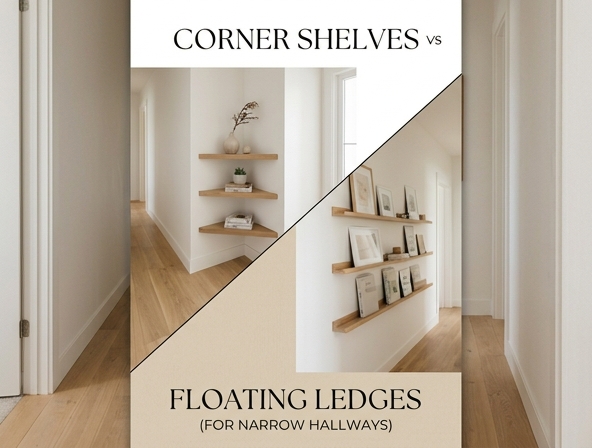
Navigating a narrow hallway often feels like managing a daily obstacle course, where misplaced keys, mail, and decor easily disrupt your home's natural flow. Before addressing storage solutions, it is crucial to understand how spatial layout and foot traffic dictate design; a poorly planned installation can quickly make a tight corridor feel claustrophobic.
Fortunately, reclaiming this underutilized vertical plane grants both functional organization and a visual sense of openness. However, successful implementation stipulates a strict adherence to clearance rules: storage must remain low-profile to keep walkways safe. For example, utilizing an ultra-slim 4-inch floating picture ledge or a targeted 10-inch radial corner shelf allows you to house essentials without obstructing shoulders or elbows.
In this guide, we will compare corner shelves and floating ledges across three critical dimensions: storage capacity, ease of installation, and overall aesthetic impact on small spaces.
Maximizing Tight Transitions: The Narrow Hallway Storage Dilemma
Narrow hallways are the unsung arteries of our homes, yet they pose one of the most frustrating interior design challenges. These tight transitional zones must facilitate smooth foot traffic while often serving as the primary pathways between busy rooms. Finding the right balance between functionality and open space can feel like an impossible task when floor space is at a premium. Homeowners and renters alike constantly seek clever hallway storage solutions that can hold daily essentials or display cherished decor without creating a claustrophobic bottleneck. This quest for spatial efficiency has sparked a major design debate: should you utilize forgotten corners with dedicated corner shelves, or leverage the vertical plane of high-traffic walls with ultra-slim floating ledges?
Under the Spotlight: Corner Shelves vs. Floating Ledges
When floor space is non-existent, vertical and angular storage options become your best allies. Corner shelves and floating ledges approach this space-saving mission from entirely different design philosophies. Corner shelves are designed to anchor into the intersecting points of walls, turning dead, unusable angles into stable hubs for storage. Floating ledges, conversely, hug the flat expanse of long walls, utilizing minimal projection to display items horizontally. Understanding how these two methodologies utilize space is key to unlocking your corridor's true potential.
- Design Orientation: Corner shelves capitalize on radial depth in architectural junctions, while floating ledges prioritize linear, horizontal tracks along flat walls.
- Spatial Impact: Corner shelves leave long walls entirely open, whereas floating ledges maintain clear corners while occupying a fraction of wall-to-wall corridor width.
- Primary Function: Corner units excel at holding bulkier, heavier items due to dual-wall support; floating ledges are optimized for slim profiles, frames, and lightweight decorative objects.
Corner Shelves: Utilizing the Forgotten Nooks
The corners of a hallway are often dismissed as dead space-unreachable by standard furniture and awkward to decorate. Corner shelves present a brilliant remedy by reclaiming these 90-degree junctions and turning them into practical storage stations.
Reclaiming Architectural Dead Space
By nesting directly into the intersection of two walls, corner shelves make use of areas that would otherwise remain completely empty. This allows you to introduce storage without encroaching on the primary walking path of the hallway, keeping the main thoroughfare completely unobstructed.
Superior Load-Bearing Capacity
Because corner shelves anchor into two perpendicular walls, they benefit from dual-side structural support. This unique mounting setup typically allows them to bear significantly more weight than standard single-wall shelving, making them excellent choices for heavier items like books, ceramic planters, or heavy ceramic catch-all bowls.
Ideal Layout Compatibility
These shelves are exceptionally well-suited for short hallways, L-shaped corridors, or entryways where a natural turn occurs. Placing a shelf in these transition zones turns an awkward architectural junction into an intentional focal point.
Floating Ledges: Ultra-Slim Profiles for High-Traffic Walls
For long, straight corridors where corners are scarce, floating ledges offer a sleek and streamlined alternative. These minimalist shelves feature an ultra-slim profile that projects only a few inches from the wall, ensuring they do not impede shoulder-height clearance in high-traffic zones.
Floating ledges are perfect for displaying framed photographs, art prints, and small decorative items like candles or air plants. Because they typically feature a small front lip, items stay securely in place despite the vibrations caused by doors closing or people walking past. Their primary superpower lies in their ability to maintain visual lightness, drawing the eye forward along the length of the hall without making the space feel cramped or cluttered. By keeping both the floor and the lower half of the walls completely clear, they preserve the maximum amount of physical walking space possible.
Spatial Footprint: Comparing Depth and Clearance
In a standard 3-foot-wide (36 inches) hallway, every single inch matters. Introducing any fixture requires careful calculation of the remaining clearance to ensure comfortable passage. Below is a detailed comparison of how corner shelves and floating ledges impact your hallway's physical footprint.
| Metric / Feature | Corner Shelves | Floating Ledges |
|---|---|---|
| Average Depth | 8 to 12 inches (along each wall) | 2 to 4 inches |
| Remaining Pathway Clearance | 36 inches (entire flat wall remains clear) | 32 to 34 inches (at mounting height) |
| Floor Clearance | 100% Clear (elevated mounting) | 100% Clear (elevated mounting) |
| Best Placement Height | Eye level or stacked vertically | Chest to eye level |
Aesthetic Impact: Visual Clutter vs. Open Airiness
The choice between these two storage solutions heavily influences the psychological perception of space in a narrow corridor. Floating ledges emphasize horizontal lines, which can make a short hallway appear longer by drawing the gaze continuously along the wall. This horizontal flow creates a gallery-like atmosphere, turning a boring walk through the house into a curated visual experience. On the other hand, corner shelves disrupt the linear flow to draw the eye vertically. Stacking corner shelves from waist-height up to the ceiling utilizes vertical space to give the illusion of higher ceilings, successfully distracting from the narrowness of the walls.
"To make a tight hallway feel larger, use floating ledges to create long, unbroken horizontal vistas. If your goal is to make the ceiling feel loftier, use stacked corner shelves to guide the eye upward, shifting the focus away from tight lateral boundaries."
Installation Complexity and Wall Damage
Before buying your shelving, it is vital to consider how they attach to your walls. Different mounting requirements can impact stability and the amount of repair work needed when it is time to move.
Mounting Corner Shelves
Installing corner shelves can be slightly tricky because walls are rarely perfectly square. You will need to secure the brackets into both walls. While this dual-point contact provides exceptional stability, it requires precise leveling across two planes and results in anchor holes on two separate walls, which means double the patching work for renters.
Mounting Floating Ledges
Floating ledges are generally easier to install because they mount along a single flat wall. Many modern ledges feature a keyhole mounting system or integrated bracket bar. Ideally, you should secure these into wall studs; however, because they support lighter weights, heavy-duty drywall anchors are often sufficient. This leaves fewer holes to patch later on.
Cost and Material Efficiency
Both shelving styles are available in a wide array of materials, including classic solid wood, industrial metals, and modern, sleek acrylics. Because corner shelves require more material surface area and complex bracket engineering to fit snuggly into 90-degree angles, they tend to carry a slightly higher price tag. Floating ledges, with their simple linear designs, require minimal material to manufacture, making them highly cost-effective.
For budget-conscious decorators looking to maximize value, acrylic floating ledges offer the absolute best deal. They are incredibly affordable, highly durable, and virtually invisible on the wall, which prevents any visual weight from shrinking your hallway. If you prefer natural textures, engineered wood floating ledges provide a warm aesthetic at a fraction of the cost of heavy, custom-cut hardwood corner units.
The Decision Matrix: Which is Right for Your Hallway?
Still undecided on which option will suit your home best? Use this simple scenario-based guide to match your specific layout and storage needs with the ideal shelving solution.
- Long, Straight, and Narrow Corridors
- Choose floating ledges. They maintain essential shoulder clearance along the flat walls while drawing the eye forward, avoiding the awkward visual blockages that corner shelves might create in a straight line.
- Short Entryways or L-Shaped Hallways
- Choose corner shelves. The natural turning points of L-shaped halls or small vestibules offer perfect, low-traffic nooks to house keys, mail, or decorative plants without eating into walking space.
- Rented Apartments and Temporary Housing
- Choose floating ledges. They require fewer anchor points, are easier to patch upon move-out, and often utilize simpler mounting systems that minimize wall damage.
- Heavy-Duty Storage Needs (Books, heavy items)
- Choose corner shelves. Supported by two walls instead of one, they offer the structural integrity needed to support heavier objects safely without sagging over time.
Final Verdict: Styling Your Way to a Functional Hallway
Transforming a cramped hallway into an organized, beautiful space is entirely achievable when you select the right tools for the job. Corner shelves stand out for their robust weight capacity and clever use of otherwise wasted angles, making them perfect for structural turns and heavy items. Floating ledges offer an incredibly sleek, space-saving footprint that highlights linear design and showcases artwork without crowding your path. By assessing your hallway's unique layout, your mounting comfort level, and your storage goals, you can choose the ideal system to elevate your home. Embrace your vertical space today and select the perfect shelving option to make your narrow hallway both functional and visually stunning!
Leave a comment