
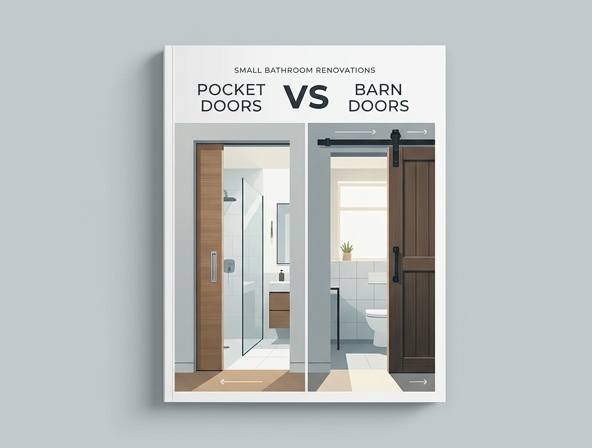
Designing a compact bathroom often feels like a game of inches, where every fixture must be meticulously placed. Traditional swinging doors represent a major bottleneck in this equation, frequently colliding with vanities, blocking toilets, or severely restricting movement. Transitioning to a sliding alternative can reclaim up to 10 square feet of functional floor space, instantly making a tight layout feel open and efficient.
However, selecting the right option requires understanding the structural realities of your home. A pocket door offers a completely concealed finish but demands invasive wall modifications, including retrofitting wall studs and rerouting plumbing or electrical wiring. Conversely, a barn door slides externally, preserving your drywall but requiring dedicated clearance alongside the frame to slide freely.
To help you make the right investment, this guide will analyze pocket doors versus barn doors across three critical categories: installation complexity, acoustic privacy, and long-term durability.
The Small Bathroom Door Dilemma
Maximizing every square inch in a small bathroom can feel like an impossible puzzle. Standard swinging doors demand a wide radius of clear floor space, often colliding with toilets, vanities, or leaving you squeezed awkwardly against the wall just to close the door. To reclaim this valuable real estate, homeowners are turning to sliding door alternatives. Pocket doors and barn doors have emerged as the two primary space-saving solutions, each offering a unique way to eliminate the dreaded door swing and optimize your layout.
Understanding the Pocket Door: Hidden Efficiency
A pocket door is the ultimate vanishing act for tight spaces. Rather than swinging open on a hinge, this door glides smoothly along an overhead track and slides directly into a hollow cavity-or "pocket"-built inside the adjacent wall. When fully opened, the door disappears completely from view, leaving the floor and wall spaces entirely unobstructed.
However, because the door must hide inside the wall, installing a pocket door requires meeting specific structural conditions:
- Double wall width to accommodate the recessed pocket when the door is open.
- No load-bearing restrictions or the installation of a proper replacement support header.
- A clear wall cavity free of electrical wiring, plumbing pipes, and HVAC ductwork.
- Adequate wall depth, typically requiring standard 2x4 framing studs.
Understanding the Barn Door: External Style
In contrast to its hidden counterpart, a sliding barn door embraces visibility. This system operates via a door slab hung from wheeled hangers that glide effortlessly along an exposed metal track mounted directly above the doorframe. Because the entire apparatus sits on the outside of the wall, the door simply slides parallel to the wall when opened, overlapping the adjacent drywall.
Beyond its functionality, the barn door serves as a prominent design feature. The exposed hardware and expansive door face allow homeowners to introduce eye-catching aesthetics, ranging from rustic farmhouse chic and sleek modern minimalist to rugged industrial grit, transforming an ordinary entryway into a striking architectural focal point.
Footprint Comparison: Wall Space vs. Floor Space
When evaluating physical footprints, these two options prioritize space differently. A pocket door excels at preserving external real estate. Because it retracts into the wall cavity, it leaves both sides of the adjacent walls completely free. This allows you to place towel racks, light switches, vanities, or storage cabinets directly next to the doorway without interference.
A barn door, on the other hand, leaves the bathroom floor space clear but demands significant external wall space. To open fully, it requires an adjacent stretch of empty wall that is at least equal to the width of the door itself. You cannot place light switches, art, or furniture along that specific section of the wall, as the door needs to glide directly over it.
Pocket doors preserve your precious wall space by utilizing hidden internal wall cavities, whereas barn doors preserve internal wall cavities at the expense of adjacent external wall surface area.
Privacy and Acoustics: The Bathroom Factor
In a bathroom, privacy is of utmost importance. This is where the structural differences between the two doors become highly noticeable. Pocket doors sit flush inside the doorframe when closed, creating a relatively tight seal. While not completely soundproof, they do a commendable job of minimizing sound transmission and blocking out light leaks, especially when fitted with quality weather stripping.
Barn doors, because they hang suspended from an external track, must sit slightly away from the wall to glide without scraping. This gap-typically around half an inch-allows for significant noise transfer and visible light gaps along the edges. Additionally, securing a reliable locking mechanism is much simpler on a pocket door using integrated mortise locks, whereas barn doors require specialized latch accessories like teardrop locks or privacy hooks which can be less discreet.
Installation Hurdles and Budget Reality
The path to upgrading your bathroom door looks vastly different depending on your choice. Installing a pocket door is a major construction undertaking, particularly in retrofits. It requires tearing down the drywall, modifying or replacing wall studs, relocating any hidden utilities, and then rebuilding and painting the wall. This complexity makes professional installation highly recommended, which significantly drives up the total project cost.
Conversely, barn doors are incredibly DIY-friendly and cost-effective. The installation process usually involves securing a header board to the wall studs above the doorframe, mounting the track, and hanging the door. Because you do not have to open up the walls, you save immensely on labor, materials, and time.
Design Aesthetics: Minimalist vs. Statement Piece
Choosing between these doors often comes down to your desired design language. Pocket doors are the champions of a clean, uncluttered aesthetic. They offer a seamless minimalist look by completely disappearing when open, allowing the bathroom's interior design, tile work, and fixtures to take center stage without any visual competition from the entryway.
Barn doors behave as a bold architectural feature. Instead of blending in, they stand out as a rustic statement piece, a sleek modern divider, or an industrial focal point. By selecting custom wood finishes, glass pane inserts, or striking matte black hardware, you can use the barn door to anchor the design theme of both the bathroom and the adjoining hallway.
Long-Term Maintenance and Durability
Every sliding door system is subject to wear and tear, but how you access those parts for maintenance is crucial. Over time, tracks can accumulate dust or become slightly misaligned, causing the door to stick or glide unevenly. With a barn door, maintenance is simple. Because the track and rollers are completely exposed, cleaning, lubricating, or adjusting the hardware takes only a few minutes with standard tools.
With pocket doors, track issues can quickly turn into a headache. Because the track is nested inside the wall cavity, correcting a severe misalignment or replacing broken rollers can sometimes require cutting through the drywall. Investing in high-quality heavy-duty hardware and a sturdy frame kit during the initial installation is vital to prevent future costly repairs.
The Verdict: Which Reigns Supreme for Small Bathrooms?
Selecting the ideal door depends on aligning your bathroom's structural limitations with your lifestyle needs. Here is how to make the right call.
Choose a Pocket Door If:
You are undergoing a full remodel, have walls free of plumbing and electrical lines, prioritize maximum sound and light privacy, and want to keep your surrounding wall space open for shelving or light switches.
Choose a Barn Door If:
You want a fast, budget-friendly DIY project, have plenty of empty adjacent wall space, love the look of sliding hardware as a decorative element, and do not mind minor sound and light gaps.
Making Your Final Choice
Both sliding door systems offer a brilliant departure from the traditional swinging door, turning cramped layouts into highly functional retreats. Before making your final decision, take precise measurements of your wall thickness, adjacent wall width, and analyze the interior wall space for utilities. With careful planning, your chosen sliding door will bring both effortless movement and elevated style to your small bathroom.
Leave a comment