
Achieving the perfect balance of illumination in a kitchen is notoriously difficult, often leaving homeowners struggling with shadowed countertops and frustrating eye strain during evening meal prep. Before selecting your fixtures, however, it is crucial to evaluate your kitchen's architectural layout and workspace needs. Getting this right does more than just prevent cooking mishaps; it instantly elevates your home's aesthetic appeal and overall market value.
Keep in mind that successful under-cabinet lighting is not a one-size-fits-all solution; it requires balancing your existing power source limitations with your desired light distribution. For example, highly reflective polished quartz countertops demand diffused, continuous lighting to avoid harsh glare spots, whereas deep, dark corner nooks benefit from concentrated directional beams. To help you make an informed investment, this guide will compare puck lights and LED strip lights across key metrics-including installation complexity, light quality, and budget-ensuring you select the ideal system for your space.
Introduction: Brightening Your Kitchen Workspace
The kitchen is the heart of the home, a bustling hub where culinary magic happens and families gather. To make this space both functional and welcoming, proper task lighting is absolutely essential. Shadowy countertops can make food preparation difficult and even unsafe. Installing under-cabinet lighting is one of the most effective ways to illuminate your workspace, enhance safety, and elevate your kitchen's overall design.
When selecting the perfect lighting solution, homeowners generally find themselves choosing between two popular contenders: Puck Lights and LED Strip Lights. Each option offers distinct visual effects and functional benefits. Understanding how they compare will help you transform your kitchen into a beautifully illuminated, highly productive space.
Understanding Puck Lights: Classic and Focused
Puck lights are small, round light fixtures that resemble hockey pucks. These compact devices are designed to cast focused beams of light downward, creating distinct pools of illumination on your countertops. They have been a favorite choice for traditional and transitional kitchens due to their simplicity and classic aesthetic.
These fixtures come with unique design characteristics that set them apart:
- Shape and Size: Typically measuring two to three inches in diameter, they are compact and easily spaced under cabinets.
- Directional Lighting: They project downward-facing cones of light, perfect for highlighting specific prep areas.
- Versatile Power Sources: Available in battery-operated, plug-in, or hardwired models to suit any home setup.
Demystifying LED Strip Lights: Modern and Seamless
LED strip lights, often referred to as tape lights, are thin, flexible circuit boards populated with small light-emitting diodes. These low-profile strips adhere directly to the underside of cabinets, offering a continuous ribbon of light. They have revolutionized modern kitchen design by providing a seamless, contemporary illumination solution.
Their flexible construction allows them to bend around corners and cover expansive areas. Key features of LED tape lights include:
- Continuous Design: A single run can cover several feet, delivering uninterrupted light along the entire length of your counter.
- Low Profile: Extremely thin strips that remain completely hidden from view under almost any cabinet lip.
- Customizable Lengths: Strips can be cut at designated intervals to fit custom cabinet measurements perfectly.
Light Distribution: Focused Beam vs. Continuous Glow
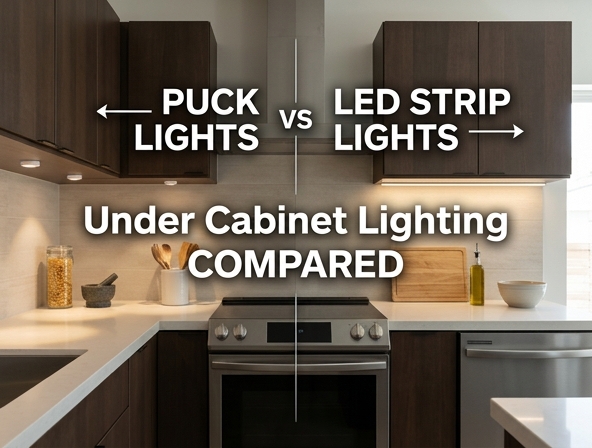
The primary difference between these two lighting options lies in how they distribute light across your countertops. Puck lights create a series of scallop-shaped beams, offering a dramatic, high-contrast spotlight effect. This focused pattern is excellent for drawing attention to specific work areas or showcasing beautiful countertop materials.
The localized beam of a puck light creates depth and visual interest, whereas LED strip lights wash the entire workspace in a smooth, uniform, and shadow-free glow.
Conversely, LED strip lights eliminate shadows entirely. Because the diodes are spaced closely together along a continuous line, the light blends together seamlessly. This creates a uniform brightness that makes reading recipes and prepping ingredients incredibly easy on the eyes. If you prefer a clean, modern workspace without dark spots, strip lighting is the superior choice.
Installation Complexity and Power Sources
How you power your under-cabinet lights plays a major role in both installation complexity and the final look. Both puck and strip lights offer various installation paths, ranging from straightforward weekend DIY projects to professional hardwired upgrades.
- Battery-Powered Options: Ideal for renters or quick fixes, many puck lights run on batteries and stick to cabinets with adhesive. Some strip lights also offer battery packs, though they may drain power faster.
- Plug-In Systems: Both styles are available in plug-in models that connect directly to standard wall outlets. This requires hiding the cords but avoids complicated electrical work.
- Hardwired Installations: For a seamless, switch-controlled look, both systems can be hardwired into your home electrical grid, which usually requires hiring a professional electrician.
Aesthetic Appeal: Fixture Visibility and Placement
How your kitchen lights look when turned off is just as important as how they perform when lit. Because puck lights are slightly thicker, they can sometimes be seen below the cabinet trim. However, this visibility can be styled as an intentional design feature, giving a classic, retro, or industrial feel to the room.
In contrast, LED strip lights are virtually invisible when installed correctly. They tuck neatly behind the face frame of your cabinets, casting light downward without revealing the source. This hidden placement is perfect for creating a clean, minimalist aesthetic where the light itself is felt but the fixture is never actually seen.
Cost, Lifespan, and Energy Efficiency
Evaluating long-term value involves looking at upfront purchase costs, installation expenses, and energy usage over time. Both options utilize energy-efficient LED technology, but their overall cost profiles differ based on the complexity of your setup.
| Lighting Feature | Puck Lights | LED Strip Lights |
|---|---|---|
| Upfront Cost | Low to Moderate | Moderate to High |
| Installation Cost | Low (DIY friendly) | Moderate (requires accessories) |
| Energy Efficiency | Excellent | Outstanding |
| Lifespan | Up to 50,000 hours | Up to 50,000 hours |
While basic battery-powered puck lights are highly affordable initially, the cost of replacement batteries can pile up. High-quality LED strip lights require an initial investment in drivers and connectors, but their exceptional efficiency and long lifespan yield substantial energy savings over time.
When to Choose Puck Lights
Puck lights are the ideal choice for specific kitchen designs and functional needs. They are particularly well-suited for adding localized focus rather than broad illumination.
- Glass-Front Cabinets: Placing a puck light at the top of a glass cabinet creates a stunning display case for fine china and glassware.
- Rental Homes: Battery-operated, adhesive-mounted pucks provide excellent light without damaging cabinets or violating lease terms.
- Architectural Accents: If you want to draw attention to a beautiful backsplash or a specific decorative feature, these focused beams do the job perfectly.
When to Choose LED Strip Lights
LED strip lights excel in modern workspaces where uniform visibility is the top priority. They are the go-to solution for comprehensive kitchen updates.
- Continuous Countertops: If you have long, uninterrupted prep areas, a continuous strip ensures there are no dark zones.
- Minimalist Kitchens: Their ultra-thin profile ensures they remain hidden, maintaining clean lines and a modern aesthetic.
- Reflective Surfaces: Strip lights paired with diffusers reduce harsh reflections on glossy stone or polished quartz countertops.
The Final Verdict: Illuminating Your Decision
Choosing between these two excellent lighting systems comes down to your kitchen's architectural layout, your budget, and your personal design preferences. If you appreciate dramatic focal points, have glass display cabinets, or need an easy battery-powered DIY fix, puck lights are a fantastic choice. They bring a classic touch and targeted brightness right where you need it.
On the other hand, if you prefer a seamless, shadow-free workspace and a highly modern, minimalist look, LED strip lights are the perfect match. Whichever path you take, upgrading your kitchen with high-quality under-cabinet illumination will make cooking, cleaning, and gathering a much brighter and more enjoyable experience. Your ideal kitchen lighting setup is just an installation away.
Leave a comment