
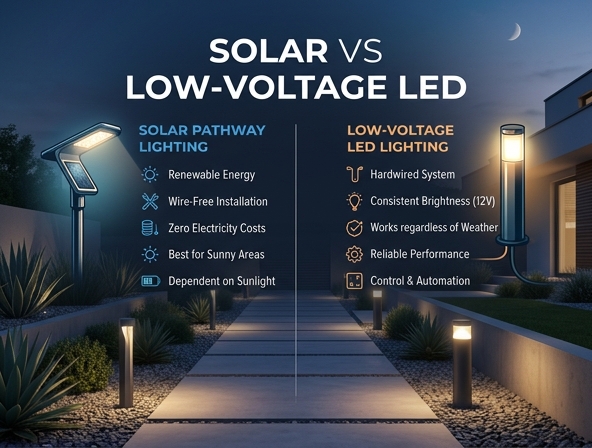
Many homeowners face the frustrating dilemma of choosing outdoor illumination that strikes the perfect balance between reliable performance, aesthetic appeal, and manageable utility bills. It is easy to end up with walkways that are either hazardously dim or prohibitively complex and expensive to install. Before selecting fixtures, however, one must consider how modern landscape design has evolved to prioritize both environmental integration and architectural harmony.
Making the right choice grants you effortless, year-round curb appeal and a significant upgrade to your property's nighttime security. Still, we must stipulate that performance is highly conditional; your local climate and yard shading will heavily dictate your results. For example, while a monocrystalline solar path light offers rapid, wire-free installation, a hardwired 12-volt cast-brass LED fixture delivers unwavering, weatherproof brightness through every season.
To help you decide, this guide compares solar and low-voltage LED systems across installation costs, lifetime durability, and overall light output.
Introduction: Brightening Your Path
A well-lit walkway does more than just prevent stumbles in the dark; it transforms your home's curb appeal and creates a warm, welcoming ambiance. When planning your outdoor lighting project, you will inevitably face a major decision: should you go with solar-powered fixtures or a low-voltage LED system? Solar pathway lights offer unmatched convenience and wireless freedom, capturing the energy of the sun to illuminate your garden. On the other hand, low-voltage LED systems provide reliable, professional-grade brightness that remains consistent regardless of the weather. Choosing the right option requires balancing installation effort, budget, and long-term performance expectations.
How Solar Pathway Lights Work
Solar-powered lights operate as independent, self-sustaining units that require no connection to your home's electrical grid. Each fixture is engineered with integrated components that allow it to collect, store, and utilize energy automatically on a daily cycle.
- Photovoltaic Cells: Micro-solar panels positioned on top of the fixture absorb sunlight during daylight hours and convert solar energy into direct current electricity.
- Rechargeable Batteries: The generated electrical energy is channeled into an internal rechargeable battery housed within the fixture body.
- Photo-Sensors: A small built-in sensor detects the lack of ambient light at dusk, automatically triggering the flow of electricity from the battery to the bulb.
- LED Bulbs: Highly efficient light-emitting diodes consume minimal power to illuminate the path throughout the night until the battery drains or dawn arrives.
The Mechanics of Low-Voltage LED Systems
Unlike independent solar fixtures, low-voltage LED systems are fully integrated into your home's electrical infrastructure. They rely on a central power source to deliver a steady stream of electricity to every connected fixture along the line.
- The Transformer: This essential component plugs into a standard outdoor electrical outlet and steps down the household voltage to a safe twelve volts.
- Low-Voltage Cabling: Specialized direct-burial wires run from the transformer beneath the ground, carrying the reduced electrical current safely to each light.
- Daisy-Chained Fixtures: Each individual LED fixture is physically spliced into the main line, drawing reliable power directly from the transformer.
- Control Systems: Photocells, smart timers, or manual switches connected to the transformer dictate exactly when the entire lighting system turns on and off.
Brightness and Reliability Comparison
The primary performance difference between solar and low-voltage systems lies in how consistently they shine. While solar fixtures rely entirely on daily weather conditions, low-voltage systems maintain uniform brightness regardless of cloud cover, seasonal changes, or shade.
| Feature | Solar Pathway Lights | Low-Voltage LED Systems |
|---|---|---|
| Average Brightness | 1 to 30 Lumens per fixture | 100 to 300 Lumens per fixture |
| Weather Dependency | Highly dependent on daily sunlight levels | Completely unaffected by weather or clouds |
| Shade Performance | Poor; dim or non-functional under trees | Excellent; operates perfectly anywhere |
| Consistency Over Time | Dims gradually as the battery drains | Maintains stable, bright light all night |
Installation: DIY Simplicity vs. Wired Complexity
Setting up your new landscape lights can range from a quick weekend hobby to a labor-intensive project. Solar pathway lights represent the peak of DIY simplicity. Because they require no wiring or external power source, you simply unbox the fixtures, assemble the stakes, and push them into the ground. There are no tools, no trenching, and no safety hazards to worry about during installation.
Conversely, low-voltage LED systems demand a much higher level of wired complexity. You must first plan the layout and calculate the total wattage to avoid voltage drop. The installation process involves mounting the transformer, digging shallow trenches to bury the low-voltage cables, splicing each fixture into the main line, and backfilling the soil. While many homeowners still tackle this as a DIY project, it requires careful planning, physical labor, and occasionally professional assistance to ensure a safe and neat installation.
Upfront Cost vs. Long-Term Value
When evaluating the financial side of landscape lighting, you must look beyond the initial price tag to understand the true cost of ownership over several years.
- Initial Purchase Price: Solar lights are incredibly inexpensive upfront, often sold in budget-friendly multipacks. Low-voltage systems require purchasing a transformer, heavy-duty cables, and more expensive metal fixtures.
- Installation Expenses: Solar setup costs absolutely nothing, whereas a wired system might require hiring a professional landscaper or electrician if you choose not to DIY.
- Operational Costs: Solar lights cost nothing to run since they utilize free sunlight. Wired LED systems will add a tiny, negligible amount to your monthly electric bill due to their high efficiency.
- Replacement Frequency: Low-cost solar lights often need to be completely replaced every two to three years as their casings degrade and internal electronics wear out. A quality low-voltage system can last for decades, offering far superior long-term value.
Durability, Lifespan, and Maintenance
The materials and engineering of your lighting system dictate how well it stands up to lawnmowers, pets, and harsh weather conditions. Standard solar lights are frequently constructed from lightweight plastics that can turn brittle under constant UV exposure, and their internal rechargeable batteries usually degrade within a couple of years, requiring manual replacement or disposal of the entire fixture.
"Wired low-voltage fixtures constructed from solid brass, copper, or powder-coated aluminum can withstand decades of exposure to snow, rain, and lawn maintenance equipment." Landscape Design Association
Low-voltage systems utilize heavy-duty, weather-sealed metal housings. While you may occasionally need to wipe dirt off the lenses or swap out an LED bulb after many years of use, the infrastructure itself remains intact and functional for a lifetime, minimizing maintenance and reducing overall waste.
Design Options and Placement Flexibility
Your property's layout and tree canopy will dictate which lighting system is viable for your yard. Solar pathway lights require direct, unobstructed sunlight for at least six to eight hours a day to achieve a full charge. This restriction severely limits your design options, preventing you from placing fixtures along shaded pathways, under dense tree canopies, or on covered patios where light is often needed most.
Low-voltage LED systems offer total design freedom. Because they draw power from your home's electrical grid, you can place fixtures anywhere the cable can reach. You can light up dark side yards, heavily shaded garden beds, covered entryways, or architectural features without ever worrying about sunlight exposure. Additionally, wired systems offer a much wider array of designer fixture styles, color temperatures, and beam angles to match your home's aesthetic.
Environmental Impact and Sustainability
From an ecological perspective, both lighting types offer distinct environmental pros and cons. Solar lights are highly praised for utilizing clean, renewable solar energy, which means they do not draw power from fossil-fuel-burning power plants. However, the production and disposal cycle of solar fixtures can be highly wasteful, as many cheap plastic models are discarded in landfills once their non-replaceable batteries or solar cells fail.
Wired low-voltage systems rely on grid electricity, but modern LED bulbs are highly energy-efficient, consuming up to eighty percent less power than traditional halogen bulbs. Furthermore, because these wired systems are made of durable, recyclable metals like brass and aluminum, and because their individual components are replaceable, they generate significantly less electronic waste over their lifespans, making them a highly sustainable choice for long-term homeowners.
The Verdict: Which System Should You Choose?
Selecting the ideal pathway lighting setup depends on your yard's layout, your budget, and how much time you want to invest in installation and maintenance.
- Choose Solar Lights If: You want an affordable, quick, and completely tool-free DIY project for a sunny yard, or if you are renting your home and want portable fixtures.
- Choose Low-Voltage LEDs If: You desire a permanent, high-brightness, professional-grade lighting system that works reliably in shaded areas and adds lasting value to your property.
By weighing these key factors, you can select the system that keeps your outdoor spaces safe, beautiful, and beautifully illuminated for years to come.

Leave a comment