
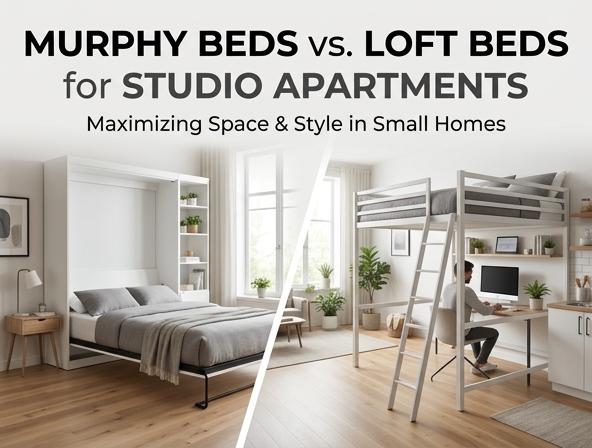
As urban rents continue to climb, studio apartment dwellers face the daily struggle of cramped, single-room living where every square foot must serve multiple purposes. Before you can design a functional home office or a welcoming living area, you must first solve the ultimate spatial puzzle: positioning the bed without sacrificing your entire layout.
Selecting the right sleeping arrangement grants you the power to instantly reclaim vital daytime floor space, transforming a cluttered room into an airy retreat. However, optimizing a micro-apartment requires realistic expectations; both solutions demand specific lifestyle trade-offs regarding daily effort and structural requirements.
Whether you favor a sleek, wall-mounted Murphy bed that hides in plain sight or a timber loft bed with integrated under-desk shelving, the ideal choice depends on your ceiling height and routine. This guide compares both systems across usability, installation, and aesthetics to help you make the perfect choice for your home.
Maximizing Square Footage in Studio Apartments
Studio apartment living is an exercise in creative spatial optimization. The biggest daily hurdle for many residents is balancing a restful sleeping area with a functional, inviting living space. Since a bed typically occupies the largest chunk of floor space, finding a way to manage its footprint is crucial. To reclaim this valuable real estate, two primary design options stand out: the classic Murphy bed and the elevated loft bed. Both offer ingenious ways to maximize square footage, yet they approach the challenge from entirely different structural perspectives.
Understanding the Murphy Bed: The Classic Fold-Away
The Mechanics of the Classic Wall Bed
A Murphy bed, commonly referred to as a wall bed, is a counterbalanced bedding system designed to fold flat against a wall or tuck away inside specialized cabinetry when not in use. This system utilizes advanced spring or piston-lift mechanisms, making the process of lowering and raising the mattress incredibly smooth. By lifting the bed out of the way during waking hours, it provides immediate, transformative space-clearing benefits, instantly converting a bedroom into an open living room, home office, or exercise area.
Understanding the Loft Bed: Elevating Your Sleep
Utilizing the Vertical Dimension
A loft bed takes an alternative approach by elevating the mattress high above the floor, supported by a heavy-duty wooden or metal frame. Similar to the top half of a bunk bed, this setup capitalizes on the often-underutilized vertical height of a room. By hoisting the sleeping surface upward, it creates permanently usable square footage directly underneath the mattress. This newly cleared ground-floor zone can then be customized for workspaces, seating, or storage solutions.
Space-Saving Efficiency: Floor Space vs. Vertical Space
When comparing spatial dynamics, the choice comes down to how you prefer to allocate your room's volume. A Murphy bed is a dynamic space saver; it completely frees up floor space during the day, creating an open-concept flow ideal for hosting guests. However, when the bed is lowered, that floor space is temporarily lost. In contrast, a loft bed offers a static, multi-level solution. The footprint remains constant day and night, but you gain continuous access to both the elevated sleeping platform and the dedicated functional zone built beneath it.

Comfort, Accessibility, and the Daily Routine
Your daily routine and physical comfort are critical factors when choosing between these two systems. A Murphy bed functions exactly like a traditional bed, resting at standard height for easy access, but it requires a consistent daily commitment to clearing and folding it away. A loft bed eliminates the need for daily folding but introduces unique physical and spatial considerations:
- Climbing a ladder or steep steps every night and morning, which may be challenging for those with mobility issues.
- Making the sheets and changing bedding in a confined, elevated space.
- Navigating low ceiling clearances, which can make sitting completely upright in bed difficult.
Aesthetic Integration and Interior Design Impact
The visual presence of your bed heavily influences the overall atmosphere of a studio apartment. Murphy beds excel at maintaining a sleek, minimalist aesthetic. When folded, they disappear behind elegant cabinet doors or faux-wardrobe panels, keeping the focus entirely on your active living decor. Loft beds, however, cannot be hidden; they stand as permanent structural features.
"An elevated bed frame acts as an architectural focal point, defining the apartment's layout and instantly signaling a creative, zoned approach to modern micro-living."
Multi-functionality: Integrated Desks, Sofas, and Storage
Modern furniture designers have pushed the boundaries of multi-functionality, transforming both bed styles into highly integrated hubs. These dual-purpose designs ensure that every square inch of your studio performs multiple roles throughout the day.
Common built-in features for both systems include:
- Murphy Bed Conversions: Many premium wall beds feature integrated desks, shelving units, or even full sofas attached to the front panel. When the bed is folded up, the desk or sofa automatically swings into position without requiring you to clear off your workspace items.
- Loft Bed Ground Zones: The spacious cavity underneath an elevated bed is ideal for customizing. Manufacturers frequently offer units with pre-integrated computer desks, built-in wardrobes, bookshelves, or cozy lounge seating.
Budget, Installation, and Rental Compatibility
Before making a decision, it is vital to evaluate the financial investment and installation complexity of your chosen system. Murphy beds are generally more expensive due to their heavy metal framing, counterweights, and the necessity of secure wall mounting. Because they must be anchored directly into wall studs, they can damage drywall and may conflict with rental lease agreements. Loft beds, on the other hand, are highly renter-friendly.
Pros and Cons at a Glance
This comparison table summarizes the primary advantages and drawbacks of both systems to help guide your decision process.
| Feature | Murphy Bed | Loft Bed |
|---|---|---|
| Floor Space Impact | Frees up maximum daytime floor space | Maintains constant footprint with usable space below |
| Installation | Complex, usually requires wall mounting | Simple, mostly freestanding structures |
| Accessibility | Easy, standard bed height access | Requires climbing stairs or ladder |
| Visual Footprint | Disappears completely when folded away | Remains a permanent architectural feature |
The Verdict: Choosing the Right Bed for Your Lifestyle
Selecting the ideal space-saving solution depends on analyzing your apartment's physical limits and your daily personal habits. If you have low ceilings, a healthy budget, or physical limitations that make climbing ladders difficult, a Murphy bed is the superior choice. It offers the traditional comfort of a standard bedroom while preserving your ability to host gatherings on an open floor during the day.
Conversely, if you are renting on a budget, have high ceilings, and want to create a permanent, separate functional zone like a dedicated home office, a loft bed is an exceptional alternative. By carefully assessing your space and routines, you can make an informed choice that turns your cozy studio into a perfectly balanced sanctuary.
Leave a comment