
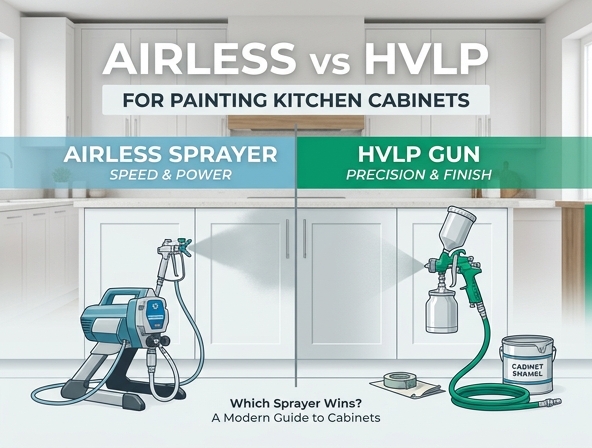
Refinishing kitchen cabinets is notoriously unforgiving. Standard brushes and rollers often leave behind unsightly lap marks, texture, and bristles, ruining the sleek aesthetic homeowners desire. Before selecting an application tool, however, one must consider the viscosity of modern cabinet coatings. Specialized waterborne alkyds and heavy latex paints behave differently under pressure than standard wall paints.
Utilizing the correct paint sprayer grants you the power to achieve a flawless, factory-smooth finish in a fraction of the time, instantly elevating your home's value. Yet, a high-end sprayer is not a magic wand; success still stipulates meticulous masking, proper material thinning, and controlled spraying technique. Whether you are coating intricate maple shaker doors or flat-panel oak cabinets, the tool must match the project scale.
Below, we break down the critical differences between Airless and HVLP systems to help you select the perfect match for your kitchen remodel.
Choosing the Right Paint Sprayer for Flawless Kitchen Cabinets
Kitchen cabinets are the focal point of your kitchen, and achieving a professional finish can dramatically elevate the value and aesthetic of your entire home. While brush marks and roller textures can make even high-end cabinets look cheap, a quality paint sprayer provides a seamless, factory-like surface. However, choosing the right tool for the job is a common dilemma. The debate between Airless paint sprayers and HVLP (High Volume Low Pressure) paint sprayers is central to this decision, as each technology offers distinct advantages depending on your budget, skill level, and project scope.
Understanding Airless Paint Sprayers: Power and Speed
Airless paint sprayers operate by pumping paint at incredibly high pressures, typically ranging from 1,500 to 3,000 PSI, through a very small fluid tip. This intense force shears the liquid paint into a fine mist without relying on compressed air. This mechanism makes them incredibly efficient for specific types of painting tasks.
- High pressure allows the sprayer to draw paint directly from a one-gallon or five-gallon bucket.
- They can handle unthinned, heavy-viscosity paints like latex and heavy primers easily.
- The speed of application is unmatched, making them ideal for large surface areas.
Understanding HVLP Paint Sprayers: Precision and Control
HVLP stands for High Volume Low Pressure. These sprayers utilize a high volume of air at a very low pressure, typically around 10 PSI or less, to atomize the paint. This gentle volume of air shapes the paint into a highly controllable spray pattern, ensuring that the finish lands precisely where you aim it.
- Lower air pressure results in much less turbulence and far less overspray.
- They offer extreme precision, allowing you to paint intricate details and corners with ease.
- The high transfer efficiency means more paint lands on the cabinet and less is wasted in the air.
Finish Quality: Achieving the Factory-Smooth Look
When it comes to the doors and drawers of kitchen cabinets, the smoothness of the finish is paramount. An HVLP sprayer is widely recognized as the gold standard for achieving a true, high-end factory finish. Because HVLP systems atomize paint into incredibly fine droplets under low pressure, they lay down a thinner, more controlled wet film. This minimizes runs, sags, and orange peel texture on detailed woodwork.
An Airless sprayer can still produce a remarkably smooth surface, but its high-pressure output can lead to heavier paint application. This makes it slightly harder to achieve the same level of micro-atomization required for mirror-like cabinet finishes. While professional painters can achieve beautiful results with an airless unit by using fine-finish tips, the HVLP remains the superior choice for unmatched precision and detail work.
Overspray and Transfer Efficiency: Minimizing Waste and Mess
Overspray is the fine mist of paint that misses the target and floats into the surrounding air. When painting indoors, managing overspray is crucial to avoid ruining walls, floors, and appliances. HVLP sprayers offer a transfer efficiency of up to 65% to 80%, meaning most of the paint actually sticks to your cabinet doors.
Using an airless sprayer indoors requires extensive masking and containment work. You must seal off the room with plastic sheeting to prevent paint dust from settling elsewhere. If you prefer a simpler prep process with minimal cleanup, the HVLP is the clear winner for indoor residential projects.
Speed and Efficiency: Tackling Large Cabinet Projects
While HVLP excels in control, it falls behind when it comes to sheer speed. Airless sprayers are built for rapid coverage. If you have a large kitchen with dozens of cabinets, doors, drawers, and framework to paint, an airless sprayer will complete the spraying phase in a fraction of the time.
An airless sprayer can coat a cabinet door in seconds, making it the preferred tool for high-volume commercial painters and large-scale home renovations.
For small DIY projects, the speed of the airless sprayer might actually work against you, as it is easy to over-apply paint in a split second. However, for sheer productivity on massive jobs, the airless system remains undefeated.
Material Compatibility: Do You Need to Thin Your Paint?
The type of paint you choose heavily influences which sprayer you should use. Modern kitchen cabinets are often painted with heavy latex, acrylic-alkyd hybrids, or specialty polyurethane coatings. An airless sprayer handles these thick materials with ease without requiring any thinning. You can simply insert the suction tube into a can of latex paint or heavy primer and start spraying.
Conversely, HVLP sprayers struggle with high-viscosity paints. To get a smooth flow and prevent clogging, you must thin the paint with water or compatible solvents. You will need to use a viscosity cup to measure the flow rate and carefully mix the paint. This extra step requires patience, but it is necessary to avoid clogging the delicate fluid nozzle of your HVLP gun.
Cost and Learning Curve: DIYers vs. Professionals
The entry barrier for both sprayers varies significantly in terms of cost and the skills required to operate them safely and effectively.
| Feature | Airless Sprayer | HVLP Sprayer |
|---|---|---|
| Average Cost | Moderate to High | Low to Very High |
| Learning Curve | Moderate (Fast speed, hard to control) | Low (Slow speed, high precision) |
| Best Suited For | Professionals & Large Renovations | DIYers & Fine Finishes |
Airless systems demand careful technique because the high pressure can cause instant paint build-up and runs if your hand stops moving even for a second. HVLP systems are much more forgiving, allowing beginners to move at a slower, more comfortable pace while learning how to overlap their spray passes.
Step-by-Step Tips for Spraying Kitchen Cabinets
Regardless of the sprayer you choose, preparation is the absolute key to achieving a professional-grade finish on kitchen cabinets.
- Remove all doors, drawers, and hardware before painting to avoid drips and overspray on hinges.
- Clean thoroughly with a degreaser like TSP to remove kitchen grease and oils that prevent paint adhesion.
- Sand all surfaces with medium-grit sandpaper, then wipe away dust with a tack cloth.
- Apply a high-quality primer, especially if you are painting over laminate or dark wood.
- Spray in light, even coats, keeping the spray gun parallel to the surface at all times rather than arching it.
The Verdict: Airless vs. HVLP for Kitchen Cabinets
Choosing the ideal system comes down to your priorities: speed and power versus control and precision. For large projects with many cabinets where time is of the essence, an Airless sprayer equipped with a fine-finish tip is the most efficient choice, despite the extensive cleanup and prep work required.
If you are a homeowner tackling a DIY kitchen makeover and you want a flawless, furniture-grade finish with minimal mess, the HVLP sprayer is the superior option. It offers the gentle air pressure and refined control needed to create a smooth, streak-free surface that will make your kitchen look like it was styled by a professional designer.
Leave a comment