
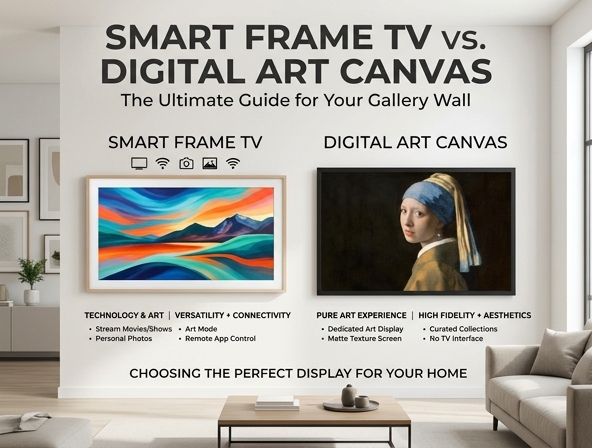
Designing a cohesive living space often presents a frustrating compromise: sacrificing your home's aesthetic to accommodate a massive, lifeless television screen that disrupts your decor. Historically, the gallery wall was a sanctuary for curated physical art, but modern design now demands a thoughtful bridge between analog beauty and digital convenience. Successfully blending these worlds grants you a dynamic, ever-changing canvas that elevates your interior design while retaining modern functionality.
However, achieving this integration requires understanding a key educational stipulation: a screen's ability to genuinely mimic physical art depends entirely on its panel technology and light diffusion. For instance, while a multi-functional smart TV like the Samsung The Frame offers dual-purpose entertainment, a dedicated digital art frame such as the Netgear Meural Canvas II prioritizes museum-grade matte textures and specialized lighting sensors.
To help you make an informed investment, this guide will analyze the technical performance, installation footprints, and art curation ecosystems of both options, ensuring you choose the perfect centerpiece for your ultimate modern gallery wall.
The Evolution of the Gallery Wall: Dynamic Art in the Modern Home
For centuries, the gallery wall has served as a static testament to personal taste, displaying a curated mix of oil paintings, family photographs, and cherished prints. However, the rise of modern digital technology is reshaping how we interact with art in residential spaces. No longer bound to fixed frames, homeowners are now embracing dynamic displays that can transition from a Renaissance masterpiece to a contemporary abstract painting with a single swipe.
This aesthetic shift has sparked an intriguing design dilemma: the choice between a multi-functional Smart Frame TV and a dedicated Digital Art Canvas. Both technologies promise to seamlessly blend into home decor while concealing their electronic components, yet they approach this mission from vastly different angles. As design and technology continue to merge, selecting the right device becomes paramount to creating an authentic, modern gallery wall experience.
Defining the Contenders: Smart Frame TV vs. Dedicated Art Canvas
To make an informed decision, one must understand how these two hardware categories differ in execution and intent. Each represents a distinct philosophy on how digital displays should inhabit our living spaces.
A Smart Frame TV is engineered as a hybrid device. It functions as a fully capable television, complete with streaming apps and gaming interfaces, but transitions into an art display when turned off. Its primary design philosophy is disguise-making a highly functional entertainment hub disappear into the background.
Conversely, a dedicated Digital Art Canvas is built from the ground up solely to display visual art. It lacks television tuners, streaming app stores, and traditional video inputs. Its core philosophy is purity, targeting art collectors and design purists who want a distraction-free digital canvas that looks as close to physical media as possible.
- Smart Frame TV target audience: Families and design-conscious homeowners seeking to reclaim living room space from large black screens.
- Digital Art Canvas target audience: Fine art enthusiasts, digital art collectors, and creators who prioritize museum-grade display fidelity.
Screen Technology: Matte Finishes, Glare, and Realism
The Anti-Glare Matte Surface
The illusion of real art hinges entirely on the screen's ability to diffuse light. Traditional television screens feature glossy finishes that reflect windows and light fixtures, immediately exposing them as electronic monitors. Modern smart frame displays and dedicated art canvases utilize advanced anti-glare matte finishes that scatter light across the panel, effectively mimicking the flat surface of paper or canvas.
Ambient Light Integration and Color Fidelity
An equally important element is the ambient light sensor. This sensor continuously monitors the brightness and color temperature of the room, adjusting the screen's backlighting in real-time. By dynamically matching the ambient conditions, the display ensures that white pixels look like paper under warm evening lamps rather than a glowing, unnatural blue. This precise calibration is what allows these screens to replicate the delicate texture of paint strokes and charcoal sketches with convincing depth.
Hardware Aesthetics: Bezels, Mounts, and the Cord Dilemma
The physical presence of the display must match its digital output. To fool the eye, these devices employ custom magnetic bezels that resemble traditional wood, metal, or plaster frames. When paired with ultra-thin, flush-to-wall mounting brackets, the gap between the wall and the display is virtually eliminated, replicating the exact posture of a hung painting.
The greatest threat to this aesthetic illusion is the power cord. Innovative manufacturers utilize proprietary, paper-thin clear cables that carry both power and data to an external connection box, which can be hidden inside a media console. Alternatively, dedicated art canvases often require in-wall routing systems or paintable flat cables to keep the installation completely seamless.
Curating Your Collection: Art Libraries and Custom Uploads
Subscription Ecosystems and Historical Archives
Having a high-fidelity display is only as good as the art shown on it. Smart frame manufacturers usually offer subscription-based models that grant access to thousands of classic and contemporary pieces licensed from world-renowned museums.
Personal Curation and Web3 Formats
For those looking to showcase personal creations, uploading high-resolution imagery is essential. While smart TVs rely on companion mobile apps, dedicated art canvases often feature more robust software interfaces designed to handle advanced digital formats.
- Browse the integrated digital storefronts or subscription libraries to license museum-quality masterpieces.
- Upload high-resolution personal photography and family portraits via a dedicated mobile app.
- Connect digital Web3 wallets to display owned NFTs and digital-native artwork with secure verification.
Power and Efficiency: The Cost of 24/7 Display
Displaying art continuously requires constant power, raising valid concerns about electricity bills and component longevity. Leaving a standard display active all day can quickly add up, making energy-efficient hardware features essential for any continuous gallery wall installation.
To combat this, modern systems utilize highly sensitive motion sensors that automatically power down the display when a room is vacant, instantly reactivating it the moment someone enters. Integrated timers allow users to schedule active hours, while eco-modes dynamically lower power draw based on ambient dimness, protecting both your wallet and the lifespan of the screen's LED array.
Dual-Purpose Entertainment vs. Pure Aesthetic Focus
The Multi-Functional Entertainment Hub
A smart frame TV excels at versatility. It serves as the visual centerpiece of a living room, easily transitioning from a digital painting to a live sports broadcast, 4K movie streaming, or video game interface. This dual functionality saves physical space and eliminates the need for separate entertainment setups.
The Distraction-Free Art Sanctuary
Conversely, the dedicated art canvas remains entirely unbothered by notifications, updates, or entertainment inputs. It provides a serene, non-intrusive presence that honors the purity of the art, ensuring your curated space is never interrupted by system alerts or accidental menu overlays.
- Versatile smart frames combine home theater capabilities with ambient aesthetic displays.
- Dedicated canvases focus entirely on zero-latency, distraction-free art presentation.
Designing the Layout: Integrating Digital Frames into Physical Gallery Walls
Achieving perfect visual balance requires careful planning when mixing physical and digital art. When placing a digital frame alongside traditional oil paintings, watercolors, and physical prints, scale and spacing become your most powerful tools. Keeping the spacing consistent across all frames helps unite the diverse mediums into a cohesive visual statement.
"The key to a successful mixed-media gallery wall is balancing the visual weight. A glowing digital screen, even with a matte finish, naturally draws the eye first, so it should be balanced by larger or more textured physical pieces on the opposing side."- Lead Designer, Modern Spaces Studio
Investment and Longevity: Price Points and Lifespan
The total cost of ownership goes far beyond the initial price tag on the box. When evaluating which option fits your long-term interior design goals, you must factor in the price of specialized frames, mounting kits, recurring subscription fees for art databases, and the expected lifespan of the display panel before technological obsolescence sets in.
| Metric | Smart Frame TV | Dedicated Art Canvas |
|---|---|---|
| Average Hardware Cost | Medium to High ($1,000 - $2,500) | Low to Medium ($400 - $1,200) |
| Art Subscription Cost | Monthly recurring fee ($4.99 - $7.99/mo) | Optional free tier or annual premium pass |
| Hardware Lifespan | 5 to 7 years (due to smart OS updates) | 6 to 8 years (focused solely on static display) |
The Final Verdict: Choosing the Centerpiece for Your Space
Your choice between these two advanced technologies depends on how you intend to use your space. If your goal is to maximize the utility of your primary living area, a Smart Frame TV provides the ideal compromise. It allows you to enjoy premium home entertainment when desired, while gracefully hiding the screen behind stunning masterpieces when the TV is off.
For those dedicating a quiet space, hallway, or dining room specifically to visual culture, the Dedicated Art Canvas remains the superior option. Its focus on matte realism, museum-quality texture replication, and freedom from standard television distractions ensures your gallery wall retains its authentic, artistic soul. Assess your lifestyle, select your frames, and let your walls tell your story.
Leave a comment