
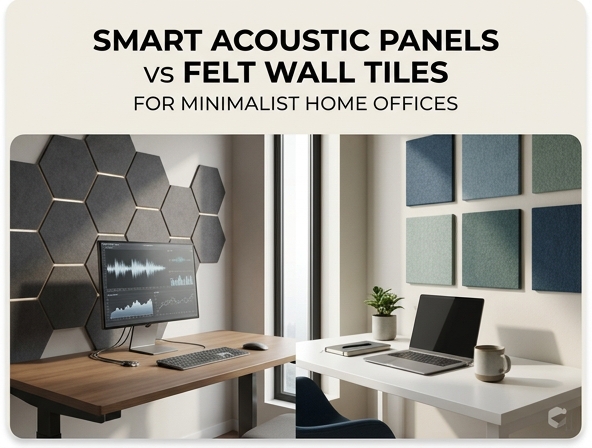
Many remote professionals struggle to maintain focus during video calls due to distracting echoes and hollow room acoustics. This frustration is particularly common in modern, minimalist home offices, where clean design lines and hard surfaces-like hardwood floors and bare drywall-unintentionally amplify every keyboard clack and distant siren.
Selecting the right wall treatment restores acoustic balance, granting you professional-grade audio clarity without sacrificing your design aesthetic. However, a key distinction must be made: acoustic treatment is not about soundproofing a room to block external noise entirely, but rather managing internal sound reflections to improve overall clarity.
Whether you need to tame the echo of a Zoom presentation or silence the ambient hum of household activities, choosing between active, app-controlled smart acoustic panels and sleek, passive felt wall tiles can be challenging. Below, we evaluate both options across design integration, sound absorption performance, and budget to help you select the ideal solution for your workspace.
Introduction: The Quest for Quiet in the Minimalist Workspace
In the modern home office, visual clutter is often the first distraction we eliminate, yet auditory clutter remains a persistent, invisible disruptor. A truly minimalist workspace is not just about clean lines and empty desks; it is about creating a sensory sanctuary where focus can flourish. Achieving proper sound control is essential for maintaining concentration, reducing cognitive fatigue, and ensuring crystal-clear communication during virtual collaborations.
As professionals seek to harmonize acoustic performance with design restraint, two primary contenders have emerged: Smart Acoustic Panels and Felt Wall Tiles. While one leverages active technology and dynamic lighting to define the space, the other relies on tactile simplicity and passive acoustic dampening. Choosing between them requires balancing functional utility with your personal aesthetic philosophy.
Understanding Smart Acoustic Panels: Tech-Driven Sound Control
Smart acoustic panels represent a fusion of architectural design and active environmental control. Unlike traditional static treatments, these systems are engineered to integrate seamlessly into a modern smart home ecosystem, offering both sound modification and visual feedback.
- Active Sound Management: Engineered to disperse sound waves while responding in real-time to ambient room noise.
- Customizable LED Lighting: Features integrated, multi-colored backlighting capable of displaying millions of colors to match your workflow.
- App-Controlled Ecosystem: Managed entirely via dedicated mobile apps or desktop software, allowing users to schedule illumination patterns, adjust sound profiles, and sync visuals to media.
Exploring Felt Wall Tiles: Tactile Simplicity and Elegance
Felt wall tiles offer an elegant, low-tech alternative that embraces physical texture and quiet simplicity. These tiles prioritize silent utility, relying on natural and engineered fibers to soften both the visual and auditory harshness of a room.
- Recycled PET Composition: Crafted primarily from compressed, post-consumer recycled plastic bottles, resulting in a dense, felt-like texture.
- Passive Sound-Dampening: High-density fiber structures absorb medium-to-high frequency sounds, drastically reducing room echo and flutter.
- Modular Geometric Configurations: Available in various shapes like hexagons, squares, and triangles, allowing for infinite creative layouts without visual noise.
Visual Design: Sleek Tech vs. Organic Texture
The Futuristic Glow of Smart Panels
Smart panels bring a distinct, sci-fi aesthetic to the home office. With their crisp lines, hard geometric casing, and sharp LED arrays, they create a futuristic accent wall. When illuminated, they emit a clean-lined glow that can transform from a cool energizing blue during the day to a warm amber in the evening, functioning as both art and task lighting.
The Matte Warmth of Felt Tiles
Felt wall tiles champion a softer, more grounded design language. The organic texture of compressed fiber absorbs light rather than emitting it, presenting a rich, matte finish that adds depth without distraction. The lack of cables, plastic bezels, or light sources creates a quiet warmth, grounding the minimalist workspace in natural comfort.
Acoustic Efficiency: Decibels and Dampening
Passive Fiber Absorption
For high-frequency noise mitigation, felt tiles excel by trapping sound waves within their porous, multi-layered recycled fibers. This reduces the bounce of typing, clicking, and vocal sibilance, creating a quiet, dampened atmosphere ideal for deep focus work.
Active Soundscapes and Diffusion
Smart panels address acoustics from a multi-dimensional angle. While their outer casings provide mild sound diffusion to scatter direct reflections, their primary strength lies in creating an immersive soundscape. By integrating with audio systems, they can emit counter-frequencies or soothing white noise masks that digitally neutralize distracting external sounds.
"The goal of acoustics in a minimalist space is not absolute dead silence, but rather the elimination of distracting peaks and harsh reflections."
Installation and Spatial Flexibility
Peel-and-Stick Modularity
Felt tiles are designed for effortless setup. Utilizing simple pressure-sensitive adhesive backing, they can be applied directly to almost any wall surface. This lightweight, peel-and-stick approach requires no specialized tools, leaving walls undamaged and allowing for quick adjustments if you decide to change the pattern.
Hard-Wired Precision
Smart panels demand a more methodical installation process. They require mounting brackets, anchors, and precise alignment to ensure the electrical contact pins connect properly between tiles. Additionally, users must plan for power routing and cable management to hide the main power cord, maintaining the clean lines of a minimalist desk setup.
Smart Integration: Building an Interactive Environment
For the connected professional, smart panels serve as a physical dashboard for productivity. By syncing with platforms such as Apple HomeKit, Google Home, and Amazon Alexa, these panels can be programmed to reflect the state of your workday. Lighting cues can signal when a meeting is starting, change colors to indicate "Do Not Disturb" status to family members, or shift dynamically with desktop sync software to mirror the colors on your monitor, reducing eye strain during late-night coding or design sessions.
Sustainability and Eco-Impact
As environmental responsibility becomes central to design, the ecological footprint of office accessories cannot be ignored. Felt wall tiles stand out as an eco-friendly option. Manufactured from up to 60% recycled PET plastics, they divert waste from landfills and require minimal energy to produce, presenting a circular lifecycle that appeals to eco-conscious minimalists.
In contrast, smart panels involve a more intensive manufacturing process. Incorporating printed circuit boards, plastic housings, and LED components, they contribute to electronic waste at the end of their lifecycle. Furthermore, their continuous operational power consumption adds a recurring, albeit small, environmental cost over years of use.
Cost-Benefit Analysis: Upfront Investment vs. Long-Term Value
Budget allocation plays a significant role when configuring an office layout. Balancing the sophisticated capabilities of technology against simple physical materials reveals a stark contrast in value propositions:
- Smart Panel Premium: High initial cost due to microprocessors, LED hardware, and software development, making large-scale wall coverage a significant financial commitment.
- Felt Tile Scalability: A highly economical, budget-friendly alternative that allows users to start small and purchase additional modular tiles as resources permit.
- Depreciation vs. Longevity: Felt tiles suffer no software obsolescence and will function indefinitely, whereas smart panels rely on ongoing app updates and hardware compatibility.
The Verdict: Matching Your Minimalist Philosophy
The Case for High-Tech Warm Industrial
If your version of minimalism embraces clean lines, dynamic workspaces, and seamless automation, smart panels are the ideal choice. They elevate a high-tech, modern workspace, providing interactive visual stimulation and system-wide integration that complements a connected lifestyle.
The Case for Soft Minimalist Sanctuaries
If your primary goal is a tactile, distraction-free environment that emphasizes natural materials and silent serenity, felt wall tiles are unmatched. They craft a soft, warm minimalist sanctuary that allows your mind to rest, focusing entirely on your work without the constant stimulation of glowing screens and LEDs.
Leave a comment