
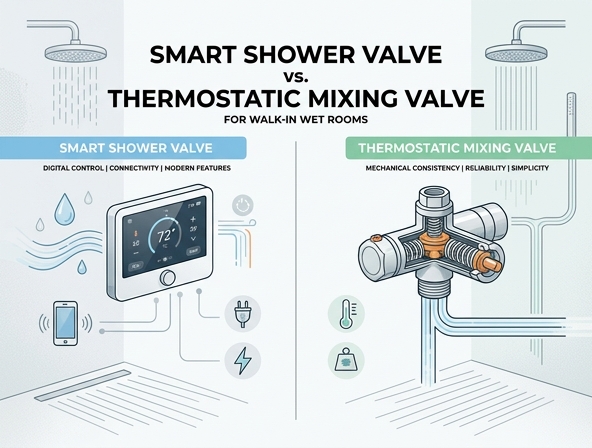
Designing a modern walk-in wet room often introduces a frustrating compromise between minimalist aesthetics and reliable temperature control, leaving homeowners to battle sudden, jarring water temperature spikes. Before selecting your brassware, however, it is crucial to understand how contemporary water delivery systems integrate with behind-the-wall infrastructure.
Choosing the correct control technology grants unmatched thermal precision, elevating a standard daily shower into a highly personalized, safe sanctuary. Of course, the efficacy of any premium valve remains contingent upon your property's existing water pressure and boiler system. For instance, feeding a multi-outlet rainfall system via a smart console like the U by Moen requires vastly different structural preparation than installing a traditional, mechanical Grohe Grohtherm thermostatic mixing valve.
This article will evaluate smart shower valves against thermostatic mixing valves across installation complexity, user experience, and long-term reliability, helping you specify the ideal system for your wet room project.
The Wet Room Revolution: Choosing the Ultimate Water Control
The modern bathroom has undergone a dramatic evolution, transitioning from a purely functional utility space into a private wellness sanctuary. At the forefront of this movement is the walk-in wet room. Characterized by continuous tiling, flush floor drains, and expansive open space, the contemporary wet room strips away the physical barriers of traditional shower enclosures. However, creating a flawless open-concept shower environment requires more than just beautiful stone tiles and high-end drainage systems. It demands precise management of the active element: water.
Managing water temperature and flow rate is the foundation of any luxury shower experience. In a wet room, where barriers are absent, poor water control can lead to temperature fluctuations, unexpected splashing, or hazardous slip conditions. Homeowners planning a renovation are presented with two primary control technologies: traditional Thermostatic Mixing Valves (TMVs) and modern Smart Shower Valves. While TMVs rely on time-tested mechanical reliability to protect users and blend water, smart systems leverage cutting-edge smart technology to deliver digital precision, custom user profiles, and seamless integration into the modern smart home ecosystem. Choosing between these systems is a decision that impacts the luxury, daily functionality, and future-proofing of your home.
Decoding the Thermostatic Mixing Valve (TMV)
The Mechanics of Mechanical Precision
Thermostatic Mixing Valves (TMVs) have served as the benchmark for safe, reliable showering for decades. At its core, a TMV is a mechanical device designed to blend hot and cold water supplies to a designated, safe output temperature. Unlike basic manual valves, which simply open the hot and cold lines to fixed positions, a TMV continuously self-adjusts to maintain stable temperatures even when other appliances in the household alter the supply pressure.
To achieve this constant regulation without electrical power, TMVs utilize physical thermal expansion elements. The heart of the valve contains a specialized wax cartridge or a liquid-filled capsule that is highly sensitive to temperature variations. When the incoming water temperature changes, the wax or liquid expands or contracts. This physical movement drives a sliding piston that dynamically restricts or increases the flow of the hot and cold water inlets, balancing the output mixture in real-time.
This mechanical system is highly regarded for its robust durability and long-term reliability. Because they operate independently of household electricity, TMVs remain fully functional during power outages and are less vulnerable to the component degradation that can affect digital electronics in high-moisture environments.
- Wax Thermostatic Element: The primary sensor that expands and contracts based on water temperature.
- Sliding Piston / Shuttle: The internal component moved by the wax element to throttle hot and cold water inlets.
- Return Spring: Instantly pushes the piston back when water temperatures cool, ensuring a continuous safety loop.
- Non-Return Valves (Check Valves): Prevent the backflow of hot water into cold lines and vice versa.
- Inlet Strainers: Mesh filters that trap debris before it can interfere with the physical movement of the internal valve piston.
Unveiling the Smart Shower Valve
Technical Features of Digital Water Regulation
Smart Shower Valves represent the digital frontier of bathroom design. These systems replace traditional physical mixing cartridges with advanced electronic actuators and digital processors. Instead of turning a manual lever to adjust a wax element, the user interacts with an electronic wall controller, a smartphone application, or a voice command helper to set a precise target temperature.
The digital architecture of a smart shower separates the user interface from the actual water-mixing hardware. The smart valve itself-often a compact, motorized unit-is installed behind the wall, in a vanity unit, or even in an adjacent airing cupboard or loft space. Inside this unit, high-precision temperature sensors monitor the incoming water streams. A microprocessor recalculates the optimal mix hundreds of times per second and commands rapid-acting electronic stepper motors to position the ceramic dynamic discs. This digital loop ensures that water arrives at the showerhead at the exact degree selected, while also allowing users to control flow rates down to precise percentage increments.
Beyond basic temperature management, smart shower valves integrate directly with modern home automation networks. Utilizing built-in Wi-Fi and Bluetooth modules, these systems communicate with smart home hubs, allowing users to pre-heat their showers remotely, track aggregate water consumption, and establish custom profiles that configure spray heads, lighting, and music simultaneously.
Design and Aesthetics: Minimalist Integration in Wet Rooms
A primary goal of modern wet room design is the creation of a clean, uninterrupted visual plane. The choice of valve plays a major role in achieving this minimalist aesthetic, as it dictates how much hardware must be physically mounted on the finished wet room walls.
Traditional TMVs require a physical wall-plate interface directly inside the shower zone. Because the user must turn dials to adjust the internal mechanical parts, these plates carry a certain level of physical depth and footprint. While manufacturers offer beautifully finished concealed TMVs where the valve body is buried in the wall, the external plate still features prominent metallic levers, handles, or knobs. This can create a classic, tactile look, but it can break up the sleek, continuous stone or tile surfaces of ultra-modern wet rooms.
In contrast, Smart Shower Valves excel at preserving minimalist aesthetics. Because the actual mixing processor is located in a remote, easily accessible location, the interface in the wet room can be incredibly streamlined. Homeowners can install ultra-thin, flush-mounted glass controllers that sit nearly flat against the tile. Some smart systems even allow for entirely wireless, battery-operated controllers that can be placed anywhere in the wet room, completely free of hardwired location constraints. This layout keeps visible hardware to a minimum, ensuring the focus remains on the texture of the tiles and the architectural lines of the space.
"True minimalism in wet room design is about removing physical obstacles. By relocating the mechanical mixing body away from the wet zone, digital interfaces allow the architecture of the shower to speak for itself without the visual clutter of heavy brass dials."
Water Conservation and Eco-Efficiency
As sustainability becomes a central pillar of modern residential design, the eco-efficiency of shower systems is under closer scrutiny. Both mechanical and digital valves offer pathways to conservation, though they approach the challenge through different technologies.
Thermostatic Mixing Valves contribute to water conservation primarily by reducing the time spent adjusting water temperatures manually. Because the valve balances the temperature almost instantly, users do not have to let gallons of water run down the drain while trying to find the comfortable zone. Additionally, many high-quality TMVs feature physical "eco-stops"-mechanical buttons on the flow control dial that restrict water flow to a sensible, pre-set limit (often around 50-60% of maximum flow) unless the user consciously presses the override button to access full pressure.
Smart Shower Valves, however, offer a much more sophisticated suite of water-saving features. Through digital customization, smart systems allow users to track their exact water usage in real-time or view historical consumption data via a companion mobile app. Furthermore, smart valves can be programmed with eco-friendly defaults, such as automatic shut-off timers that gently turn off the water after a set period, or "warm-up pauses" that hold the water at the valve once it reaches the target temperature, only releasing it to the showerhead when the user physically steps in and presses a button. This eliminates the water wasted while waiting for a shower to warm up.
Precision Control and Safety: Preventing Thermal Shock
In an open-concept wet room, maintaining steady water temperature is not merely a matter of luxury-it is a critical safety requirement. Sudden changes in water pressure, caused by a toilet flushing or a washing machine starting elsewhere in the house, can result in sudden, painful temperature spikes or drops, commonly known as thermal shock.
Thermostatic Valve Safety Profile
A TMV provides rapid protection against thermal shock through its physical mechanics. If the cold water supply drops suddenly, the wax capsule reacts within milliseconds to shut off the hot water inlet completely. This physical fail-safe prevents scalding water from reaching the user. Because this process is entirely self-contained and mechanical, there is zero risk of system lag due to software crashes, power fluctuations, or electrical interference.
Smart Valve Safety Profile
Smart valves manage safety through digital thermistors and motorized shut-offs. While incredibly precise, the system relies on electronic communication between the sensors and the actuator motors. Under normal operation, a smart valve can maintain temperatures within a fraction of a degree. However, in the rare event of a sudden, total power failure or sensor glitch, the system requires a built-in battery backup or an automatic, spring-loaded default state to guarantee instant safety shut-off. Most certified smart valves feature high-speed digital shut-off protocols that match or exceed traditional mechanical standards.
| Valve Technology | Reaction Mechanism | Avg. Response Time to Pressure Drop | Power Dependency for Safety |
|---|---|---|---|
| Thermostatic Mixing Valve (TMV) | Thermal Wax Expansion / Mechanical Piston | < 1.0 Second | Completely Independent (No electricity required) |
| Smart Shower Valve | Electronic Thermistor & Motorized Actuators | < 0.5 Seconds | Dependent (Requires mains power or battery backup) |
Installation Complexity and Behind-the-Wall Requirements
The practicalities of installation are a major factor when deciding between these two valve categories, particularly in wet room configurations where plumbing is permanently sealed behind waterproof membranes and tiling.
Step-by-Step System Preparation
Traditional TMVs require straightforward but precise plumbing work. The valve body is directly plumbed to the hot and cold water pipes within the wall cavity. Once installed, tested, and sealed behind the waterproofing system, accessing the valve body for major repairs can be challenging, though high-quality models feature front-access cartridges that can be serviced by simply removing the external wall plate.
Smart Shower Valves require a different, multi-trade installation approach. Because the digital valve unit is housed away from the wet room, plumbers must run pipework from the remote valve location to the shower outlets in the wet room. Additionally, an electrician must install a dedicated, GFCI-protected electrical outlet near the remote processor box to power the control board and motorized valves. Low-voltage data cables must then be routed from the processor to the wall-mounted controller inside the wet room, or wireless pairing must be established.
- Ensure the wet room wall cavity has sufficient depth (typically 3 to 4 inches) for concealed TMV body mountings.
- Locate an accessible, dry area (e.g., an airing cupboard, loft, or under-sink space) to install the smart valve processor unit.
- Verify that a reliable 110V/220V power supply with GFCI protection is available near the smart processor location.
- Confirm the local Wi-Fi signal strength at both the processor and the controller locations to avoid connectivity drops.
- Ensure waterproof membranes are correctly sealed around the low-voltage cable conduits or TMV wall brackets before tiling.
User Experience: Tactile Feedback vs. Digital Customization
The daily interaction with a shower valve shapes the overall sensory experience of your wet room. The choice between mechanical and digital systems ultimately comes down to a preference for tactile, physical control versus customizable, automated convenience.
Operating a Thermostatic Mixing Valve offers a deeply satisfying, classic experience. Turning a solid metal dial provides instant, intuitive physical feedback. There are no menus to navigate, no screens to wake up, and no apps to load. You simply twist the lever, feel the *reassuring mechanical drag* of the internal cartridge, and enjoy the water. For many users, this *tactile simplicity* represents the peak of stress-free relaxation, requiring no learning curve or tech troubleshooting.
Smart valves replace this tactile simplicity with unparalleled digital customization. Imagine waking up, tapping a button on your bedside table, and hearing your shower pre-heat to your precise preference of 101°F. When you step into the wet room, the water is already at the perfect temperature, pausing its flow to conserve water until you step underneath. Through multi-user presets, different family members can save their preferred combination of temperature, flow rate, and active spray outlets. For tech-focused users, the *sleek touch panel interfaces* and *seamless voice commands* offer a futuristic, highly tailored daily ritual.
Cost Analysis: Upfront Investment vs. Long-Term Value
Budget considerations play a significant role in any wet room design. Understanding the full cost of ownership-including initial purchase price, labor, and future maintenance-helps ensure a balanced investment.
Thermostatic Mixing Valves represent a highly cost-effective and durable solution. A premium, designer-grade concealed TMV can be purchased for a moderate price. Because installation only requires standard plumbing work without electrical wiring, labor costs remain low. Maintenance is also straightforward; if the internal cartridge fails after years of service, a plumber can easily swap it out from the front of the wall plate, representing unbeatable budget longevity and predictable long-term costs.
Smart Shower Valves require a substantially higher upfront investment. The digital processor and controller kit carries a premium price point, which is further increased by the multi-trade installation costs of coordinating both a plumber and an electrician. However, smart valves can deliver significant long-term value through their water-saving features and remote diagnostic capabilities. If an issue occurs, the digital system can often run self-diagnostics to pinpoint the exact component failure, reducing troubleshooting labor. While the initial investment is higher, the system represents a high-end value investment that can elevate home resale value and appeal to modern buyers.
The Verdict: Selecting the Perfect Valve for Your Wet Room
Choosing the ideal water control system for your walk-in wet room depends on your design goals, family needs, and renovation budget. Both systems excel in delivering safety and temperature stability, but they cater to very different lifestyles.
The Budget-Conscious Renovator
If you prioritize simple, reliable, and cost-effective luxury, a high-quality Thermostatic Mixing Valve is the logical choice. It offers excellent safety, classic aesthetics, and simple maintenance without requiring complex wiring or a large upfront budget.
The High-Tech Luxury Seeker
For those building a state-of-the-art wet room where clean design lines, smart integration, and custom luxury are paramount, a Smart Shower Valve is the ideal option. Its ability to tuck away physical pipework while offering custom presets, voice activation, and consumption tracking represents the cutting edge of bathroom design.
The Multi-Generational Household
In homes where safety and ease of use are critical across multiple generations, both valves perform exceptionally well. However, a smart valve configured with precise maximum temperature limits and simple, one-touch presets can offer unmatched peace of mind for children and elderly family members alike.
Balancing your priorities around reliability, user profile tailoring, and long-term asset protection will guide you to the perfect water control system, transforming your wet room into a highly functional personal spa.
Leave a comment