
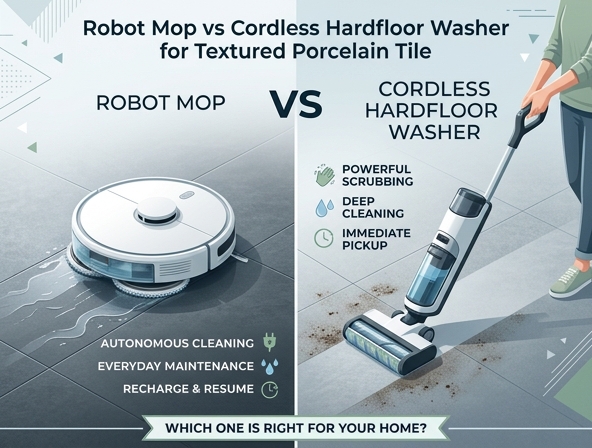
Textured porcelain tile offers stunning slip-resistant beauty, yet keeping its microscopic ridges clean is a constant, frustrating battle. Traditional mopping often fails, merely pushing dirty water deeper into the tile's crevices.
While this durable flooring is highly prized for modern homes, maintaining its pristine look requires a specialized approach. Finding the right cleaning technology promises to restore your floor's original luster while reclaiming your valuable time. However, a crucial educational stipulation remains: no single device is a magic wand. The ideal choice depends on balancing autonomous convenience against the heavy-duty agitation required for deep textures.
For example, tackling dried muddy paw prints embedded in wood-look tile grooves or fine pet hair trapped along grout lines requires specific physical mechanics. To help you make the right investment, this guide directly compares robot mops and cordless hardfloor washers across scrubbing power, maneuverability, and maintenance to crown the ultimate textured tile champion.
Introduction: The Challenge of Cleaning Textured Porcelain Tile
Textured porcelain tile has become a premier choice for modern homeowners seeking the perfect blend of durability and aesthetic elegance. With finishes that realistically mimic natural stone, rustic wood, or industrial concrete, these tiles add depth, character, and vital slip-resistance to high-traffic areas. However, that beautiful tactile surface comes with a hidden cost: maintenance. Unlike smooth ceramic, the physical peaks and valleys of textured tile act as magnets for dust, grease, and household grime.
Keeping these intricate surfaces clean turns a simple household chore into an ongoing battle against trapped dirt. Standard cleaning methods often fall short, leaving homeowners frustrated by lackluster results. To solve this problem, two distinct technological contenders have emerged in the floor care market: autonomous Robot Mops and heavy-duty Cordless Hardfloor Washers. The core dilemma lies in deciding whether the hands-free convenience of automation can truly match the deep-cleaning muscle of manual scrubbing when tackling highly textured surfaces.
Why Textured Porcelain Tile Demands Special Attention
The very features that make textured porcelain tile so appealing also make it incredibly stubborn to clean. Unlike flat surfaces, textured tiles possess microscopic pockets, crevices, and ridges designed to provide traction and visual depth. Over time, daily foot traffic forces fine dust, pet dander, and moisture deep into these low points, where they dry and bond to the tile surface.
Traditional mopping methods fail to address this issue because standard string or flat mops merely glide over the raised ridges of the tile, skipping over the lower recesses entirely. This process often ends up redistributing dirty water into the microscopic valleys and grout lines rather than lifting it away. The unique maintenance challenges of textured tile include:
- Micro-Crevice Trapping: Fine dirt particles settle in the deep recesses of the textured pattern, out of reach of standard flat pads.
- Friction and Wear: Rough tile textures act like sandpaper, shredding delicate mop fibers and leaving behind unsightly lint.
- Grout Line Discoloration: Excess dirty water naturally flows into the lowest points (the grout lines), drying into a dark, stubborn film.
- Chemical Film Build-up: Overusing cleaning solutions in an attempt to dissolve dirt often leaves a sticky residue that attracts even more grime.
Robot Mops: Hands-Free Convenience or Surface-Level Shine?
Robot mops promise to liberate homeowners from manual labor by utilizing smart navigation, internal water reservoirs, and automated scrubbing mechanisms. These compact devices navigate around furniture, map out cleaning zones, and execute scheduled cleanings with zero physical effort required from the user. Most modern robot mops rely on vibrating plates or dual spinning microfiber pads to agitate dirt, paired with a slow drip or spray of water to loosen surface grime.
While these machines excel at daily dust mitigation and maintaining a baseline level of cleanliness on smooth floors, textured porcelain presents a significant hurdle. Because robot mops are lightweight, they lack the downward physical pressure needed to force cleaning pads deep into tile crevices. The pads often skim over the peaks of the textured pattern, leaving the trapped dirt in the valleys untouched. Despite these limitations on rough textures, robot mops offer compelling benefits for busy lifestyles, particularly through their automated scheduling, smart obstacle avoidance, and continuous surface maintenance capabilities.
Cordless Hardfloor Washers: Heavy-Duty Scrubbing Power
Cordless hardfloor washers are engineered specifically to tackle tough, stubborn grime through active scrubbing and powerful suction. Unlike a passive mop pad, these machines use a high-speed motorized brush roller that spins at hundreds of revolutions per minute. This rapid mechanical action allows the bristles to flex and penetrate directly into the uneven textures and dips of textured porcelain tile.
What sets these washers apart is their active dual-tank design, which ensures that dirty water is never reintroduced to the floor. The machine continuously feeds clean water and specialized cleaning solution to the brush roller while instantly vacuuming the dirty slurry off the tile and into a separate recovery tank. Key hardware components driving this deep-cleaning process include:
- High-RPM Motorized Brush Roller: Rapidly agitates the floor surface, pulling dirt out of deep crevices with mechanical force.
- Dual-Tank System: Completely separates clean water from dirty recovery water, ensuring a sanitary wash.
- Powerful Vacuum Suction: Pulls moisture and suspended dirt out of tile valleys and grout lines, leaving floors dry within minutes.
- Ergonomic Cordless Body: Offers total maneuverability around home obstacles without the restriction of power cords.
Head-to-Head: Scrubbing Power on Textured Surfaces
To understand how these devices perform on textured porcelain tile, we must look at the physical mechanics of how they interact with the floor. Below is a direct comparison of the cleaning dynamics between typical robot mops and cordless hardfloor washers.
| Cleaning Metric | Robot Mop (Spinning/Vibrating Pads) | Cordless Hardfloor Washer (Motorized Roller) |
|---|---|---|
| Downward Pressure | Minimal (relies solely on the lightweight body of the robot) | High (leveraged by user weight and motor housing) |
| Brush/Pad Speed | Low to Moderate (vibrations or slow spins) | Very High (typically 400 to 500 RPM) |
| Surface Contact | Skims the surface peaks; struggles in deep valleys | Conforming brush fibers flex deep into crevices |
| Debris Extraction | Absorbed into flat microfiber pad (limited capacity) | Squeegeed and vacuumed instantly into a recovery tank |
Automation vs. Manual Labor: The Usability Factor
Choosing between these two appliances often comes down to a fundamental trade-off: your time versus the level of cleanliness achieved. Robot mops represent the peak of convenience, functioning as a set-it-and-forget-it solution. They run silently in the background while you work, sleep, or relax, making them incredibly easy to integrate into a busy routine. “I love being able to run the robot mop from an app while I am out of the house,” many busy professionals note, finding comfort in the automated upkeep of their living spaces.
In contrast, a cordless hardfloor washer requires your active participation. You must guide the machine across the floor, fill the clean water tank, and empty the dirty recovery chamber after every session. It demands physical effort, but it delivers instantaneous, dramatic results. For those who view cleaning as a highly targeted task, the perspective shifts: “It takes me fifteen minutes of physical effort, but the sheer volume of black water I empty from the tank tells me my textured floors are genuinely clean.”
Deep Dive: Tackling Dirty Grout Lines and Crevices
Grout lines are the deepest channels on any tiled floor, making them the natural collection point for dirty water and settling dust. Because textured porcelain tiles also feature micro-crevices across their faces, a cleaning device must have the ability to penetrate below the top plane of the tile and extract dirty water out of these recessions.
Robot mops struggle significantly in this arena. Because they lack a vacuum suction system, they rely on the absorption capacity of their microfiber pads. When a robot mop crosses a grout line or deep texture pocket, the pad cannot compress deeply enough to reach the bottom of the channel, often skimming right over the dirt. Conversely, cordless hardfloor washers utilize high-powered vacuum motors alongside their spinning brushes. Superior water extraction is the single most important factor in preventing dirty water from settling back into porous grout lines. The vacuum squeegee of a hardfloor washer pulls the suspended dirt and dirty water out of the tile valleys and grout lines, leaving no residue behind to dry and discolor.
Post-Clean Maintenance: Which Device is Easier to Clean?
A cleaning machine is only helpful if keeping the machine itself clean does not become an exhausting chore. Both systems require regular maintenance to prevent odors and maintain peak performance, but their workflows differ substantially.
To keep these devices functioning properly, users must perform specific sequential maintenance steps after cleaning sessions:
- Robot Mop Maintenance:
- Remove the dirty microfiber pads and place them in the washing machine.
- Empty and rinse the small onboard water reservoir to prevent stagnant odors.
- Clear any hair wraps from the small underside wheels and navigation sensors.
- Wipe down the charging dock and empty the auto-wash station's dirty water tank (if equipped).
- Cordless Hardfloor Washer Maintenance:
- Place the washer on its storage tray and initiate the automated hands-free self-cleaning cycle.
- Remove, empty, and thoroughly rinse the dirty water recovery tank to eliminate accumulated sludge.
- Remove the brush roller cover and wipe away any trapped debris from the suction channel.
- Place the brush roller in its designated drying stand to prevent musty smells and bacteria growth.
Investment vs. Value: Budgeting for Your Floor Care
When analyzing the cost of ownership, homeowners must look past the initial price tag and consider ongoing consumable costs and the lifespan of the equipment. High-end robot mops with self-cleaning docks represent a premium investment, often carrying a high initial purchase price. Additionally, owners must factor in the recurring cost of replacement microfiber pads, specialized cleaning solutions, and eventual battery replacements over the robot's lifetime.
Cordless hardfloor washers generally demand a lower to moderate initial investment compared to fully automated robotic docking systems. While they still require consumable items like specialized, low-foaming cleaning formulas and replacement brush rollers, their mechanical simplicity often leads to a longer operational lifespan. Investing in a cordless hardfloor washer yields a high return on investment because it acts as a true deep-cleaning machine, reducing the need for professional tile stripping and sealing services over time.
The Final Verdict: Which is Best for Textured Porcelain?
Textured porcelain tile is a demanding floor surface that exposes the structural limitations of surface-level cleaning. While robot mops offer unparalleled convenience and serve as excellent tools for daily dust maintenance on flat surfaces, they lack the physical downward pressure, brush speed, and vacuum suction required to dislodge and remove deep-seated dirt from textured crevices and grout lines.
For homes with extensive textured porcelain tile installations, we recommend the cordless hardfloor washer as the superior cleaning system. Its combination of high-speed motorized scrubbing, targeted physical pressure, and powerful dirty water extraction is uniquely suited to pull embedded dirt out of micro-textures, keeping your tiled floors looking pristine and sanitary for years to come.

Leave a comment