
Achieving consistent comfort in a multi-story home is a notorious struggle; homeowners frequently battle a stifling upstairs bedroom while the downstairs living room feels like an absolute freezer. Before rushing to block registers, however, we must first consider how airflow restriction impacts your system's overall static pressure.
Balancing this air distribution correctly yields an immediate, high-value payoff: seamless temperature zoning that dramatically slashes monthly energy bills. As a crucial educational stipulation, it is important to note that while register modifications optimize airflow, they cannot cure fundamentally broken or undersized ductwork.
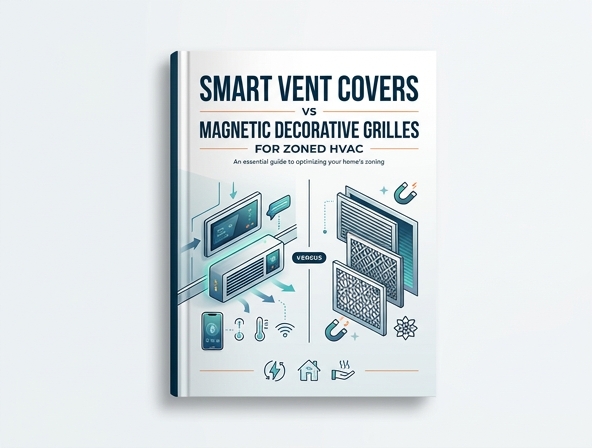
To help you address these imbalances safely, this guide compares the automated precision of smart vent covers against the cost-effective, aesthetic utility of magnetic decorative grilles, outlining which solution best aligns with your zoned HVAC goals.
Introduction: The Quest for Perfect Home Temperature Zoning
Achieving consistent, comfortable temperatures across every room in a multi-story or sprawling home is a notoriously difficult task. Hot second floors in the summer and freezing basements in the winter leave homeowners desperately seeking ways to balance their airflow. This persistent struggle has sparked a debate between two very different home improvement philosophies: high-tech smart automation designed to dynamically route airflow, versus low-tech aesthetic styling that seeks to combine visual appeal with manual air management. Today, we pit automated Smart Vent Covers directly against elegant Magnetic Decorative Grilles to see which solution truly solves your zoning woes.
Understanding Smart Vent Covers: Features and Functionality
Smart vent covers are motorized, sensor-driven registers designed to replace standard floor, wall, or ceiling vents. Unlike static registers, these devices communicate wirelessly with your home's central climate control ecosystem to dynamically open or close based on real-time room data.
Active Sensor-Driven Airflow
By pairing with remote temperature and motion sensors, smart vents continuously monitor the microclimate of individual rooms. If a guest bedroom becomes too warm while the rest of the house remains cool, the smart vent automatically constricts its louvers to redirect excess cool air to where it is needed most.
Dynamic System Integration
These devices do not work in isolation; they connect to a central smart bridge or hub. This hub processes incoming sensor data and cross-references it with your smart thermostat's state, preventing the HVAC system from overworking while maintaining optimized zones.
What Are Magnetic Decorative Grilles?
Magnetic decorative grilles are design-focused vent covers crafted to replace industrial-looking metal registers with beautiful, artistic patterns. These covers do not contain motorized parts or electronic sensors; instead, they rely on strong magnetic borders to adhere securely to steel vent frames, transforming an eyesore into a striking home accent.
- Tool-Free Magnetic Adhesion: Built-in rare-earth magnets hold the grilles securely against steel registers, allowing for effortless installation and removal without screws.
- Aesthetic-First Design: These grilles feature intricate geometric, Victorian, or modern laser-cut patterns that turn vents into beautiful design statements.
- Static Airflow Passage: Because they lack moving dampers, these grilles provide a fixed rate of ventilation, prioritizing visual harmony over active airflow control.
Airflow Dynamics: How Each Option Impacts Zoned HVAC Systems
The core difference between these two products lies in how they manage HVAC system airflow. Smart vents actively adjust their open/closed state in increments (e.g., closing a vent to 30% or 50% rather than completely shutting it) to carefully balance pressure. They communicate with the central system to ensure that closing one vent does not choke the overall airflow of your furnace or air conditioner.
In contrast, decorative magnetic grilles operate as passive covers. If you use a solid magnetic sheet or a highly restrictive grille pattern to block off an unused room, you create a hard barrier. This passive blocking does not allow the system to adapt, which can lead to backpressure build-up inside the ductwork.
"Completely sealing off multiple manual registers can severely disrupt system pressure, leading to frozen evaporator coils or a cracked heat exchanger." - HVAC Industry Safety Advisory
Installation and Setup: DIY vs. Tech Integration
Installing magnetic decorative grilles is a pure plug-and-play process. You simply clean the outer metal frame of your existing register and snap the magnetic grille over it. There is no need for screwdrivers, drilling, or system calibration. It takes less than thirty seconds per vent, making it an incredibly accessible weekend upgrade for any homeowner.
On the other hand, setting up smart vent covers requires a more involved technical workflow. First, you must remove the old vent using screws, insert specific lithium or alkaline batteries into the smart vent, and physically mount the new unit. Following the physical installation, you must install a proprietary smart hub, download the manufacturer's mobile application, pair each vent via wireless protocols, and link the system to your smart thermostat and room sensors.
Cost Analysis: Upfront Investment vs. Long-Term Savings
When choosing between these options, it is essential to weigh the initial cash outlay against potential utility savings. Smart vents demand a substantial upfront investment, but they offer the promise of lowered heating and cooling bills by optimizing energy consumption. Magnetic grilles are exceptionally affordable upfront but yield no direct utility savings.
| Feature / Cost Factor | Smart Vent Systems | Magnetic Decorative Grilles |
|---|---|---|
| Average Unit Price | $80 - $120 per vent | $15 - $35 per grille |
| Required Accessories | Smart Hub ($50 - $100) & Room Sensors ($30/each) | None (Self-contained) |
| Installation Complexity | Moderate (Requires App Setup & Batteries) | Zero Effort (Magnetic Snap) |
| Long-Term Energy Savings | High (Up to 20% on monthly HVAC bills) | None (Purely aesthetic/static) |
Smart Home Integration and Automation
Smart vents are designed to act as vital organs in a broader connected home ecosystem. Through advanced integration, these devices listen to environmental inputs and coordinate with your primary heating and cooling machinery to build a cohesive micro-zoned environment.
Thermostats and Assistant Support
Top-tier smart vents natively communicate with major smart thermostats such as Ecobee and Nest. By monitoring local room temperatures via remote sensors, the system can prompt the thermostat to cycle on or off while closing vents in unoccupied zones. Additionally, users can control these vents with voice commands via Amazon Alexa, Google Assistant, or Apple HomeKit.
No Tech, No Hassle
Conversely, magnetic decorative grilles offer zero tech compatibility. They do not run on Zigbee, Z-Wave, or Wi-Fi protocols. For homeowners who prefer an offline, distraction-free home environment without software updates, firmware bugs, or privacy concerns, this lack of connectivity is a distinct advantage.
Aesthetics and Design Customization
Standard metal vents are often eyesores, but these two alternatives tackle visual design from completely different angles. Magnetic decorative grilles are explicitly engineered for visual enhancement, offering intricate patterns ranging from classic Victorian scrollwork to mid-century geometric motifs. They easily blend into ornate, rustic, or traditional home decors, acting as true architectural accents rather than mechanical utilities.
Smart vents focus on a clean, modern aesthetic. Because they must house motorized gears, batteries, and radios, their physical profiles are thicker and more industrial. Their design language is decidedly minimalist, sleek, and utilitarian, usually coming in neutral shades like matte white or brushed silver to match contemporary, high-tech interiors without drawing too much attention to themselves.
HVAC System Safety: Avoiding Static Pressure Damage
Modern HVAC systems are carefully engineered to move a specific volume of air (measured in CFM) against a calculated resistance known as static pressure. When you arbitrarily block vents, you increase this resistance, forcing your blower motor to work harder and restricting airflow across the system's vital internal elements.
Restricting too many manual vents with magnetic covers or grilles can cause catastrophic component failure. For example, in the summer, reduced airflow over the evaporator coil can cause it to freeze solid, which can easily destroy your expensive compressor. In winter, inadequate airflow causes heat to build up inside the heat exchanger, leading to cracks that pose severe carbon monoxide leak risks.
Smart vents bypass this hazard using integrated pressure algorithms. If a user tries to close too many smart vents at once, the system's software recognizes the rise in static pressure and overrides the command, keeping select vents partially open to safeguard your compressor and heat exchanger.
The Verdict: Which Is Best for Your Zoned HVAC?
Your selection depends on whether you seek active climate optimization or a fast, stylish visual upgrade. Each solution offers a clear path forward depending on your household priorities.
Choose Smart Vent Covers if you want to resolve uneven room temperatures, lower monthly energy bills, and build a fully automated smart home ecosystem that monitors system safety.
Choose Magnetic Decorative Grilles if you want an affordable, tool-free aesthetic upgrade that eliminates ugly standard registers without adding tech complexity or app maintenance.
- Select smart vents if you have significant, uncomfortable temperature variances between different rooms.
- Opt for magnetic grilles if your primary goal is matching your home decor and maintaining standard airflow.
- Avoid using completely solid magnetic covers across multiple rooms to protect your HVAC system from static pressure damage.
Leave a comment