
Keeping a vertical garden vibrant is notoriously difficult. Because gravity constantly pulls moisture downward, upper-level planters often dry out rapidly while the bottom rows suffer from waterlogging and root rot. Before investing in automated hardware, growers must realize that traditional, time-based watering schedules fail to address these unique vertical microclimates. Upgrading to advanced irrigation technology offers the exact precision needed to automate this delicate balance, ultimately saving water and protecting your green investment.
However, technology is only as effective as its application; no system fully replaces basic horticultural observation, especially when managing diverse plant profiles-such as moisture-loving ferns on the top tier versus drought-tolerant succulents at the base. In this article, we compare Smart Sprinkler Controllers and Soil Moisture Sensors, evaluating their features, limitations, and performance to help you select the ideal watering technology for your vertical landscape.
Introduction: The Vertical Garden Watering Dilemma
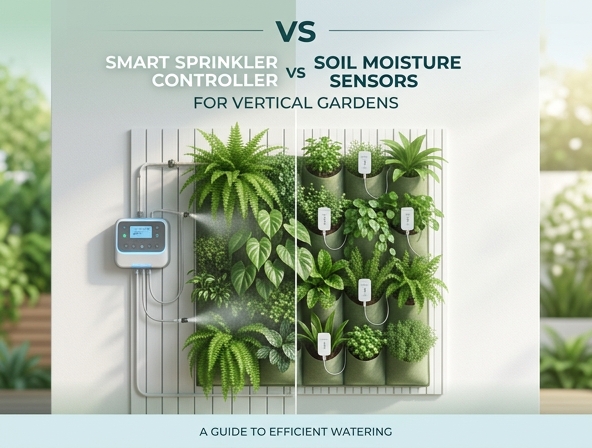
Vertical gardens have soared in popularity, transforming bare concrete walls into lush, breathing ecosystems. However, keeping these living walls alive presents a unique set of challenges. Unlike traditional horizontal plots, vertical gardens must battle gravity, which pulls moisture down rapidly, and cope with highly limited soil volume. To keep these plants thriving, gardeners are turning to technology. Two major contenders have emerged in this space: Smart Sprinkler Controllers, which rely on external weather data, and Soil Moisture Sensors, which focus on direct root-zone measurements.
Understanding Smart Sprinkler Controllers
Smart sprinkler controllers represent a major leap forward from traditional mechanical timers. These Wi-Fi-enabled devices connect directly to local weather stations to dynamically adjust watering schedules based on real-time atmospheric data.
Instead of watering on a rigid time frame, they calculate when to irrigate by evaluating local rain forecasts, wind speed, temperature, and humidity levels. General benefits of these systems for home gardens include:
- Automated scheduling that adapts to seasonal shifts without manual intervention.
- Remote management capabilities via smartphone applications.
- Substantial reduction in water waste by skipping cycles during rain events.
Demystifying Soil Moisture Sensors
Soil moisture sensors take an entirely different path by reading the soil directly. These specialized devices measure the active volumetric water content at the root level, giving a real-time assessment of how much moisture is actually available to the plants.
By placing these probes directly into the growing medium, gardeners get on-the-ground truth rather than weather estimates. This ensures irrigation systems are triggered only when the root zone reaches a specific dryness threshold, preventing both under-watering and hazardous waterlogging.
Why Vertical Gardens Require Specialized Irrigation
The physics of a vertical garden make standard flat-ground irrigation schemes completely obsolete. Gravity continuously pulls water downward, creating a sharp moisture gradient where the upper layers dry out almost instantly, while the bottom layers collect runoff and remain constantly saturated.
"Irrigating a living wall requires managing a vertical micro-climate where gravity, wind exposure, and limited substrate volume work together to create rapid fluctuations in soil moisture." - Urban Horticulture Council
This distinct vertical gradient means a uniform watering schedule will inevitably desiccate the top plants while drowning the bottom ones.
Smart Sprinkler Controllers in Vertical Spaces: Pros and Cons
The Advantages: Predictive Automation
Smart controllers bring a high degree of automation and ease of use to vertical gardening projects.
- Seamless integration with local weather forecasts to prevent overwatering during rainy days.
- Convenient remote adjustments through mobile apps, allowing quick tune-ups from anywhere.
- Easy integration with existing home automation systems and multiple valve configurations.
The Disadvantages: The Vertical Blind Spot
Despite their intelligence, these controllers operate under a fundamental assumption that does not fit vertical spaces.
- They lack awareness of the vertical gradient, meaning they cannot tell if the top layer is dry while the bottom is waterlogged.
- Weather forecasting does not accurately reflect the rapid evaporation rate within tiny vertical pocket planters.
Soil Moisture Sensors in Vertical Spaces: Pros and Cons
The Advantages: Direct Root-Level Precision
Moisture sensors excel at providing precise, localized data for complex living walls.
- Delivers micro-climate precision by measuring the exact moisture levels at different heights of the wall.
- Prevents root rot and overwatering at the bottom tiers by pausing zones that are already wet from upper-tier runoff.
- Ensures irrigation occurs only when plants genuinely require water, maximizing plant health.
The Disadvantages: Deployment Hurdles
However, implementing these sensors across a vertical surface introduces unique physical challenges.
- Requires precise calibration to match the specific lightweight, highly porous soil mixes used in living walls.
- Increased wiring and physical complexity when routing sensor cables down multiple tiers of a vertical frame.
Water Efficiency Showdown: Precision vs. Prediction
Comparing the water-saving potential of these two technologies reveals a classic battle between planning ahead and reacting to current conditions. Smart controllers predict water needs using macro-level environmental data, whereas soil sensors react to micro-level physical reality inside the planters.
| Feature | Smart Sprinkler Controllers | Soil Moisture Sensors |
|---|---|---|
| Primary Input | Atmospheric weather forecasts | Direct volumetric water content |
| Water Conservation Strategy | Preventative scheduling based on rain prediction | Demand-driven irrigation based on root dryness |
| Vertical Suitability | Moderate (relies on uniform scheduling calculations) | High (measures distinct dry and wet zones separately) |
Cost, Installation, and Maintenance Comparison
The financial and physical commitment required for each option varies significantly. Smart controllers generally feature a higher initial purchase price for the main hub, but installation is remarkably simple since it is a single device mounted near your water source. Maintenance is minimal, consisting of occasional software updates and minor setting tweaks on your phone.
On the other hand, soil moisture sensors can have a lower per-unit cost, but setting up multiple sensors across different tiers of a vertical wall increases both cost and complexity. The installation requires carefully routing wires and embedding probes securely in the soil pockets. Long-term maintenance demands regular battery changes for wireless units and periodic cleaning to prevent mineral buildup on the probes.
The Ultimate Setup: Integrating Both Technologies
For a truly resilient vertical garden, you do not have to choose just one technology. Integrating smart sprinkler controllers with soil moisture sensors creates a highly responsive, closed-loop irrigation system.
This hybrid approach functions through a systematic, multi-step process:
- The smart controller downloads the local weather forecast to determine if irrigation is scheduled.
- The soil moisture sensors read the actual water level at both the top and bottom of the living wall.
- If the forecast calls for dry weather but the bottom sensors report high moisture due to gravity runoff, the system bypasses the bottom zone while watering the dry upper zone.
- The controller logs this custom cycle, refining its future predictive scheduling for the vertical micro-climate.
Conclusion: Choosing the Best Tech for Your Living Wall
Making the final decision comes down to your garden's physical size, your budget, and how much hands-on management you prefer. Smart sprinkler controllers are excellent for large, single-zone installations where simplicity and remote app control are the top priorities. Meanwhile, soil moisture sensors are highly recommended for complex, multi-tiered walls where different plant species experience varying rates of dry-out. For those seeking the best of both worlds, a combined system offers the highest level of water efficiency and plant health. Assess your specific setup, consider your local climate, and select the technology that best fits your living wall's needs.
Leave a comment