
Keeping houseplants thriving can feel like an endless guessing game, especially when a seemingly healthy Monstera suddenly succumbs to root rot or compacted soil. Many indoor gardeners struggle to balance soil moisture, often blaming themselves when the real culprit is an incompatible potting medium.
Before diving into modern amendments, we must recognize that traditional horticulture has long relied on standardized, resource-intensive mixes to manage hydration. Transitioning to the right sustainable alternative grants your plants optimal root aeration and effortless moisture control, ensuring lush, resilient growth.
However, we must stipulate that no single growing medium is a universal cure-all; different species require distinct soil physics. For instance, while a moisture-loving fern thrives on the natural acidity of peat, a delicate succulent demands the rapid drainage and neutral pH of coconut coir.
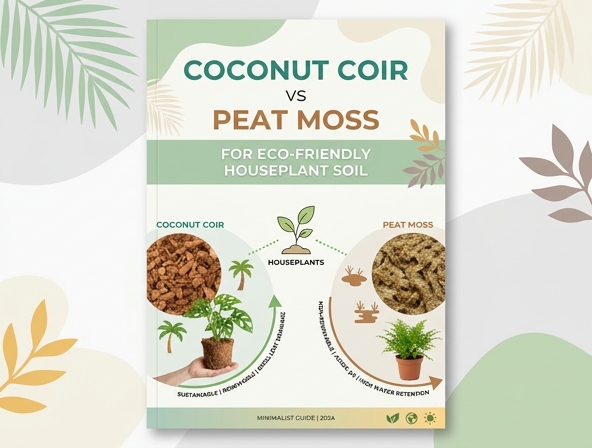
In this guide, we will compare coconut coir and peat moss across key performance metrics-including water retention, nutrient capacity, and environmental footprint-to help you select the perfect, eco-friendly foundation for your indoor jungle.
Introduction: The Battle of the Eco-Friendly Growing Media
For dedicated houseplant enthusiasts, choosing the perfect growing medium is a critical decision that directly influences root development, moisture retention, and overall plant vitality. In recent years, a passionate debate has emerged surrounding the two most popular soil-less substrates on the market: coconut coir and peat moss. While both media serve as excellent bases for custom potting mixes, they possess distinct physical properties, chemical profiles, and environmental impacts.
Selecting the right substrate is not just about keeping your tropical plants lush and green; it is also a choice that deeply impacts global sustainability. As gardeners become more environmentally conscious, the balance between ecological responsibility and plant performance has become a central focus of modern horticulture. Understanding how these substrates function will help you make an informed choice for your indoor jungle.
Understanding Coconut Coir: The Coconut Byproduct
Coconut coir, often simply called coco coir, is a natural fiber extracted from the outer husk of coconuts. Historically treated as industrial waste by the coconut processing industry, this fibrous material is processed through a series of steps: the husks are cured in water, shredded, dried, and then graded into different textures, such as pith, fibers, or chips. The resulting product is compressed into blocks or sold as loose soil.
As a growing medium, coconut coir possesses several unique physical characteristics:
- High water absorption: It can hold up to ten times its weight in water while maintaining excellent structural stability.
- Strong structural resilience: Coir fibers resist decomposition, allowing the medium to maintain its physical shape over multiple seasons.
- Natural porosity: The coarse texture provides an ideal balance of air pockets and water retention, preventing root suffocation.
Understanding Peat Moss: The Ancient Wetland Resource
Peat moss is a dark, fibrous material formed from the decayed remains of dead organic matter, primarily Sphagnum moss, that accumulates over thousands of years in oxygen-poor, acidic wetlands known as peat bogs. Because of the waterlogged environment and lack of oxygen, the rate of decomposition is incredibly slow, resulting in deep, dense layers of highly absorbent organic material.
In traditional horticulture, peat moss has been the gold standard for container gardening since the mid-20th century. Its exceptional ability to hold water and dissolved nutrients, combined with its sterile nature and high acidity, made it the preferred base for commercial potting soils, helping growers cultivate healthy, disease-free crops on a massive scale.
Water Retention and Aeration: A Side-by-Side Comparison
Both coconut coir and peat moss excel at holding moisture, but they manage water and air in fundamentally different ways. Peat moss acts like a sponge, holding onto immense amounts of water, but it can become compacted and heavy when fully saturated, which may limit airflow to the root zone. Coconut coir, on the other hand, distributes moisture evenly through its capillary structure while maintaining superior aeration, ensuring that roots always have access to vital oxygen.
| Property | Coconut Coir | Peat Moss |
|---|---|---|
| Water-Holding Capacity | High (releases water easily to roots) | Very High (holds water tightly, can waterlog) |
| Aeration | Excellent (retains structural air space) | Moderate (can compact over time) |
| Rewetting Ability | Excellent (absorbs water instantly when dry) | Poor (becomes hydrophobic when fully dry) |
pH Levels and Nutrient Profiles: Chemical Differences
The chemical makeup of these two substrates dictates how you must fertilize and manage your plants. Coconut coir is naturally close to neutral, typically sitting at a pH range of 5.8 to 6.8. This makes it highly compatible with a wide variety of houseplants, allowing them to absorb essential nutrients without drastic chemical modifications. Peat moss, by contrast, is highly acidic, with a pH range of 3.5 to 4.5, which requires the addition of agricultural lime to make it suitable for most standard houseplants.
Nutrient storage, or cation exchange capacity (CEC), also differs. Peat moss naturally has a higher CEC, meaning it holds onto added nutrients more effectively than coir. However, coconut coir often contains natural levels of potassium and sodium, which requires thorough flushing and buffering with calcium and magnesium before use to prevent nutrient lockouts.
The Ecological Footprint: Harvesting and Sustainability
The environmental debate is perhaps the most significant differentiator between these two media. Peat bogs are vital carbon sinks, storing more carbon globally than all the world's forests combined. Harvesting peat moss involves draining these wetlands and scraping away layers of organic material that took millennia to form, releasing massive amounts of carbon dioxide into the atmosphere and destroying unique ecosystems.
Conversely, coconut coir is a renewable resource harvested directly from agricultural byproducts. Rather than exploiting undisturbed ecosystems, the utilization of coir turns what would otherwise be a waste product of the coconut industry into a valuable horticultural asset.
"Peatlands cover only 3% of the world's land area but store nearly 30% of all land-based carbon. The extraction of peat moss disrupts these delicate biomes, making the transition to renewable alternatives like coconut coir a key step in ecological conservation."
- Global Wetland Preservation Alliance
Cost, Lifespan, and Reusability
When choosing a substrate, long-term costs and physical durability are crucial economic factors to evaluate. While initial pricing can vary by region, understanding how these materials perform over time reveals their true value.
- Initial Cost: Peat moss is often cheaper and more widely available in large compressed bales, whereas high-quality, pre-washed coconut coir can carry a slightly higher upfront price tag.
- Decomposition Rate: Coconut coir decomposes much slower than peat moss due to its high lignin content, maintaining its structure for several years without compacting.
- Reusability: Coir can easily be washed, sterilized, and reused for multiple growing cycles. Peat moss degrades rapidly after a year or two, making it difficult to reuse without altering the soil structure.
Best DIY Houseplant Soil Recipes Using Coconut Coir
The Premium Chunky Aroid Mix
This well-draining recipe utilizes coconut coir as a sustainable, moisture-retentive base that supports healthy root development for Monsteras, Philodendrons, and Pothos.
- Prepare your base by expanding one brick of compressed coco coir in warm water, ensuring it is fully hydrated and fluffy.
- Measure out 3 parts of the prepared coconut coir and place it in a large mixing tub.
- Add 2 parts of coarse perlite to facilitate rapid water drainage and prevent compaction.
- Incorporate 2 parts of orchid bark chips to create air pockets for root respiration.
- Mix in 1 part of organic worm castings to provide a gentle, slow-release source of nutrients.
- Stir the ingredients thoroughly until a chunky, loose texture is achieved before potting your plants.
Best DIY Houseplant Soil Recipes Using Peat Moss
The Acid-Loving Tropical Blend
This specialized mix leverages the natural acidity of peat moss, making it perfect for acid-loving houseplants such as ferns, Calatheas, and African violets.
- Measure out 3 parts of premium Canadian sphagnum peat moss into a mixing container.
- Add 1 part of coarse perlite or vermiculite to improve aeration while preserving high moisture levels.
- Incorporate 1 part of well-composted organic matter or leaf mold to enrich the substrate.
- Add a half-part of horticultural charcoal to help filter impurities and sweeten the soil environment.
- Thoroughly moisten the peat moss prior to mixing, as dry peat moss is highly hydrophobic and will repel water if not pre-saturated.
- Blend the ingredients together until the mixture is uniform and holds a loose shape when squeezed.
The Final Verdict: Which Soil Medium Should You Choose?
Your choice between coconut coir and peat moss depends on your personal gardening values, budget, and the specific plants in your collection. If you prioritize environmental conservation, long-term reusability, and a neutral growing base, coconut coir is the superior choice. Its ability to absorb water easily when dry and resist decomposition makes it an incredibly low-maintenance option for busy plant parents.
If you cultivate acid-loving species that require consistent moisture and you are operating on a tight budget, peat moss remains a reliable and highly effective growing medium. Your decision should align with your plants' physiological requirements and your commitment to ecological stewardship. By choosing the right medium for your specific environment, you ensure a thriving indoor garden that respects the natural world.

Leave a comment