
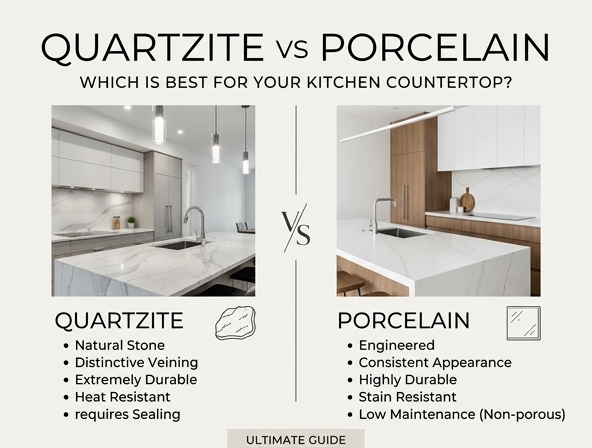
Selecting the perfect kitchen countertop often feels like an overwhelming compromise between aesthetic desire and daily practicality. Before committing to a major financial investment, homeowners must first navigate a crowded market where design trends and marketing buzzwords frequently obscure actual material performance.
Choosing the right surface guarantees a lifetime of high-yield ROI and effortless daily maintenance. However, we must establish an important stipulation: true quartzite is a natural metamorphic rock, distinct from weaker "soft quartzites" (which are actually dolomites), while modern porcelain is an engineered, ultra-dense ceramic slab.
For instance, comparing the natural, veined depth of Taj Mahal quartzite against the sleek, non-porous resilience of a Calacatta porcelain slab highlights how closely these two premium materials compete. In this comprehensive guide, we will analyze their durability, cost, installation complexities, and maintenance requirements to help you make an informed, confident decision for your home.
Introduction: The Battle for the Ultimate Kitchen Countertop
When planning a kitchen remodel, selecting the perfect surface is one of the most critical decisions you will make. Today, the debate often centers on two premium materials that have captured the attention of designers and homeowners alike: natural quartzite and engineered porcelain. Both options promise stunning aesthetics and high performance, but they arrive at these results through vastly different origins.
While natural quartzite offers the raw, untamed beauty of Earth's geological history, engineered porcelain represents the pinnacle of modern manufacturing and customizable design. Choosing between them requires a deep dive into how they handle daily wear, installation demands, and long-term maintenance. This comprehensive guide will break down the head-to-head comparison to help you crown the champion for your home.
What is Quartzite? Nature's Masterpiece
An Organic Wonder Formed Deep Within the Earth
Quartzite is a 100% natural metamorphic rock that begins its journey as quartz-rich sandstone. Over millions of years, tectonic activity subjects this sandstone to intense heat and extreme pressure beneath the Earth's crust. This geological process recrystallizes the quartz grains, fusing them into a dense, incredibly hard rock structure.
The result of this natural alchemy is a highly durable slab that boasts some of the most striking visual patterns found in nature. Because it is formed organically, no two slabs of quartzite are identical. Homeowners cherish its elegant veining, depth of character, and marble-like appearance, which comes without the inherent fragility of traditional marble.
What is Porcelain? Engineered Perfection
High-Tech Manufacturing Meets Modern Design
Porcelain countertops are an engineered, man-made product crafted from a specialized blend of raw clay, feldspar, and silica. This mixture is compacted under immense pressure and then fired in a kiln at temperatures exceeding 2,200 degrees Fahrenheit. This process, known as vitrification, creates an incredibly dense, non-porous, and glass-like material.
Thanks to advanced industrial printing technology, manufacturers can apply virtually any design, color, or pattern to the surface of the slab. This allows porcelain to mimic rare marble, concrete, or wood with incredible accuracy. Because it is engineered, it offers a level of uniform consistency in pattern and color that natural stones simply cannot match.
Aesthetics and Design: Natural Veining vs. Printed Realism
The visual choice between quartzite and porcelain comes down to a preference for organic, unpredictable beauty versus precision-engineered design consistency. Each material brings a distinct visual language to a kitchen design, particularly when looking at how patterns run through the slabs and translate to the finished edges.
- Quartzite's Visual Depth: The veining in quartzite runs all the way through the thickness of the slab. This structural continuity means that when the slab is cut and polished, the natural patterns flow seamlessly over the edges, creating a luxurious, three-dimensional look.
- Porcelain's Surface Precision: Porcelain features highly convincing, printed-on designs that can replicate almost any material. However, because the pattern is only printed on the surface, the interior body of the slab does not match the surface pattern. Specialized mitered edges must be fabricated to conceal this transition.
If you desire a countertop where every swirl and mineral deposit is entirely unique, quartzite is unmatched. If you prefer a highly predictable, repeatable layout with modern, ultra-thin profiles, porcelain provides the perfect aesthetic solution.
Durability Showdown: Scratch, Heat, and Impact Resistance
When it comes to everyday wear and tear, both materials rank among the toughest options on the market, though they excel in different ways. Quartzite is exceptionally hard, registering a 7 on the Mohs hardness scale. This gives it superior scratch resistance against metal knives, keys, and heavy cookware, meaning you rarely have to worry about dulling or scraping its surface during meal prep.
Porcelain, on the other hand, boasts unmatched heat resistance because of its high-temperature kiln-firing process. You can place boiling-hot pots directly onto its surface without risking thermal shock or discoloration. However, porcelain is a thinner, more glass-like material, making it more brittle than dense quartzite. This brittleness makes porcelain vulnerable to edge chipping and cracking if struck by a heavy object, whereas quartzite offers better impact resistance overall.
Maintenance and Sealing: Low-Maintenance vs. Zero-Maintenance
Understanding the long-term upkeep of your countertops can save you hours of labor and unexpected repair costs. Quartzite is a natural stone, which means it retains a microscopic degree of porosity. To prevent oils, wines, and acidic liquids from penetrating the surface and causing permanent stains, quartzite requires periodic application of a high-quality impregnating sealer, typically on an annual basis.
Porcelain stands out as a completely zero-maintenance surface. Because the manufacturing process vitrifies the clay into a completely solid, non-porous sheet, it is entirely impervious to liquids and staining agents. It never needs to be sealed, waxed, or treated. For busy households, a simple wipe-down with warm water and soap is all that is ever required to keep porcelain looking pristine.
Cost and Installation: Budgeting for Premium Surfaces
When planning your budget, it is important to separate the cost of the raw slabs from the cost of fabrication and installation. Quartzite is a premium natural stone, and its raw material costs are generally higher than porcelain. The rarity of the specific quartzite slab, along with the quarrying and shipping processes, contributes to this elevated price point. However, fabricating quartzite is relatively straightforward for experienced stone cutters because of its solid, dense structure.
Porcelain raw slabs are typically more budget-friendly, but the material presents unique installation challenges. Because porcelain is thin and brittle during the cutting phase, it requires highly specialized tools and expert fabricators to prevent cracking and chipping. Complex edge profiles, like mitered aprons to hide the unpatterned core, add significant labor hours. Consequently, the high cost of specialized porcelain fabrication can sometimes make the final installed price equal to or even higher than natural quartzite.
Direct Comparison: Quartzite vs. Porcelain Key Differences
| Feature | Natural Quartzite | Engineered Porcelain |
|---|---|---|
| Origin | 100% Natural Metamorphic Rock | Man-Made (Clay and Minerals) |
| Sealing Required | Yes (Annually) | No (Never) |
| Heat Resistance | High (Coasters Recommended) | Outstanding (Direct Heat Proof) |
| Scratch Resistance | Excellent (Harder than Steel) | Very Good (Can scratch with ceramic knives) |
| Average Cost | High raw cost; Standard fabrication | Moderate raw cost; Expensive fabrication |
Ideal Use Cases: Which Material Suits Your Lifestyle?
Matching Your Countertop Choice to Your Daily Needs
The decision between these two surfaces often comes down to the environment they will live in and the lifestyle of the homeowners. Here are the scenarios where each material shines brightest:
- Choose Quartzite if: You are designing a high-end luxury kitchen where one-of-a-kind natural beauty is the primary goal. It is perfect for dramatic waterfall islands where the natural veining can be showcased as a focal point. It is also ideal for families who want a heavy, solid stone feel underhand and excellent resistance to scratches.
- Choose Porcelain if: You are building an outdoor kitchen, as porcelain is completely UV-resistant and will not fade under direct sunlight. It is also the perfect match for minimalist, ultra-modern designs that call for thin slabs, integrated sinks, or large-format, seamless wall cladding with zero maintenance requirements.
Final Verdict: Choosing Your Dream Countertop
Your choice of countertop will shape the functionality and beauty of your kitchen for decades. If you fall in love with the organic depth, tactile solidity, and unique personality of natural stone, quartzite is an investment that brings unmatched luxury to your home, provided you are willing to spend a few minutes sealing it once a year.
If you prefer a worry-free, ultra-durable, and modern aesthetic that resists extreme heat and never requires maintenance, porcelain offers incredible versatility. Weighing these attributes against your personal budget, aesthetic taste, and kitchen layout will guide you to the surface that best complements your home and lifestyle. Both materials stand out as exceptional choices, ensuring your kitchen remains both stunning and functional for years to come.
Leave a comment