
Renting a home often means balancing the desire for personal style against the strict rules of a landlord-tenant agreement. Hanging curtains is one of the most effective ways to elevate a space, yet the prospect of drilling holes into drywall frequently threatens your security deposit.
Fortunately, achieving a polished, customized aesthetic is entirely possible without permanent hardware. However, selecting the ideal damage-free method requires a careful assessment of your window frame depth and the overall weight of your textiles-whether you are styling lightweight, airy linen sheers or heavy, light-blocking thermal drapes.
To help you navigate this decision, this guide evaluates the two most popular budget-friendly alternatives: tension rods and adhesive Command hooks. We will compare both options across key performance metrics, including weight capacity, installation complexity, and long-term durability, ensuring you choose the optimal solution for your rental.
Introduction: The Rental Curtain Dilemma
Moving into a new rental property brings the exciting challenge of turning a blank canvas into a cozy home. However, the dream of hanging elegant, light-filtering drapes often clashes with the reality of strict lease agreements and the looming fear of losing a security deposit over wall damage. Drilling holes into drywall is a risky endeavor for any tenant. Thankfully, achieving privacy and light control does not require permanent modifications. Two budget-friendly, damage-free champion solutions have emerged to save your deposit: tension rods and adhesive hooks. Both offer distinct paths to beautifully dressed windows without a single drill bit in sight.
Understanding Tension Rods: How They Work
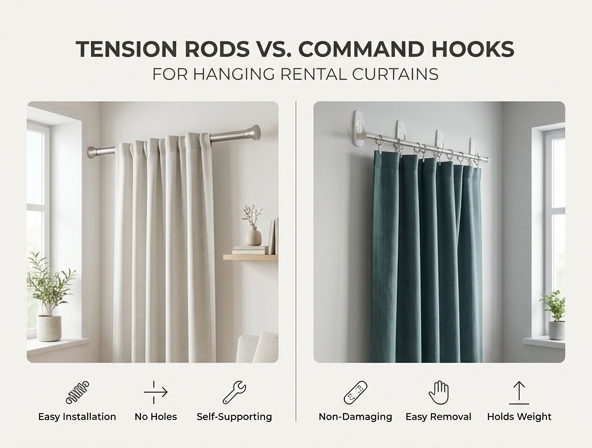
Tension rods are incredibly straightforward yet effective tools for hanging window treatments. They operate using an internal spring mechanism that pushes outward against the vertical surfaces of a window frame, creating a secure hold purely through horizontal pressure. Because they rely entirely on this physical expansion, their ideal use case is strictly inside the window frame. For renters, the main benefits of using a tension curtain rod include its incredibly fast setup, the complete lack of sticky adhesives, and the zero-damage guarantee on the face of your walls.
Exploring Command Hooks: Adhesive-Based Hanging
On the other hand, Command hooks take a completely different approach by utilizing specially formulated adhesive strips to mount standard curtain rods onto the wall surface. This method allows you to position the hooks outside the window frame, mimicking a traditional, professional installation. Command hooks have exploded in popularity due to their sheer versatility, allowing renters to hang curtains high and wide to make ceilings feel taller. Best of all, they offer an effortless removal process that pulls completely clean off the wall when it is time to pack up and move out.
Head-to-Head: Weight Capacity and Stability
Tension Rod Weight Limits
Tension rods depend entirely on the friction between their rubber end caps and the window casing. While they can easily support lightweight sheers and medium-weight cotton panels, they are prone to slipping if loaded with heavy, lined blackout curtains or if pulled too hard by pets or children. Over-tightening them to support more weight can also place dangerous stress on the window trim.
Command Hook Weight Capacity
Command hooks offer specified, reliable weight limits, often supporting up to 7.5 or even 15 pounds per pair when using heavy-duty utility hooks. This makes them much better suited for supporting substantial blackout drapes or heavy velvet panels, provided you use a compatible curtain rod that distributes the weight evenly across the adhesive brackets.
Damage-Free Inspection: Protecting Your Security Deposit
While both methods are marketed as damage-free, each carries unique risks if installed or removed incorrectly. Understanding these risks is crucial for safeguarding your security deposit during your final move-out inspection.
- Command Hooks: Risk of peeling off wall paint or tearing drywall paper if the adhesive strip is pulled outward instead of straight down during removal. They can also leave a sticky residue if left in high-humidity rooms for too long.
- Tension Rods: Risk of scraping paint inside the window frame during adjustment, or causing minor drywall indentation if overtightened against soft plaster walls.
Aesthetics and Styling: Achieving the Perfect Look
Your choice of hardware heavily dictates the final look of your space. Tension rods are confined to the inside of the window casing, offering a clean, minimalist, and recessed aesthetic. This is excellent for modern spaces, but it means your curtains will block a portion of the window glass even when fully open. Conversely, Command hooks allow you to mount your rod above and wider than the frame. This traditional layout creates the illusion of larger windows and higher ceilings, letting in maximum natural light while giving you a more luxurious, designer-level styling opportunity.
Installation Battle: Effort, Time, and Mistakes
When it comes to putting these solutions to work, the installation processes differ wildly in terms of timing and margin for error. Tension rods offer an instant gratification experience: you simply twist, extend, and lock them into place within seconds. If you make a mistake or get the height wrong, you can adjust it immediately without any consequences. Command hooks require a much more methodical, patient approach. You must prep the wall with rubbing alcohol, measure precisely to ensure the hooks are perfectly level, and crucially, wait a full hour for the adhesive to cure before hanging any weight. A mistake with adhesive means wasting a strip and starting the process over.
Budget and Reusability: Long-Term Value
Both options are highly affordable compared to drilling heavy-duty hardware, but their long-term value trajectories diverge. A tension rod is a one-time purchase with infinite reusability; you can pack it up, take it to your next apartment, and adjust it to fit a completely different window frame for free. Command hooks, while inexpensive initially, require purchasing new replacement adhesive strips every single time you move, adjust their height, or make an installation error. Over several moves, the cost of replacement strips can gradually add up, making tension rods the more economical choice in the long run.
The Verdict: When to Choose Tension Rods vs. Command Hooks
Choose Tension Rods If:
You have deeply recessed window frames, prefer a clean and minimalist look, want to hang lightweight or sheer curtains, and desire an instant setup that you can easily reuse in future homes without buying extra parts.
Choose Command Hooks If:
You want to hang heavy blackout curtains, wish to make your windows appear larger by mounting curtains high and wide outside the frame, or are dealing with shallow window casings that cannot accommodate a spring rod.
Conclusion: Elevate Your Rental Without the Risk
Decorating a temporary space does not mean you have to compromise on style or risk your hard-earned security deposit. By choosing between the quick-adjusting convenience of tension rods and the grand, traditional look of adhesive Command hooks, you can easily customize your rental windows to match your personal aesthetic. Assess your window depth, select your curtain fabric weight, and confidently elevate your living space with a damage-free solution that makes your rental truly feel like home.

Leave a comment