
Few household chores are as frustrating as staring at a perpetually cloudy glass shower door. Despite daily rinsing, stubborn soap scum and calcium deposits quickly bond to the surface, dulling its brilliant shine. Fortunately, restoring a streak-free, crystal-clear finish does not require harsh chemical fumes-provided you understand how different cleaning materials interact with tempered glass. While glass is highly durable, utilizing the wrong abrasive can cause permanent microscopic scratching, which actually traps more grime over time.
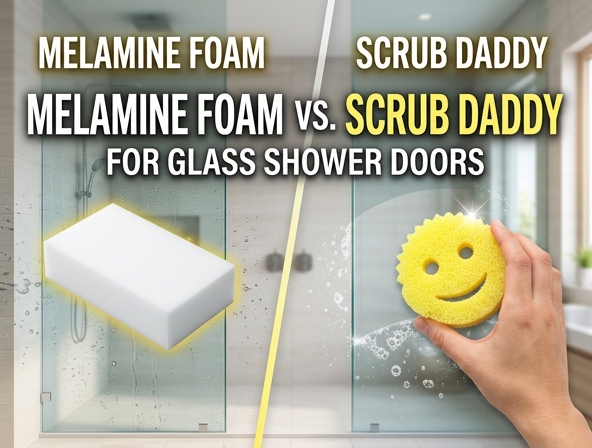
To help you avoid costly mistakes, this guide evaluates two of the most popular mechanical cleaning tools on the market: Melamine Foam and the temperature-responsive Scrub Daddy. We will analyze their effectiveness against bonded mineral buildup, assess their safety on delicate glass surfaces, and ultimately determine which tool delivers the most efficient, scratch-free results for your bathroom.
The Battle of the Shower Door: Melamine Foam vs. Scrub Daddy
Few things are as frustrating as stepping into what should be a clean oasis, only to be confronted by a cloudy, dull glass shower door. Over time, a stubborn combination of mineral-rich hard water stains and sticky soap scum coats the surface, transforming crystal-clear glass into an unsightly, opaque mess. Standard sprays and light wiping chemical solutions rarely do the trick, leaving homeowners searching for a heavy-duty physical alternative.
Enter two of the internet's most celebrated cleaning champions: Melamine Foam (commonly known as the Magic Eraser) and the cheerful, color-changing Scrub Daddy. Both have gone viral for their ability to restore surfaces to their former glory, but which one actually reigns supreme when facing the grueling environment of your bathroom glass? We are putting these two powerhouse tools head-to-head to determine the true champion of the shower door battle.
What is Melamine Foam and How Does It Clean Glass?
Melamine foam looks and feels like a soft, pillow-like sponge, but its physical composition is surprisingly high-tech. Made from a formaldehyde-melamine-sodium bisulfite copolymer, this foam cures into an open-cell microstructure that is incredibly hard-almost as hard as glass itself.
The Science of Micro-Abrasion
When you wet a melamine foam sponge, its microscopic structure becomes active. It functions like an ultra-fine sandpaper (roughly equivalent to 3000 to 6000 grit). Instead of relying on chemical detergents, the foam physically scrapes away dirt, oils, and minerals at a microscopic level, trapping the debris within its open cells.
Pros and Cons for Glass Cleaning
- Pro: Cleans effectively using water alone, eliminating the need for harsh chemical fumes in a confined shower space.
- Pro: Lifts fine, hazy film and light mineral deposits with minimal downward pressure.
- Con: Disintegrates quickly during heavy-duty scrubbing, leaving behind crumbly white residue.
- Con: Can strip away pre-applied protective water-repellent coatings on the glass.
What is Scrub Daddy and How Does It Work on Glass?
The Scrub Daddy is not your average kitchen sponge. Its distinctive, smiling face is engineered from a proprietary, high-tech polymer material called FlexTexture. This unique material reacts dynamically to water temperature, allowing you to customize your scrubbing power on the fly.
The Power of FlexTexture
When exposed to cold water, the FlexTexture material compresses and becomes highly firm, delivering rigorous scrubbing power without scratching. When rinsed in warm water, the material relaxes, becoming soft, highly absorbent, and gentle. This temperature-controlled adaptability makes it uniquely suited for tackling diverse bathroom residues.
Pros and Cons for Glass Cleaning
- Pro: Adjusts from stiff to soft, allowing you to break up hard deposits first and then wipe away the loose grime.
- Pro: Highly durable and does not break down or crumble during intensive scrubbing sessions.
- Con: Requires more physical downward force to clean flat glass surfaces compared to micro-abrasives.
- Con: May require a supplemental cleaning agent to fully dissolve heavy mineral spots.
Round 1: Tackling Heavy Soap Scum
Soap scum is a tacky, stubborn combination of body oils, talc, and soap minerals that bakes onto glass doors under the heat of daily showers. Getting through a thick layer of this sticky residue requires serious cutting power. When matched against heavy soap scum, Scrub Daddy used with cold water acts like a heavy-duty scraper. Its firm texture physically slices through the thickest build-ups, lifting the greasy layer away from the glass in seconds with relatively low physical effort.
Melamine foam, on the other hand, struggles with thick, greasy soap scum. Because of its ultra-fine pore structure, the greasy oils of the soap scum quickly clog the tiny open cells of the foam. This causes the sponge to glide uselessly over the surface rather than cutting through it, requiring you to scrub harder and rinse the sponge constantly. While melamine foam excels at removing thin, dry film, it is easily overwhelmed by thick, wet soap scum, leaving a slightly smeary finish unless you follow up with a microfiber cloth.
Round 2: Eliminating Hard Water Spots and Mineral Deposits
Hard water spots are formed when mineral-heavy water evaporates, leaving behind solid calcium and magnesium deposits. These deposits bond chemically to the glass, making them notoriously difficult to remove. Melamine foam shines brightest in this category. Its microscopic abrasive structure acts as a physical polish, shearing off these microscopic mineral bonds and leveling the surface. For light to moderate hard water spots, melamine foam can restore pristine optical clarity using nothing but plain water.
Scrub Daddy relies entirely on its surface texture to scrub. Because its polymer material is designed to be completely non-scratch, it lacks the microscopic abrasive edge needed to shear off chemically bonded calcium deposits on its own. To match the performance of melamine foam, you must pair the Scrub Daddy with an acidic cleaner, such as vinegar or a commercial descaler, to dissolve the minerals first. Without these chemical helpers, restoring complete optical clarity to mineral-stained glass with just a Scrub Daddy requires excessive physical exertion.
Scratch Risk: Are They Safe for Glass Shower Doors?
Safety is a primary concern when taking abrasive materials to expensive tempered glass shower doors. Because melamine foam is a micro-abrasive, there is a common misconception that it will scratch the glass. Standard tempered shower glass is harder than melamine, meaning the foam will not scratch the glass itself. However, many modern shower doors come treated with factory-applied hydrophobic protective coatings, such as EnduroShield or CleanCoat. Melamine foam will gradually wear these delicate coatings away, ruining the water-repellent properties of your door.
Scrub Daddy's FlexTexture polymer is rigorously tested to be 100% scratch-free on glass, even when used in its stiffest, cold-water state. It is highly gentle on surfaces while still providing enough mechanical action to lift surface debris. However, caution must still be exercised with specialty treated glass surfaces.
WARNING: Always test both cleaning tools on a small, inconspicuous corner of your shower door before tackling the entire surface, especially if your glass features a protective hydrophobic coating or frosted finish.
Durability and Longevity: Which Tool Lasts Longer?
When evaluating cost-efficiency and convenience, durability is a massive differentiator. Melamine foam functions essentially like a pencil eraser. As you scrub the hard, rough surface of a glass shower door, the delicate open-cell structure of the foam tears and sheds. Cleaning a single, heavily soiled shower door can easily destroy an entire melamine sponge, leaving you with a pile of crumbled white debris and a sponge that must be thrown away.
In contrast, Scrub Daddy is built for outstanding longevity. Its robust polymer material does not disintegrate under pressure. It resists tearing, does not shed micro-plastics during normal use, and is highly resistant to holding onto foul odors. After scrubbing your shower door, a quick rinse in warm water cleans the Scrub Daddy completely, keeping it ready for dozens of future cleaning sessions. From a long-term cost and environmental waste perspective, the Scrub Daddy is the far superior investment.
Ergonomics and Ease of Use in the Shower
The physical act of cleaning a shower door requires a tool that is easy to hold in a wet, slippery, and confined space. Melamine foam is typically manufactured as a simple, rectangular block. Once wet and soapy, this block becomes exceptionally slick and difficult to grip. As it wears down and becomes smaller, it easily slips out of your hand, requiring constant readjustment and causing hand fatigue during long cleaning sessions.
The iconic round shape and smiling face of the Scrub Daddy are not just for aesthetics; they are brilliant ergonomic features. You can place your fingers through the eye cutouts to secure a firm, slip-free grip, even when your hands are covered in soapy water. The round shape fits naturally into the palm of your hand, allowing you to apply even pressure across the glass surface without straining your fingers or wrists.
The Ultimate Comparison: Melamine Foam vs. Scrub Daddy
| Metric | Melamine Foam | Scrub Daddy | Winner |
|---|---|---|---|
| Soap Scum Removal | Poor (Clogs easily) | Excellent (Cuts through thick layers) | Scrub Daddy |
| Hard Water Spots | Excellent (Polishes away minerals) | Moderate (Requires chemical aid) | Melamine Foam |
| Scratch Safety | Safe for plain glass; strips coatings | 100% Scratch-free on all surfaces | Scrub Daddy |
| Durability | Very Low (Disintegrates) | Very High (Lasts for months) | Scrub Daddy |
| Ergonomics | Slippery block shape | Secure smile-face grip | Scrub Daddy |
| Verdict | Best for polishing light spots | Best for heavy-duty scum and grip | Scrub Daddy (Overall Champion) |
How to Keep Your Shower Glass Spotless for Longer
- Squeegee Daily: Keep a squeegee hung inside your shower and run it over the wet glass after every single shower to prevent water droplets from drying into mineral spots.
- Apply a Hydrophobic Spray: Treat your clean glass with a water-repellent spray to force water to bead up and slide off the surface effortlessly.
- Establish a Weekly Touch-Up: Use your Scrub Daddy once a week during your regular shower routine to wipe away minor soap build-up before it has the chance to bake on.
Leave a comment