
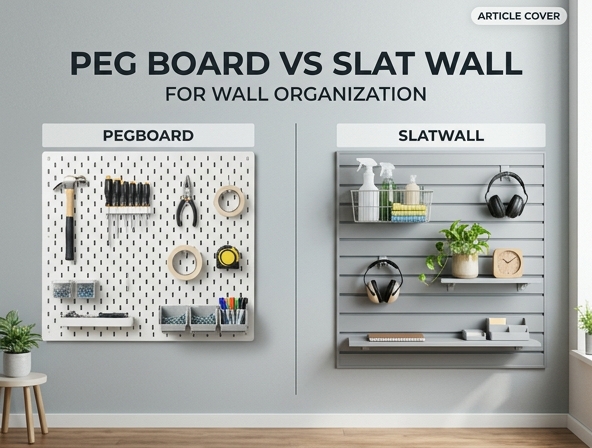
Staring at a cluttered home office desk can instantly drain your focus and productivity. Essential tools disappear right when you need them, and cords tangle around your keyboard, turning a professional workspace into a source of daily stress. As the modern remote workspace continues to evolve, optimizing your vertical real estate has transitioned from a design trend into a functional necessity. Transforming underutilized walls into active storage grants you immediate mental clarity while reclaiming valuable desk surface area.
However, successful wall organization requires a crucial stipulation: the ideal system depends entirely on your specific gear. While lightweight items like headphones and charging cables are easily managed, heavier equipment like tablets, reference books, or mechanical keyboards require robust support. Selecting the wrong foundation can lead to damaged walls or fallen devices.
In this guide, we will compare pegboards and slatwalls across durability, aesthetics, installation, and cost to help you select the ultimate storage system for your home office.
Introduction: Reclaiming Your Home Office Wall Space
Working from home offers unmatched flexibility, but it also invites a common enemy: desk clutter. When your keyboard, notepad, coffee mug, and charging cables compete for the same physical space, productivity drops. Finding a way to reclaim your work surface becomes essential, and the most underutilized asset in your room is the wall space directly in front of you.
Vertical organization systems turn empty walls into highly functional storage hubs. Among the most popular solutions are pegboards and slatwalls. While both systems promise to clear your desktop, they cater to very different aesthetic preferences, weight requirements, and installation capabilities. Understanding these differences is the first step toward creating an efficient workspace.
Understanding Pegboards: The Classic Utility Player
What is a Pegboard?
A pegboard is a tempered hardboard, metal, or plastic panel pre-drilled with evenly spaced holes. Historically found in garages, workshops, and retail backrooms, pegboards have traditionally been used to hang hand tools, scissors, and hardware.
Adaptation to the Modern Workspace
In recent years, the pegboard has transitioned from the garage to the home office. Modern designs feature powder-coated steel, sleek acrylics, and warm natural woods. They offer a highly visible, modular storage solution that makes it easy to grab items you use daily.
Key characteristics of pegboards include:
- Grid-based layout utilizing standardized hole spacings (usually 1-inch intervals).
- Lightweight panels available in diverse materials.
- High visibility of all stored items for quick access.
- Endless flexibility to rearrange accessories as your workflow changes.
Exploring Slatwalls: The Sleek Retail-Inspired Alternative
What is a Slatwall?
Slatwalls are building materials characterized by horizontal grooves-or slats-running across the width of the panel. Unlike pegboards, which rely on individual holes, slatwalls utilize these continuous horizontal tracks to support a wide range of hooks, shelves, and bins.
The Leap from Retail to Home Offices
Traditionally used in commercial retail spaces to display merchandise, slatwalls have become a favorite in high-end home office designs. Their clean, architectural lines hide mounting hardware and create a seamless, integrated look on the wall. They offer a premium alternative for those who find the industrial grid of a pegboard too utilitarian.
Key characteristics of slatwalls include:
- Continuous horizontal grooves that allow for lateral sliding of accessories.
- Exceptional weight distribution across the length of the track.
- A highly polished, flush-mount appearance that can cover entire walls.
- Seamless integration into modern, minimalist design schemes.
Aesthetic Appeal: Finding Your Office Style
Your home office is an extension of your personal style. Choosing between a pegboard and a slatwall significantly impacts the visual tone of your workspace. Pegboards tend to lean toward a highly functional, industrial, or Scandinavian modern aesthetic. With their visible hole patterns, they celebrate utility and organization, making them perfect for creative workspaces, craft rooms, and tech stations.
"The choice of wall storage shapes the visual landscape of your workspace, transforming bare drywall into a dynamic canvas of daily productivity."
Slatwalls, on the other hand, provide a minimalist and architectural look. Because the mounting points are hidden inside horizontal channels, slatwalls present a much cleaner, unbroken surface. They are ideal for high-end corporate home offices, sleek modern setups, or rooms where you want the storage system to blend seamlessly into the existing wood paneling or drywall.
Weight Capacity and Durability: Heavy Duty vs. Light Storage
Before purchasing, it is crucial to analyze what you plan to store. Hanging heavy cameras, audio interfaces, computer towers, or shelving units requires a system with a higher weight threshold. While both options can hold basic office supplies, slatwalls are built for significantly heavier loads due to their construction materials and tracking system.
| System Type | Common Materials | Typical Weight Capacity | Best Suited For |
|---|---|---|---|
| Pegboard | Hardboard, Plastic, Steel | Low to Moderate (10–50 lbs) | Pens, headphones, cables, small tools |
| Slatwall | MDF, PVC, Aluminum | High to Very High (50–200+ lbs) | Monitors, heavy shelving, professional gear |
If you have heavy electronic equipment, professional cameras, or massive book collections, a slatwall made of PVC or MDF reinforced with metal inserts is the safest option. For everyday items like stationery, keyboards, and light headphones, a steel or wooden pegboard will easily suffice.
Accessory Ecosystems: Hooks, Shelves, and Bins
The Pegboard Ecosystem
Pegboards excel in accessory availability and budget-friendliness. Because pegboard holes are standardized, you can purchase large kits of hooks, bins, and cups from almost any hardware store at a low cost. This makes customizing a pegboard incredibly simple and affordable.
The Slatwall Ecosystem
Slatwalls use specialized brackets, faceouts, and trays that slide securely into the horizontal tracks. While these accessories are often more robust and less prone to wobbling than pegboard hooks, they are also more expensive. However, they allow for unique configurations, such as angled laptop stands and heavy-duty floating shelves.
When choosing accessories, keep these factors in mind:
- Pegboard accessories are universally available and inexpensive, but can wobble when items are removed.
- Slatwall attachments lock firmly into place, providing a much sturdier feel.
- Slatwall accessories often have a higher individual cost due to their heavier construction.
- Pegboards offer a wider variety of small bin storage, while slatwalls offer better options for deep shelving.
Installation and Setup: DIY Friendly or Professional Required?
The ease of mounting these systems can determine which one is right for your DIY comfort level. Pegboards are generally highly accessible for beginners, but they do require one critical step: creating clearance behind the board. Because hooks must loop through the holes, the pegboard cannot sit flush against the wall without spacers or a built-in frame.
Installing a slatwall is a more intensive project that often requires precise leveling and stud finding. Because slatwalls are designed to carry heavy loads, securing them directly into wall studs is non-negotiable.
Here is a step-by-step overview of the installation demands for both systems:
- Pegboard Setup: Locate studs, attach furring strips or use a spacer kit, and screw the pegboard to the wall. Some modern metal pegboards come with self-spacing flanges, removing the need for separate spacers.
- Slatwall Setup: Find and mark studs, level the large panels, pre-drill holes through the grooves, and drive heavy-duty screws into the studs. Heavy MDF panels may require two people to hold them in place.
Cost Comparison: Budget-Friendly vs. Premium Investment
Budget is often the deciding factor when planning a home office upgrade. Pegboards represent a highly budget-friendly option. A standard hardboard panel is incredibly cheap, and even high-quality powder-coated steel pegboards remain relatively affordable. Because the market is filled with third-party accessory kits, outfitting an entire pegboard with hooks, cups, and shelves can be done for a modest price.
Slatwalls represent a premium investment. The cost of the panels themselves-especially those made of high-grade PVC, aluminum, or finished MDF-is significantly higher. Furthermore, because slatwall accessories must fit the specific groove dimensions of the panel, you are often locked into buying proprietary accessories, which can quickly drive up the total project cost.
If you want maximum storage organization on a tight budget, the pegboard wins. If you are willing to invest in a seamless, high-end design that increases the value and utility of your room, the slatwall is worth the premium price.
Tailoring to Your Needs: Which System Fits Your Workflow?
The Creative and Crafter Workflow
For crafters, artists, and creators, pegboards are hard to beat. The need to organize hundreds of small tools, scissors, spools of thread, and paintbrushes matches perfectly with the tight grid layout and small plastic cups of a pegboard system.
The Tech Enthusiast and Gamer Setup
If your office is focused on hardware, gaming, and heavy tech, slatwalls provide the perfect foundation. They allow you to mount heavy headphones, controller cradles, and shelves to hold expensive audio interfaces or external hard drives without worrying about structural failure.
The Classic Professional and Paperwork Organizer
For those managing paperwork, invoices, and standard reference materials, both systems can work, but they offer different advantages:
- Pegboards excel at holding small notebooks, pens, and lightweight folder holders.
- Slatwalls are better suited for heavy binders, floating book displays, and deep document trays.
The Final Verdict: Choosing Your Ultimate Office Organizer
Both storage systems offer fantastic ways to clear your desk and transform your productivity. Choosing the right one comes down to a balance of weight capacity, visual taste, and your budget.
Select a pegboard if you want an affordable, highly customizable, and easy-to-install system for organizing lightweight office supplies and creative materials. It offers a playful, industrial charm that is incredibly functional for daily work. Select a slatwall if you require a high-end, clean aesthetic with exceptional load-bearing strength to support heavy electronics, monitors, and deep shelving. Your choice will set the stage for a clutter-free, highly focused working environment.
Leave a comment