
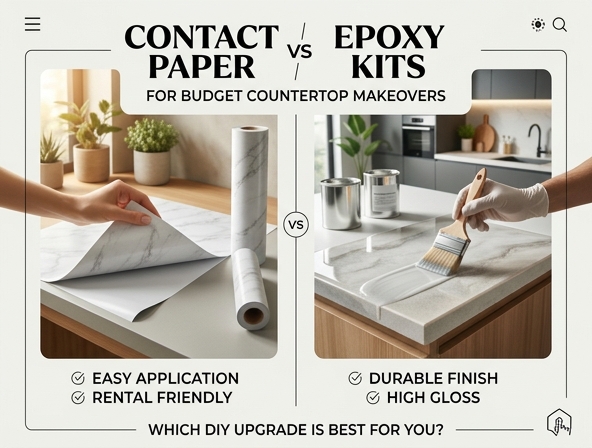
Staring at stained, outdated countertops can make any kitchen or bathroom feel tired, yet the high cost of slab stone replacements often stalls renovation plans. Before committing to a major demolition, it is vital to understand that modern surface engineering offers highly viable, non-structural alternatives. These budget-friendly methods grant homeowners the power to achieve a premium, high-end aesthetic for a fraction of the cost of traditional materials.
However, a successful DIY transformation requires a realistic understanding of material limitations and the precise installation preparation required for each. For instance, heavy-duty vinyl contact paper offers a tenant-friendly, reversible solution, while multi-step epoxy pour kits yield a seamless, heat-resistant barrier. This comprehensive comparison evaluates both options across durability, application complexity, and long-term value to help you select the ideal makeover for your space.
Revamp Your Kitchen on a Dime: The Countertop Dilemma
The kitchen is the heart of the home, but outdated, stained, or scratched countertops can quickly drain the life out of the space. While a full-scale kitchen remodel can cost thousands of dollars and take weeks of dusty disruption, you do not have to live with unsightly surfaces. Modern DIY innovations have made it possible to completely transform your kitchen surfaces on a shoestring budget.
Two major players dominate the budget-friendly countertop renovation space: self-adhesive vinyl and pourable liquid epoxy. To help you choose the right path, we will look at a detailed head-to-head comparison of contact paper versus epoxy countertop kits to help you decide which low-cost method matches your skill level, lifestyle, and design goals.
Peel and Stick: Understanding Contact Paper Countertops
Contact paper has evolved far beyond the thin drawer liners of the past. Modern interior design contact paper is a heavy-duty vinyl material engineered specifically for high-traffic surfaces. It features a decorative printed design on the top layer and a pressure-sensitive adhesive backing protected by a paper release liner.
When applied to kitchen countertops, this self-adhesive vinyl acts as a giant sticker, wrapping seamlessly over clean, flat surfaces. The application requires minimal tools-usually just a utility knife, a squeegee, and a hairdryer to help stretch the vinyl around tricky corners and edges.
- Self-Adhesive Backing: No messy glues or chemical activators are required; simply peel the protective backing and stick.
- Diverse Design Range: Available in highly realistic prints, including Carrara marble, granite, concrete, wood grain, and modern matte solid colors.
- Textured Finishes: Many premium options feature embossed textures that mimic the physical feel of natural stone or wood.
Liquid Stone: What Are Epoxy Countertop Kits?
Epoxy countertop kits offer a chemical approach to replicating the look of high-end stone. These kits do not rely on pre-printed patterns. Instead, they use a two-part liquid system consisting of an epoxy resin and a chemical hardener. When these two components are thoroughly mixed, an exothermic chemical reaction begins, transforming the liquid into a rock-hard solid polymer.
During the application, the liquid is poured directly over your existing countertops. Users can tint the liquid base and use accent colors, metallics, and spray paint veins to simulate the deep, multi-dimensional look of authentic marble, granite, or soapstone. The self-leveling nature of the mixture ensures a completely seamless, high-gloss finish once cured.
Price Tag Showdown: Upfront Costs vs. Long-Term Value
While both methods represent a massive saving compared to buying new quartz or granite slabs, their cost profiles and return on investment vary significantly. Contact paper represents the lowest possible barrier to entry, while epoxy kits require a larger initial investment but offer greater longevity.
| Factor | Contact Paper | Epoxy Countertop Kits |
|---|---|---|
| Average Upfront Cost | $20 – $50 total | $80 – $250 per kit |
| Required Tools Cost | Minimal (under $10 for utility knife and squeegee) | Moderate ($30+ for rollers, brushes, blowtorch, and plastic sheeting) |
| Average Lifespan | 1 – 3 years (temporary) | 5 – 10+ years (semi-permanent) |
| Value Per Dollar | High for short-term fixes or rentals | Excellent for long-term homeowners on a budget |
DIY Difficulty Level: Peel-and-Stick vs. Pour-and-Pray
Contact Paper Process
Applying contact paper is tedious but relatively low-risk. The prep work involves deep cleaning the surface to remove grease and grime, as any speck of dust will create a visible bump under the vinyl. The primary challenge is slowly backing off the liner while smoothing out air bubbles and lining up seams if your countertops are wider than the roll. If you make a mistake, you can gently peel the vinyl back up and re-align it, making this project very forgiving for novices.
Epoxy Process
The epoxy process is a high-stakes, time-sensitive chemistry project. The preparation is intensive: you must sand the old countertops, apply an epoxy-safe primer, tape off the entire room to protect cabinets and floors, and ensure the room is completely dust-free. Once the resin and hardener are mixed, you have a strict 30-to-45-minute working window before the mixture begins to gel and harden. You must use a blowtorch or heat gun to pop millions of rising micro-bubbles and manually guide the self-leveling liquid over the edges. There is very little room for error; mistakes can result in permanent sticky spots, wavy surfaces, or trapped dust and hair.
Battle of Endurance: Durability, Heat, and Moisture Resistance
Kitchen surfaces endure heavy daily abuse from knives, moisture, hot dishes, and harsh cleaning agents. How these budget materials withstand daily wear and tear will dictate how long they remain beautiful in your home.
Contact paper is highly water-resistant, making it great for areas around sinks. However, it is highly vulnerable to physical damage. Sliding a heavy ceramic mug can scratch the vinyl, dropping a sharp knife can slice right through it, and placing a warm pot on it will instantly melt the plastic. Cleaning must be restricted to mild dish soap, as abrasive chemicals can degrade the printed pattern.
In contrast, epoxy cures into a highly durable, non-porous solid plastic. It is entirely waterproof, highly scratch-resistant, and unaffected by standard household cleaners. However, it still has a major weakness: extreme heat.
Safety & Preservation Warning: While epoxy is tough, it is not heatproof. Temperatures exceeding 150°F to 300°F (depending on the brand) will scorch, melt, or yellow the epoxy. Always use trivets or hot pads for hot pots and pans.
Visual Appeal: Realism and Aesthetic Options
If your goal is to fool guests into thinking you splurged on solid stone, epoxy is the clear winner. Because it is applied as a liquid, it creates a completely seamless, continuous surface that flows over edges and curves. The depth of color achieved by blending different metallic powders and paints creates a multi-dimensional sheen that perfectly mimics real marble veins or granite flecks.
Contact paper can look stunning from a distance, but closer inspection usually reveals its limitations. Unless your countertop is perfectly rectangular and shorter than the width of the roll, you will likely have visible seams. Additionally, while high-quality vinyl prints look excellent, they lack the glossy depth and light-refraction qualities of a poured liquid surface.
The Renter's Choice: Removability and Damage Control
Your living situation should heavily influence your choice of countertop upgrade. If you do not own your home, making permanent structural modifications can lead to a forfeited security deposit or costly damage fees upon move-out.
Contact paper is the gold standard for temporary, renter-friendly updates. When it is time to pack up, you can simply heat the surface with a hairdryer to soften the adhesive, peel the vinyl away, and clean up any sticky residue with isopropyl alcohol or adhesive remover. The original countertop remains completely untouched and undamaged beneath.
Epoxy, on the other hand, is a permanent commitment. Applying epoxy involves sanding down the original countertop to create mechanical adhesion. Once cured, epoxy cannot be peeled off. It must be aggressively scraped, sanded, or entirely demolished and replaced. For renters, this makes epoxy an off-limits project.
Quick Comparison: Pros and Cons at a Glance
Contact Paper Countertops
- Pros: Extremely inexpensive, highly forgiving and easy to install, completely removable, safe for renters, endless pattern designs.
- Cons: Lacks durability, susceptible to heat and cuts, visible seams are common, shorter lifespan of 1-3 years.
Epoxy Countertop Kits
- Pros: Highly durable, seamless finish, luxurious high-gloss look, customized stone-like patterns, heat and moisture resistant.
- Cons: High difficulty level, toxic fumes during curing, permanent and non-reversible, costly preparation tools required.
The Verdict: Which Budget Countertop Makeover is Right for You?
Choosing between these two popular DIY methods depends on your current living situation, your budget, and how much effort you are willing to exert. Neither option is universally superior; instead, each serves a distinct set of needs and limitations.
Your Final Decision Guide
Opt for contact paper if you are a renter, working with an extremely tight budget of under $50, or want a low-risk project that can be completed in an afternoon. It is perfect for low-use bathrooms, guest suites, or temporary fixes while saving up for a major renovation.
Choose an epoxy countertop kit if you own your home, desire a high-end seamless stone look, and have the patience to handle meticulous preparation and precise chemical mixing. While the learning curve is steep, the payoff is a durable, long-lasting surface that can elevate the aesthetic of your kitchen for years to come.
Leave a comment