
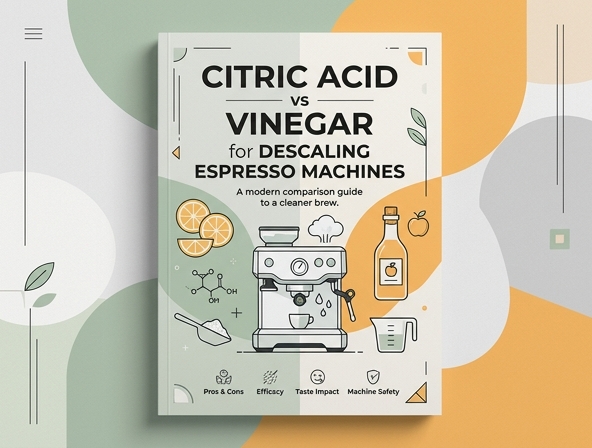
Few things frustrate a coffee lover more than a sluggish espresso machine dispensing lukewarm, bitter shots due to stubborn limescale buildup. While commercial chemical descalers are the standard industry recommendation, many home baristas seek safer, more budget-friendly household alternatives.
Choosing the right natural acid not only restores your machine's peak heating efficiency but also safeguards your investment for years to come. However, successful descaling requires a caveat: improper acid concentration can corrode internal copper boilers or instantly void your manufacturer's warranty. For example, while vinegar is highly accessible, its stubborn acetic acid residue can ruin subsequent brews, whereas citric acid target-dissolves calcium carbonate deposits cleanly and odorlessly.
Below, we break down the chemistry, costs, and step-by-step performance of citric acid versus vinegar to determine the ultimate champion for your espresso routine.
Why Descaling Your Espresso Machine is Non-Negotiable
For any coffee enthusiast, the espresso machine is the heart of the morning routine. However, every time you brew, water passes through the internal plumbing, leaving behind microscopic mineral deposits. Over time, these minerals build up into a hard barrier that severely impacts heat transfer, clogs delicate water pathways, and reduces pump pressure. This mineral insulation directly affects your espresso extraction, leading to inconsistent brewing temperatures and sour, under-extracted shots. Neglecting this maintenance task shortens your machine's lifespan and ruins your daily cup. To keep your equipment running at peak performance, you must recognize the key symptoms of scale buildup: diminished steam power, lukewarm coffee extractions, slowed or restricted water flow, and unusual pump vibrations.
Understanding Limescale: The Silent Coffee Killer
To fight mineral buildup effectively, we must understand what we are dealing with. Limescale is the hard, chalky deposit consisting primarily of calcium carbonate that accumulates inside pipes, heating elements, and boilers. When tap water-which contains dissolved minerals like calcium and magnesium-is heated inside an espresso boiler, a chemical reaction occurs. The high heat accelerates the crystallization process, causing these dissolved minerals to precipitate out of the liquid state and solidify onto the nearest metal surfaces. Because espresso machines rely on incredibly precise temperatures and high-pressure dynamics, even a thin layer of this crystalline structure acts as an unwanted thermal insulator, forcing your heating element to work twice as hard and eventually burn out.
Meet the Descaling Rivals: Vinegar vs. Citric Acid
When it comes to maintaining your machine without breaking the bank, commercial descalers are often bypassed in favor of two highly popular, budget-friendly DIY alternatives: white vinegar and citric acid powder. Both are acidic solutions capable of breaking down stubborn calcium deposits, yet they behave very differently inside your machine's sensitive plumbing. To determine which acid deserves a spot in your maintenance routine, we must compare them across several key performance metrics:
- Cost and Accessibility: How inexpensive and easy are they to source?
- Odor and Aftertaste: Do they leave lingering flavors that ruin subsequent coffee extractions?
- Material Safety: Are they safe for internal metal boilers and rubber gaskets?
- Chemical Efficacy: How quickly and thoroughly do they dissolve calcium carbonate?
The Case for Vinegar: Household Staple with a Strong Scent
White vinegar, which contains about 5% acetic acid, is the most common household cleaning agent. Its main appeal lies in its convenience; almost everyone has a bottle in their pantry. Acetic acid is highly effective at breaking down the calcium carbonate bonds that make up limescale. However, vinegar has two major drawbacks when used in delicate espresso machinery. First, its pungent, volatile aroma is incredibly difficult to eliminate, often requiring endless rinse cycles. Second, acetic acid can be highly aggressive toward natural rubber seals and gaskets, causing them to dry out, crack, and leak over time.
Crucial Safety Tip: If you choose to descale with vinegar, you must flush the machine's reservoir and boilers with clean water at least four to five times. Failing to rinse thoroughly will leave a lingering, sour acetic taste that will ruin your espresso extractions for weeks.
The Case for Citric Acid: The Odorless Powerhouse
Citric acid, commonly sold as a dry, food-grade powder, is widely considered the gold standard for DIY descaling. Derived from citrus fruits, it is highly concentrated and exceptionally efficient at dissolving calcium deposits. Unlike vinegar, citric acid is completely odorless and leaves behind no foul taste, meaning it is incredibly easy to rinse away completely. Because of this clean rinse profile and its rapid reaction time, citric acid is the primary active ingredient used in most high-end, commercial-grade descaling products on the market today.
Side-by-Side Comparison: Chemical Efficacy
On a chemical level, both acids dissolve calcium carbonate, but they do so with varying degrees of efficiency. Citric acid acts as an exceptional chelating agent, meaning it binds tightly to the calcium ions, pulling them into the water solution and preventing them from resettling. Acetic acid (vinegar) lacks this strong chelating property, making it slower and less thorough at removing heavy scale buildup.
| Descaling Agent | Primary Acid | Chelating Strength | Odor Level | Rinse Effort Required |
|---|---|---|---|---|
| White Vinegar | Acetic Acid (~5%) | Moderate | Extremely High | Very High (4+ Flushes) |
| Citric Acid Powder | Citric Acid (100%) | Excellent | None | Minimal (2 Flushes) |
Machine Compatibility: Protecting Metal and Rubber Components
Before putting any acid into your machine, you must consider the internal metallurgy of your boilers and group heads. Espresso machines are constructed using copper, brass, stainless steel, and aluminum. While stainless steel and copper are highly resilient, aluminum is highly reactive to acidic environments. Prolonged exposure to concentrated acids can strip the protective oxide layer from aluminum, causing severe corrosion.
Warning: Always check your manufacturer's manual before descaling. If your espresso machine features an aluminum boiler (common in some entry-level models), do not use highly concentrated solutions of either acid, as this can cause permanent metal pitting and black residue in your water.
Step-by-Step Guide: Descaling with Vinegar
If you choose to use white vinegar, follow this structured process to minimize damage and clear out the pungent odor as quickly as possible.
- Mix a solution of 1 part white vinegar to 2 parts filtered water, and pour it directly into the empty water reservoir.
- Turn on the machine and run about half of the solution through the steam wand and the brew head to fill the internal boilers.
- Turn off the machine and let the solution sit inside the boilers for 30 minutes to dissolve the scale.
- Turn the machine back on and flush the remaining vinegar solution completely through the system.
- Refill the reservoir with fresh, clean water and run at least four full reservoirs through the machine to purge any remaining vinegar taste and odor.
Step-by-Step Guide: Descaling with Citric Acid
Descaling with citric acid is straightforward, highly effective, and leaves no foul odors behind. Follow these steps to clean your machine safely.
- Dissolve 2 tablespoons of food-grade citric acid powder into 1 liter of warm water, stirring thoroughly until the powder is completely dissolved.
- Pour the clear citric acid solution into your espresso machine's empty water reservoir.
- Power on the machine and run approximately one-third of the solution through the group head and steam wand.
- Turn off the machine and let the acidic mixture rest inside the boiler for 20 to 30 minutes to break down the minerals.
- Turn the machine on, pump the remaining solution out of the boilers, refill the reservoir with fresh water, and run two full reservoirs of clean water through the system to rinse.
The Final Verdict: Which Descaler Reigns Supreme?
While both household acids can successfully break down mineral buildup, they are not equal in practice. White vinegar is a convenient, cheap option for emergencies, but its intense, lingering odor and potential to degrade rubber gaskets make it a risky choice for regular maintenance. Citric acid is odorless, highly effective, safe on gaskets, and extremely easy to rinse out of internal boilers.
Taking all performance, safety, and taste factors into account, citric acid stands out as the superior choice for espresso machine descaling. It offers commercial-grade cleaning power at a fraction of the cost, ensuring your espresso machine continues to deliver delicious, untainted espresso shots for years to come.
Leave a comment