
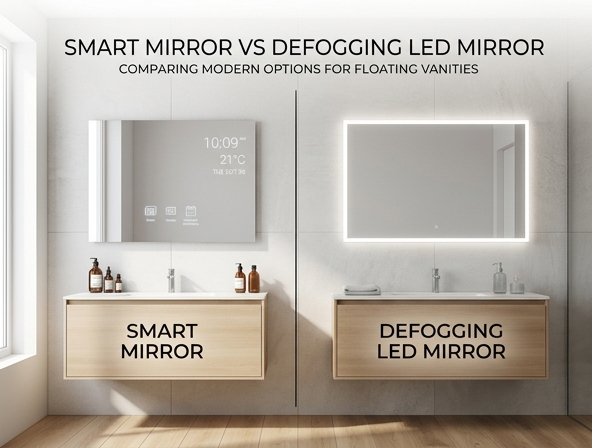
Designing a modern bathroom often feels like a frustrating balancing act between sleek minimalism and daily functionality. For those installing floating vanities, the struggle to maintain a clutter-free, steam-free grooming space is a persistent challenge. Before selecting your fixtures, however, it is crucial to consider how your vanity's suspended design interacts with the room's ambient moisture.
Choosing the right reflective surface elevates your bathroom's aesthetic while granting you effortless mornings free of condensation. Still, a key stipulation is that these advanced systems require specific pre-wiring and wall reinforcement before installation. For instance, pairing a minimalist oak floating vanity with a hardwired, copper-free anti-fog mirror ensures a seamless, cord-free look that stands up to heavy shower steam.
To help you navigate these choices, this guide compares the technology, installation demands, and design compatibility of smart mirrors versus defogging LED mirrors to find the ultimate match for your floating vanity.
Elevating the Floating Vanity: The Mirror Dilemma
The floating vanity has redefined modern bathroom design, offering a sleek, wall-mounted silhouette that maximizes floor space and radiates contemporary elegance. However, this minimalist masterpiece is only as good as the glass that hangs above it. To unlock the full aesthetic and functional potential of your space, choosing the correct partner for your floating setup is essential.
This design challenge brings us to a compelling clash of modern bathroom innovations: high-tech smart mirrors versus practical defogging LED mirrors. One promises an interconnected, futuristic hub right on your glass surface, while the other focuses on delivering flawless, crystal-clear utility through reliable engineering. Resolving this dilemma requires exploring how these two contenders balance form, function, and daily usability.
Understanding the Contenders: Smart vs. Defogging LED Mirrors
To make an informed decision for your bathroom renovation, it is important to understand exactly what sets these two innovative categories apart in terms of technology and design.
What is a Smart Mirror?
A smart mirror is an interactive, internet-connected display hidden behind a semi-reflective glass surface. It acts as a digital dashboard for your morning routine, running software that can show calendar appointments, stream media, and respond to touch commands.
What is a Defogging LED Mirror?
A defogging LED mirror focuses on high-performance utility and ambient lighting. It relies on a dedicated anti-fog heated element-usually a thin silicone resistance heating pad-secured directly behind the glass surface to gently warm the mirror and prevent condensation from forming.
Key technological distinctions include:
- Smart mirrors use integrated touchscreens, operating systems, and Wi-Fi receivers to deliver real-time data.
- Defogging mirrors utilize simple, reliable thermal conduction to clear moisture rapidly.
- Smart mirrors require regular software updates, whereas defogging models operate via straightforward manual switches or motion sensors.
Aesthetic Harmony with Floating Vanities
Floating vanities are celebrated for their clean lines, suspended architecture, and uncluttered profiles. Because these vanities remove visual weight from the floor, the accompanying mirror must continue this sense of weightlessness and sleekness. Frame choice, glass thickness, and mounting depth play critical roles in maintaining this delicate design balance.
Smart mirrors often feature ultra-thin glass overlays to make touchscreen interactions more responsive, but they can occasionally carry a slightly thicker chassis behind the glass to house processing hardware. On the other hand, defogging LED mirrors offer incredibly streamlined, low-profile designs that sit almost flush with the wall. Achieving true aesthetic harmony requires matching the clean, sharp edges of your floating vanity with a mirror that values minimalist execution over bulky hardware.
The Power of Clarity: Demystifying the Defogging Technology
There is nothing more frustrating than stepping out of a relaxing hot shower only to find your bathroom mirror entirely obscured by thick condensation. Defogging technology elegantly solves this daily annoyance by preventing the physical process of condensation from occurring in the first place.
By warming the surface of the glass to a temperature slightly above the dew point of the humid bathroom, the moisture in the air cannot settle on the mirror. This simple, thermal solution keeps a designated central zone perfectly clear, allowing you to shave, style your hair, or apply makeup immediately without wiping the glass down and leaving messy streaks behind.
"A crystal-clear mirror is not merely a luxury; it is the foundation of an efficient morning routine in any modern household." - Architectural Design Digest
Beyond Reflection: The Features of a Smart Mirror
Smart mirrors transcend the traditional boundaries of bathroom fixtures, turning a simple glass pane into a sophisticated, central command center for your entire home. For those who love keeping their finger on the pulse of technology, these features offer unparalleled convenience.
Advanced Smart Integration
The true power of these systems lies in how they integrate with your daily digital life, transforming your morning preparation into a highly productive window of time.
- Bluetooth Connectivity: Seamlessly pair your smartphone to play music, catch up on podcasts, or take hands-free phone calls through high-quality integrated speakers.
- Built-In Information Displays: View weather forecasts, morning news headlines, commute times, and personal calendars directly on the glass surface while brushing your teeth.
- Voice Assistants: Utilize built-in microphones to command Amazon Alexa or Google Assistant to adjust smart home thermostats, read the news, or add items to your shopping list.
- Integrated Lighting Controls: Adjust color temperatures from warm golden tones to cool daylight simulation using intuitive on-screen touch sliders.
Installation Complexity and Floating Vanity Integration
Because floating vanities reveal the wall space beneath them, cable management is a paramount concern. Unlike traditional floor-standing cabinets, you cannot hide sloppy electrical work or loose cords behind a bulky base. Integrating high-voltage mirrors demands careful planning and professional execution.
Wiring and Power Management
Both smart and defogging mirrors require a reliable power source, which means running electrical lines through the wall studs behind your floating vanity. This is crucial for maintaining the clean, floating illusion of the lower cabinet.
Energy Consumption and Daily Durability
When selecting your bathroom centerpieces, understanding resource consumption and longevity is vital. Smart mirrors run continuous operating systems, demanding consistent standby power, whereas defogging LED mirrors use power only when active.
| Feature Metric | Smart Mirrors | Defogging LED Mirrors |
|---|---|---|
| Standby Power Draw | Moderate (Continuous Wi-Fi/Bluetooth standby) | Zero to negligible (Physical switch cutoff) |
| Active Power Consumption | High (Processor, display, and lighting running) | Low to moderate (Heated pad and LEDs only) |
| Lifespan of Core Components | 3 to 7 years (Software obsolescence and screen degradation) | 10 to 15 years (Durable copper-free glass and LED strips) |
| Durability in High Humidity | Sensitive (Requires highly sealed electronics housings) | Excellent (Simple, robust thermal elements) |
Budget Breakdown: Upfront Cost vs. Long-Term Value
Embarking on a bathroom remodel requires balancing design desires with financial realities. Choosing between these mirrors represents a choice between cutting-edge luxury investment and high-value practicality.
Smart mirrors occupy the premium tier of the market, requiring a substantial upfront investment for the complex touchscreen panels, internal computers, and software licensing. Conversely, defogging LED mirrors provide a highly premium, hotel-like aesthetic at a fraction of the cost. While a smart mirror may offer immediate wow-factor, a premium defogging LED mirror often secures superior long-term value due to its minimal maintenance overhead and long operational life.
Tailoring to Your Lifestyle: Which Mirror Suits You?
The decision on which mirror to hang above your gorgeous floating vanity should not be based on technology alone. It must align seamlessly with how you and your household utilize the space daily.
Identifying Your Daily Routine
Every household has distinct habits, and matching your mirror choice to these patterns ensures your investment delivers continuous satisfaction.
- The Busy Professional: If you need to monitor stock updates, read emails, or track traffic reports during your morning shave or makeup application, the smart mirror is a perfect productivity partner.
- The Active Family: For shared family bathrooms, the simple, durable, and low-maintenance defogging LED mirror is ideal, resisting heavy daily use, dirty fingerprints, and wet hands.
- The Minimalist Purist: If you view the bathroom as a serene sanctuary to disconnect from the digital world, the pure, distraction-free illumination of an LED defogger is unmatched.
The Ultimate Verdict for Your Modern Bathroom
Your floating vanity is a testament to sleek, forward-thinking home design. To complete the look, your mirror choice must reflect that same commitment to intentional living. If your priority is building a futuristic, connected smart home where efficiency reigns supreme, investing in a high-end smart mirror is a spectacular choice.
However, if you seek a timeless, highly durable, and cost-effective solution that highlights the clean lines of your vanity without adding unnecessary complexity, the defogging LED mirror stands as the superior day-to-day companion. Your decision rests on choosing between the excitement of the interactive digital world or the reliable comfort of functional minimalist design.
Leave a comment