
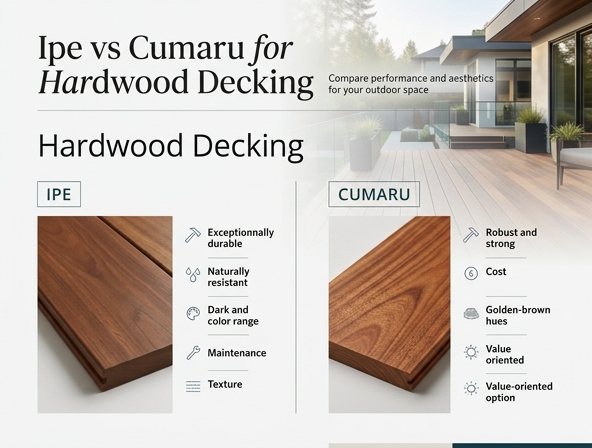
Selecting the ultimate decking material for a luxury outdoor space is often a paralyzing decision, balancing long-term durability against a significant financial investment. As homeowners increasingly design outdoor areas as seamless extensions of their interior living spaces, choosing a timber that survives both harsh weather and shifting design trends has become more critical than ever.
Investing in premium South American hardwoods guarantees decades of rot resistance and unparalleled natural beauty. However, a key stipulation is that both Ipe and Cumaru require specialized installation techniques, such as pre-drilling and carbide-tipped blades, due to their extreme density. For example, while Ipe boasts a legendary Janka hardness rating of 3,510 lbf, Cumaru offers a highly comparable 3,340 lbf profile at a more accessible price point, though it exhibits slightly more movement during seasonal moisture shifts.
Below, we break down their aesthetics, lifespans, maintenance requirements, and costs to help you select the ideal hardwood for your home.
Introduction: The Ultimate Battle of Brazilian Hardwoods
When it comes to designing a luxury outdoor living space, the choice of decking material dictates both the longevity and the visual prestige of the project. Among the elite class of natural materials, two premium Brazilian hardwoods reign supreme: Ipe and Cumaru. Homeowners and architects alike continuously seek out these exotic specimens for their unparalleled durability and striking aesthetics.
As the demand for high-end outdoor structures rises, understanding the nuances between these two powerhouses becomes essential. This head-to-head comparison will break down their physical properties, costs, and installation requirements to help you select the perfect lumber for your architectural masterpiece.
Understanding Ipe: The Gold Standard of Decking
Ipe, scientifically known as Handroanthus heptaphyllus, is sourced from the lush, tropical forests of Central and South America. Often referred to as Brazilian Walnut, this legendary wood species has earned an international reputation as the absolute gold standard for high-end luxury decks. Its tight grain structure and dense organic makeup make it virtually indestructible under normal residential use conditions.
Beyond its physical density, Ipe possesses a natural resistance to fire, rot, decay, and boring insects. It boasts a Class A fire rating-the same rating awarded to concrete and steel-making it an exceptionally safe option for wildland-urban interface zones. These unique, inherent properties are why municipal boardwalks and high-traffic resort decks worldwide rely on this premium hardwood.
Exploring Cumaru: The High-Quality, Budget-Friendly Alternative
Cumaru, commonly marketed as Brazilian Teak, is a formidable contender in the world of luxury outdoor construction. Sourced from the Dipteryx odorata tree, this hardwood presents a stunning palette of rich golden-brown and warm amber tones. What makes Cumaru highly appealing is its exceptional density, which rivals that of Ipe, making it highly resistant to physical damage and environmental wear.
In recent years, Cumaru has experienced a massive surge in popularity. Homeowners view it as a highly cost-effective alternative that delivers uncompromised performance. It provides the same high-end appearance and heavy-duty wear characteristics of traditional premium hardwoods but at a price point that makes large-scale projects significantly more accessible.
Strength and Longevity: Janka Hardness and Lifespan
To truly appreciate the heavy-duty nature of these Brazilian hardwoods, it is helpful to look at their ratings on the Janka hardness scale, which measures a wood species' resistance to denting and wear. Both materials exhibit astonishing durability that outclasses domestic softwoods and composite decking alike, ensuring a lifespan that easily exceeds 40+ years with minimal structural degradation.
- Ipe Hardness: Registers at approximately 3,680 lbf on the Janka scale, making it one of the hardest woods on Earth.
- Cumaru Hardness: Scores around 3,540 lbf on the Janka scale, matching Ipe in scratch resistance and heavy foot traffic tolerance.
- Expected Lifespan: Both species naturally resist wood-boring insects, fungal rot, and harsh weather conditions, lasting between 40 to 75 years.
Aesthetics and Color Variation: Dark Chocolate vs. Golden Amber
While both woods offer an organic, sophisticated appearance, their visual profiles differ notably. Ipe is celebrated for its deep, uniform, chocolatey reddish-brown hues. The grain is generally subtle, straight, and remarkably consistent, which creates a sleek, cohesive modern look when laid across expansive deck surfaces.
In contrast, Cumaru showcases a more dynamic and vibrant personality. It features lighter, warmer tones ranging from golden honey to reddish amber, accented by pronounced, wavy grain patterns. This natural variance creates a lively, rustic, yet deeply luxurious visual landscape under natural sunlight.
Design Tip: Use Ipe for sleek, contemporary architectural styles that benefit from deep, uniform, dark-toned flooring. Select Cumaru to complement coastal, tropical, or rustic designs where warm golden tones and pronounced natural wood patterns can shine.
Workability and Installation Challenges
Working with exotic hardwoods of this density presents unique challenges that differ greatly from installing pressure-treated pine or cedar. Because of their extreme hardness, standard woodworking tools will dull quickly. Specialized carbide-tipped blades and high-quality drill bits are non-negotiable requirements for clean cuts and precise finishes.
When installing these materials, contractors must pre-drill every screw hole to prevent splitting the dense boards. Additionally, Cumaru has a slightly higher radial and tangential shrinkage rate compared to Ipe. This physical characteristic means that proper wood acclimation on-site and strict adherence to correct expansion spacing are vital to prevent warping or cupping over time.
Cost Analysis: Upfront Investment vs. Long-Term Value
The premium characteristics of Ipe come with a corresponding price tag. Because of its global fame, limited availability, and strict export quotas, Ipe commands the highest premium in the timber market. Homeowners choosing Ipe must be prepared for a substantial upfront financial commitment for raw materials alone.
Cumaru provides relief for project budgets without sacrificing the high-end hardwood experience. Opting for Cumaru can save homeowners between 30% and 40% on material costs, allowing resources to be allocated toward premium railing systems, outdoor kitchens, or custom landscape lighting.
Sustainability and Eco-Friendly Sourcing
Given the global demand for South American timber, responsible sourcing is of paramount importance to prevent deforestation and preserve biodiverse ecosystems. Consumers must be vigilant about where their wood is harvested, ensuring that their outdoor renovation projects do not contribute to illegal logging practices in the Amazon basin.
To build an environmentally friendly outdoor space, look for lumber certified by the Forest Stewardship Council (FSC). This certification ensures that the wood has been harvested from responsibly managed forests that follow strict social, economic, and environmental standards. Sustainable harvesting practices help ensure that these magnificent forests remain vibrant for generations to come.
Maintenance Requirements: Keeping the Color or Letting it Gray
One of the most attractive aspects of dense Brazilian hardwoods is that their structural integrity does not depend on chemical sealers. Homeowners can choose between two distinct maintenance pathways depending on their preferred aesthetic outcome.
- Preserving the Original Color: To maintain the rich chocolate tones of Ipe or the golden amber of Cumaru, apply a UV-blocking penetrating oil specifically designed for exotic hardwoods once a year.
- Letting it Weather Naturally: If left untreated, both species will gradually and beautifully weather over time, developing a low-maintenance, sophisticated silver-gray patina without losing any of their structural strength.
- Basic Cleaning: Regardless of the aesthetic choice, an annual sweep and wash with a mild oxygen bleach deck cleaner will prevent dirt buildup and mold growth.
The Verdict: Which Hardwood is Right for Your Deck?
Choosing between these two premium materials comes down to your priorities regarding budget, visual style, and dimensional stability. Both woods deliver unmatched longevity and a high-end luxury feel that standard decking options simply cannot replicate.
If you desire unmatched dimensional stability, a classic dark chocolate tone, and the prestige of the absolute industry gold standard, investing in Ipe is the ideal choice. However, if your goal is to build a breathtaking, warm, golden-hued outdoor oasis while keeping your material costs 30% to 40% lower, Cumaru represents the perfect high-performance, cost-conscious solution.
Leave a comment