
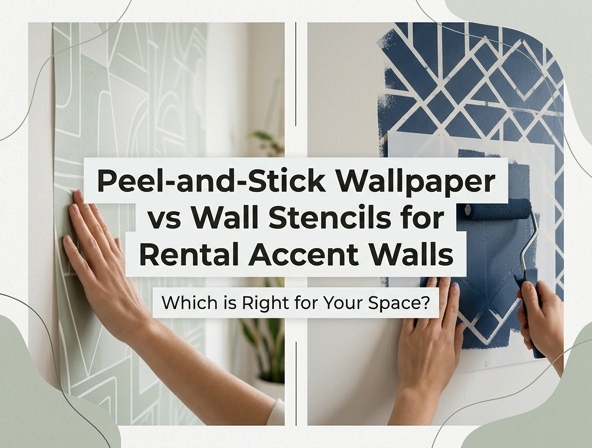
Struggling with sterile, neutral rental walls is a common frustration for tenants who long to personalize their living space but fear losing their security deposits. While traditional paint and permanent wallpaper are the standard go-to options for customizing a home, these invasive modifications are rarely permitted under strict lease agreements. Fortunately, modern temporary design methods grant renters the creative freedom to achieve a high-end, bespoke aesthetic without risking landlord penalties. However, achieving professional results requires a realistic look at your specific wall texture and the time commitment you can manage. For instance, while a botanical-print peel-and-stick vinyl offers instant impact, a modern geometric stencil provides unparalleled customization on slightly textured surfaces. To help you navigate these DIY choices, this guide will compare peel-and-stick wallpaper and wall stencils across cost, installation difficulty, and damage-free removal, helping you identify the ultimate budget-friendly solution for your accent wall.
Introduction: The Renter's Accent Wall Dilemma
Living in a rental property often feels like living in a sterile, white box. Renters face a constant struggle: they want to personalize their living space and make it feel like home, but they live in fear of losing their security deposit over permanent design choices. Standard paint and traditional wallpaper are usually out of the question due to strict landlord rules. Fortunately, you do not have to settle for boring, bare walls. Peel-and-stick wallpaper and wall stencils have emerged as the top two budget-friendly DIY solutions that allow you to create a stunning accent wall without leaving a trace when it is time to move out.
Option 1: The Lowdown on Peel-and-Stick Wallpaper
What is Removable Wallpaper?
Peel-and-stick wallpaper is essentially a giant, high-quality decal for your wall. Unlike traditional wallpaper that requires messy pastes and permanent adhesives, this self-adhesive alternative features a backing that you simply peel off to expose the sticky surface. It is designed to cling securely to smooth walls and release easily without leaving sticky residue behind.
Why It Appeals to Renters
The primary draw of this method is instant gratification. Within a few hours, you can completely transform a room with complex, high-definition designs that would be impossible to paint by hand. From realistic brick and wood textures to bold geometric patterns and lush botanical prints, the diverse options available make it an incredibly appealing choice for those who want a dramatic, high-impact aesthetic shift with minimal fuss.
Option 2: The Art of Wall Stenciling
The Stenciling Process Explained
Wall stenciling is a creative DIY technique where you use a reusable plastic template to apply paint directly to your wall. By repeating the stencil pattern across your accent wall, you can beautifully mimic the look of expensive designer wallpaper. It requires a steady hand, a painter's roller or stencil brush, and a bit of patience, but the results can look remarkably professional.
The Main Advantages of Stencils
One of the greatest benefits of this approach is endless color customization. Unlike wallpaper, which limits you to pre-printed colorways, stenciling allows you to choose any base wall color and any accent paint color you desire. Additionally, it is an ultra-low-cost solution because a single stencil can be used to cover an entire room, making it incredibly friendly to a tight budget.
Cost Analysis: Wallpaper vs. Paint and Stencils
When planning your DIY accent wall, your budget is likely a major deciding factor. The financial investment required for these two projects differs significantly based on the materials and tools needed for application.
- Peel-and-Stick Wallpaper: High-quality removable wallpaper typically costs between $30 to $50 per roll. Because most standard accent walls require three to five rolls to cover the square footage and match the pattern repeat, your total upfront cost can easily range from $90 to $250.
- Paint and Stencils: A durable, reusable plastic wall stencil generally costs between $20 and $40. When paired with a single quart of high-quality latex paint (around $15 to $25) and basic supplies like painter's tape and a foam roller, the entire project usually costs under $70.
Installation Battle: DIY Complexity and Learning Curve
The Wallpaper Alignment Challenge
Applying peel-and-stick wallpaper is a test of patience and geometry. You must carefully align the pattern seams from one panel to the next while smoothing out air bubbles and avoiding creases. It often requires two people to keep the long sheets straight, and any slight misalignment at the top of the wall will multiply as you work your way down to the baseboard.
The Precision of Paint Stenciling
Stenciling, on the other hand, demands physical precision and paint control. The biggest challenge is preventing paint bleed, which occurs when excess paint leaks under the edges of the plastic template. To achieve crisp lines, you must use a "dry brush" technique with minimal paint on your roller and carefully secure the stencil with adhesive spray or painter's tape before every single application.
The Rental Test: Damage-Free Removability
The ultimate test for any rental DIY project is how easily it can be undone when your lease ends. Landlords expect the apartment to be returned to its original condition, meaning your accent wall must be fully reversible without leaving permanent marks.
Peel-and-stick wallpaper is highly praised for its clean removal. You simply grab a corner and slowly peel the panel away from the wall. However, if the wall was not properly primed or if the adhesive was of lower quality, it can sometimes pull off chunks of drywall paint, requiring patching and repainting anyway.
Stenciling requires a different exit strategy. To revert a stenciled wall, you must paint over the design. This involves lightly sanding down any raised paint ridges left by the stencil, applying a coat of primer to block out the pattern, and then painting the entire wall back to the landlord-approved neutral color. While it requires physical labor, it guarantees a clean slate.
Design and Aesthetics: Realism vs. Customization
The visual impact of each option depends entirely on the aesthetic style you want to achieve in your home. Peel-and-stick wallpaper excels at delivering complex textures and photographic realism. You can find patterns that realistically mimic raw materials like marble, concrete, shiplap, or metallic foils, which would be impossible to replicate with paint. It offers a flawless, uniform appearance that looks polished and manufactured.
In contrast, wall stencils offer a charming, hand-painted look that feels artistic and bespoke. Because the paint is applied manually, the final design has subtle depth and organic variations that wallpaper cannot match. Furthermore, stencils give you complete control over the color palette, enabling you to coordinate the pattern perfectly with your existing furniture and decor accessories.
Time Investment: Speed of the Transformation
Your choice might come down to how much spare time you have over a weekend. The speed of application, drying times, and cleanup requirements differ dramatically between these two DIY methods.
- Peel-and-Stick Wallpaper: This method is relatively fast. Once your walls are wiped clean, you can measure, cut, and hang the panels in a single afternoon. There is zero drying time, meaning you can push your furniture back against the wall immediately after applying the last panel.
- Wall Stenciling: This is a slow, methodical process. You must paint one section, wait for it to dry slightly so you do not smudge the wet paint when repositioning the template, and then move to the next section. Covering a large wall can easily turn into a multi-day project, especially when you factor in wash-up times for the stencil to prevent paint buildup.
Best Scenarios for Each Solution
Final Verdict: Which Rental Accent Wall Wins?
Both temporary wallpaper and stenciling offer fantastic ways to break up the monotony of rental beige walls. If you have a larger budget and want a fast, high-end transformation with photographic details, then peel-and-stick wallpaper is your winner. It offers speed and complex graphics that paint simply cannot replicate.
However, if you are working with a tight budget, have textured walls, or want to customize your color palette exactly to your taste, then wall stencils are the superior choice. While they require more patience and active painting time, they are significantly cheaper and offer an authentic, artistic finish. Assess your budget, patience, and DIY confidence to choose the method that will help you create your dream home.
Leave a comment